De Verwoeste Stad: Rotterdam's WWII Memorial
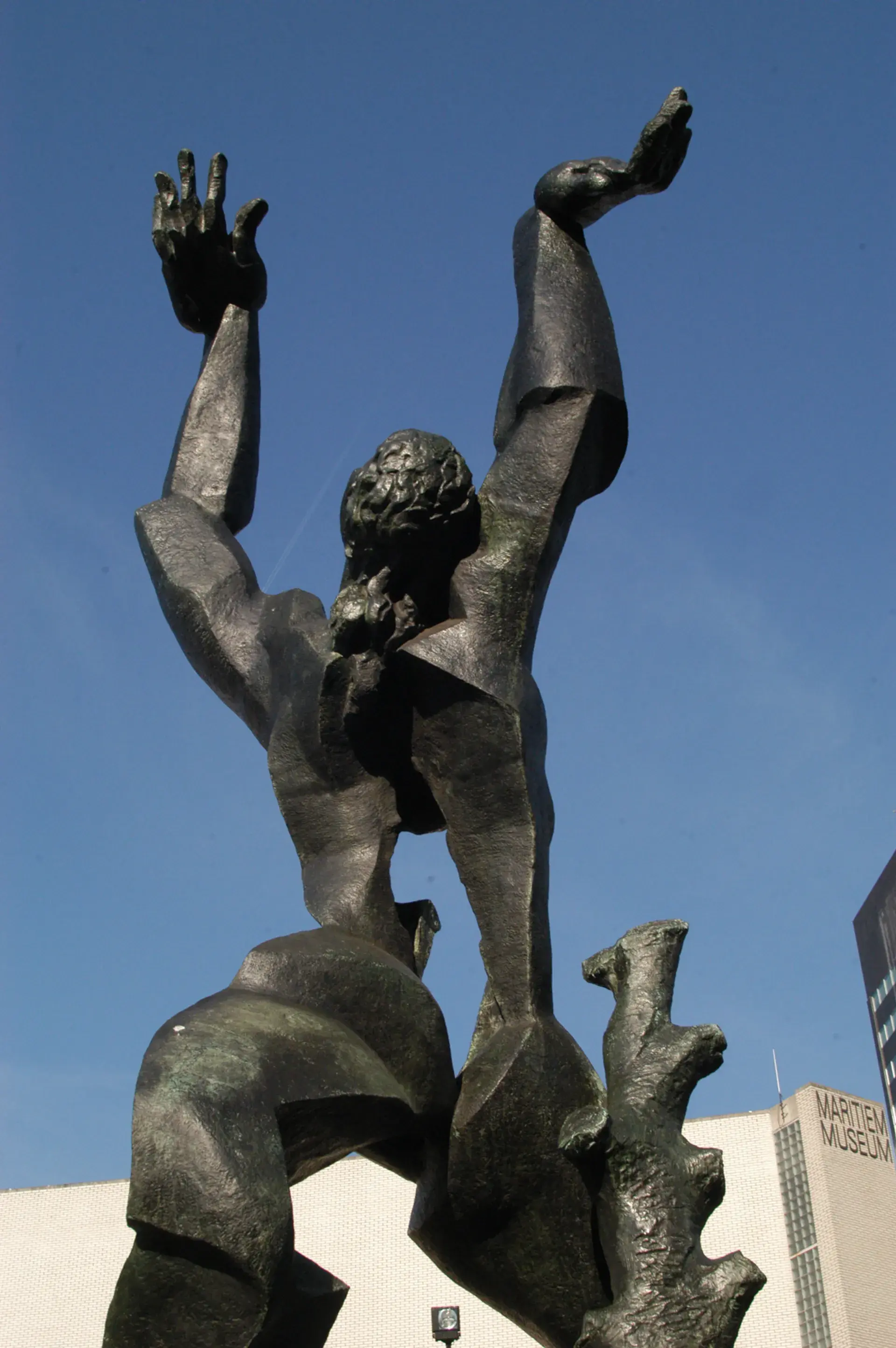
A 6-meter bronze figure screams at the sky with a gaping hole where its heart should be—a stark monument to the medieval city erased in minutes. Known as De Verwoeste Stad (The Destroyed City), this imposing sculpture stands at Plein 1940 on the north end of the Leuvehaven dock basin. Designated a Dutch national monument in 2010, the artwork acts as a historical hinge connecting the modern commercial core to the historic harbor district.
A Monument to a Lost City
Following the devastating aerial bombing by the Luftwaffe on May 14, 1940, nearly the entire medieval urban core of Rotterdam was destroyed in a matter of minutes. Rather than reconstructing the historical architecture, the city chose to rebuild with a completely modernist, open-plan design. De Verwoeste Stad stands as a powerful reminder of this wartime rupture. Today, it serves as one of the primary public war memorials in the Netherlands, anchoring the annual May 4th National Remembrance Day events.
The Vision of Ossip Zadkine
The memorial is the work of Russian-born French sculptor Ossip Zadkine. The concept was born shortly after World War II when Zadkine traveled by train across the Netherlands and looked out over the leveled, empty wasteland of central Rotterdam. By 1947, he had created a 70-centimeter terracotta maquette. The design caught the attention of prominent art figures, eventually leading Gerrit van der Wal, director of the De Bijenkorf department store, to purchase the rights for a monumental bronze casting. The board of De Bijenkorf subsequently donated the sculpture to the municipality of Rotterdam.
Zadkine personally selected the head of the Leuvehaven from several proposed locations. The site positioned the bronze figure precisely between the ruined city and the open water and sky of the historic docks. Unveiled on May 15, 1953, the monument is now managed by Sculpture International Rotterdam.
Form and Symbolism
The dark, cubist-inspired bronze figure twists upwards, rearing back against a stylized tree trunk with its hands thrown into the sky. Its most defining feature is the hollow void carved completely through its chest and torso. This gaping hole represents the destroyed medieval center—the heart—of Rotterdam. The statue's mouth is agape in an expressive scream, set in sharp contrast against the backdrop of modern high-rises and the Leuvehaven harbor. Because of its open design, light passes directly through the hollowed torso.
Hidden Curiosities
While the sculpture itself carries a heavy narrative, its 2-meter tapering granite plinth hides a surprising detail. Local reports indicate that the blocks of Labrador granite used for the base were originally quarried during World War II with the intent of being used for a monument to Adolf Hitler in Berlin.
Rotterdam residents have embraced the sobering monument with a sense of familiar affection, bestowing several blunt nicknames upon the figure. The statue is frequently referred to as "Jan Gat" (Jan Hole), "Stad zonder Hart" (City without a Heart), and "Jan met de Handjes" (Jan with the Little Hands).
Due to major infrastructure projects, including the excavation of a metro tunnel and the construction of the adjacent Maritime Museum, the massive bronze statue had to be temporarily moved twice. It was finally returned to its permanent plinth position at Plein 1940 in 2006.
FAQ
What does the hole in De Verwoeste Stad symbolize?
The hollow void in the figure's chest represents the destroyed medieval center, or the "heart," of Rotterdam, which was leveled following the May 14, 1940, aerial bombing by the Luftwaffe.
Who created the De Verwoeste Stad sculpture?
The 6-meter-high bronze memorial was created by Russian-born French sculptor Ossip Zadkine. He was inspired to create the piece after viewing the destroyed center of Rotterdam from a train shortly after World War II.
Where is De Verwoeste Stad located?
The monument is located at Plein 1940 on the north end of the Leuvehaven dock basin, adjacent to the Maritime Museum in central Rotterdam.
Does the statue have any local nicknames?
Yes, Rotterdam residents use several blunt but affectionate nicknames for the sculpture, including "Jan Gat" (Jan Hole), "Stad zonder Hart" (City without a Heart), and "Jan met de Handjes" (Jan with the Little Hands).