Erasmusbrug: Rotterdam's Iconic Swan Bridge
Healing a Divided City
Following the devastation of World War II, Rotterdam embraced experimental modern architecture. By the late 20th century, as the city's port operations moved westward, the historic Kop van Zuid docks on the southern bank were left isolated and derelict. The Nieuwe Maas river represented a distinct socioeconomic divide between the older northern center and the working-class southern port neighborhoods.
In the late 1980s, urban planners Riek Bakker and Teun Koolhaas envisioned a direct bridge to unlock the southern bank for revitalization. In 1991, the Rotterdam City Council selected a sculptural design by Dutch architect Ben van Berkel to serve as a bold visual anchor for the modernizing city. The structure officially opened in September 1996, inaugurated by Queen Beatrix, permanently integrating the two halves of the metropolis.
The Design of "The Swan"
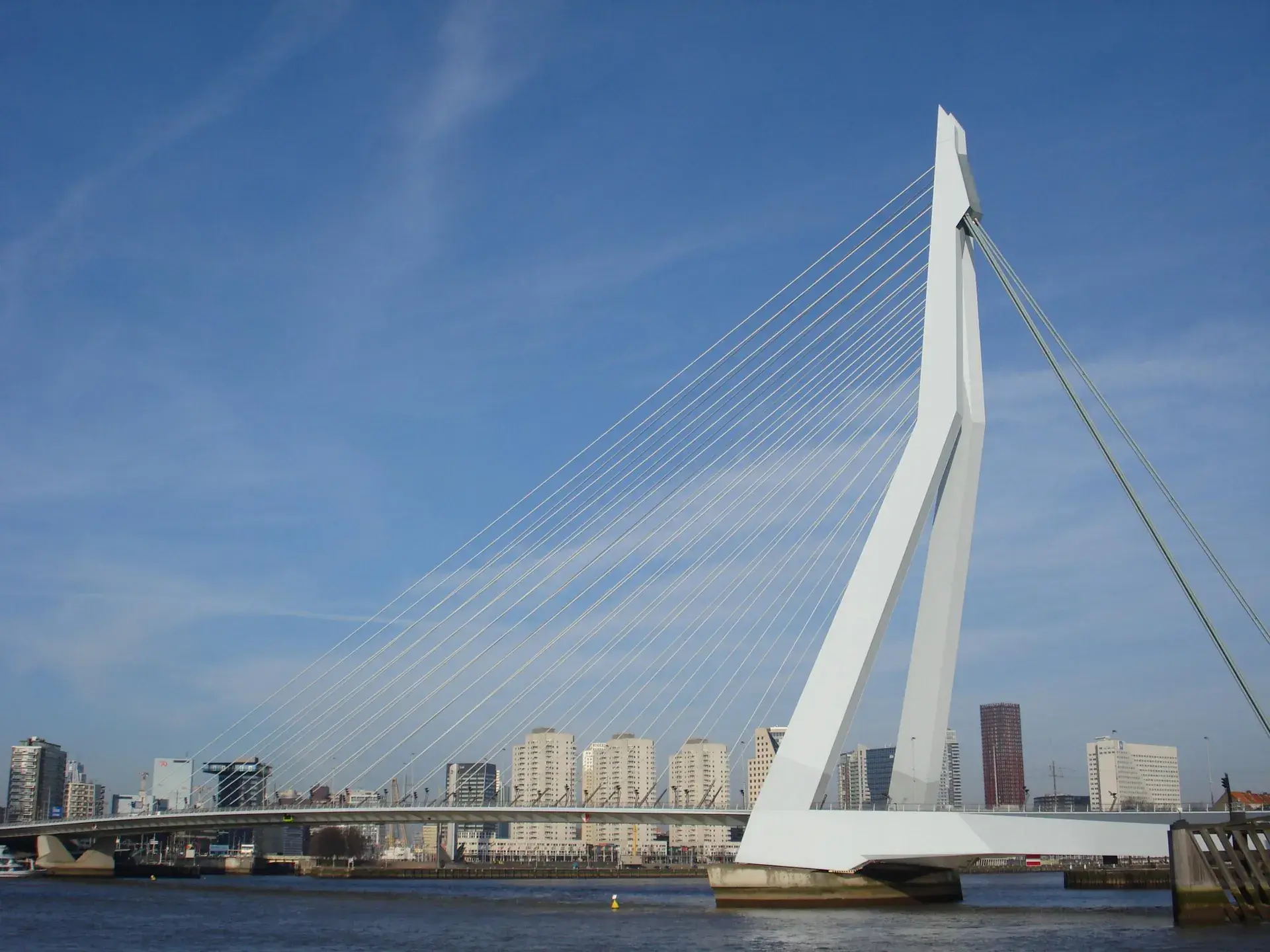
The Erasmusbrug is an 802-meter-long combined cable-stayed and bascule bridge. Its defining feature is a 139-meter-high asymmetrical steel pylon. The distinctive angled, neck-like contour of this white-to-light-blue pylon earned the structure its local nickname, "De Zwaan" (The Swan). To accommodate maritime traffic, the bridge also includes an 89-meter bascule span.
The silhouette of the Erasmusbrug left an immediate mark on the city's identity, becoming so iconic that it was incorporated directly into Rotterdam's official municipal logo. The bridge also caught international attention, featuring prominently in the climactic scenes of Jackie Chan's 1998 action film Who Am I?.
Transit and Engineering Challenges
Today, the bridge operates as a multimodal transit artery. It carries four motor lanes, tram tracks, bidirectional bicycle tracks, and pedestrian walkways. Pedestrians on the elevated paths often encounter brisk North Sea gusts, while the hollow, rhythmic rumble of trams gliding across the steel deck dominates the soundscape. The Erasmusbrug frequently serves as a central stage for major civic events, including the Rotterdam Marathon and World Port Days.
The bridge did face early engineering hurdles. Shortly after its opening in the autumn of 1996, a combination of force 6 winds and light rain caused unexpected aerodynamic cable sway. This dangerous oscillation forced engineers to temporarily stabilize the bridge until permanent hydraulic dampers could be retrofitted.
FAQ
Why is the Erasmusbrug called The Swan?
The bridge earned the local nickname 'De Zwaan' (The Swan) because of the distinctive angled, neck-like contour of its 139-meter-high white-to-light-blue asymmetrical steel pylon.
Who designed the Erasmusbrug?
The Erasmusbrug was designed by Dutch architect Ben van Berkel. His single-pylon sculptural concept was chosen by the Rotterdam City Council in 1991 over a more conventional engineering design.
What happened to the Erasmusbrug shortly after it opened?
Shortly after its inauguration in autumn 1996, the bridge experienced unexpected aerodynamic cable sway caused by force 6 winds and light rain. It required temporary stabilization before permanent hydraulic dampers were retrofitted.