Mount Fløyen & Fløibanen Funicular: Bergen's Peak
Mount Fløyen, one of the seven mountains surrounding Bergen, offers some of the most commanding views of the city and its fjords. Reaching its summit is made simple by the Fløibanen, a historic funicular railway that has been an integral part of Bergen's identity since 1918. In just a few minutes, this railway transports passengers from the city center to a natural wonderland of recreational opportunities.
A History of Health and Heritage
The idea for a transport system up Mount Fløyen was first proposed in 1895 by Member of Parliament John Lund. His motivation was not tourism, but public health, aiming to give Bergen's citizens easy access to nature for recreation. Although the project stalled, it was revived in 1907. The operating company, A/S Fløibanen, was established in 1912 with Waldemar Platou as its first director.
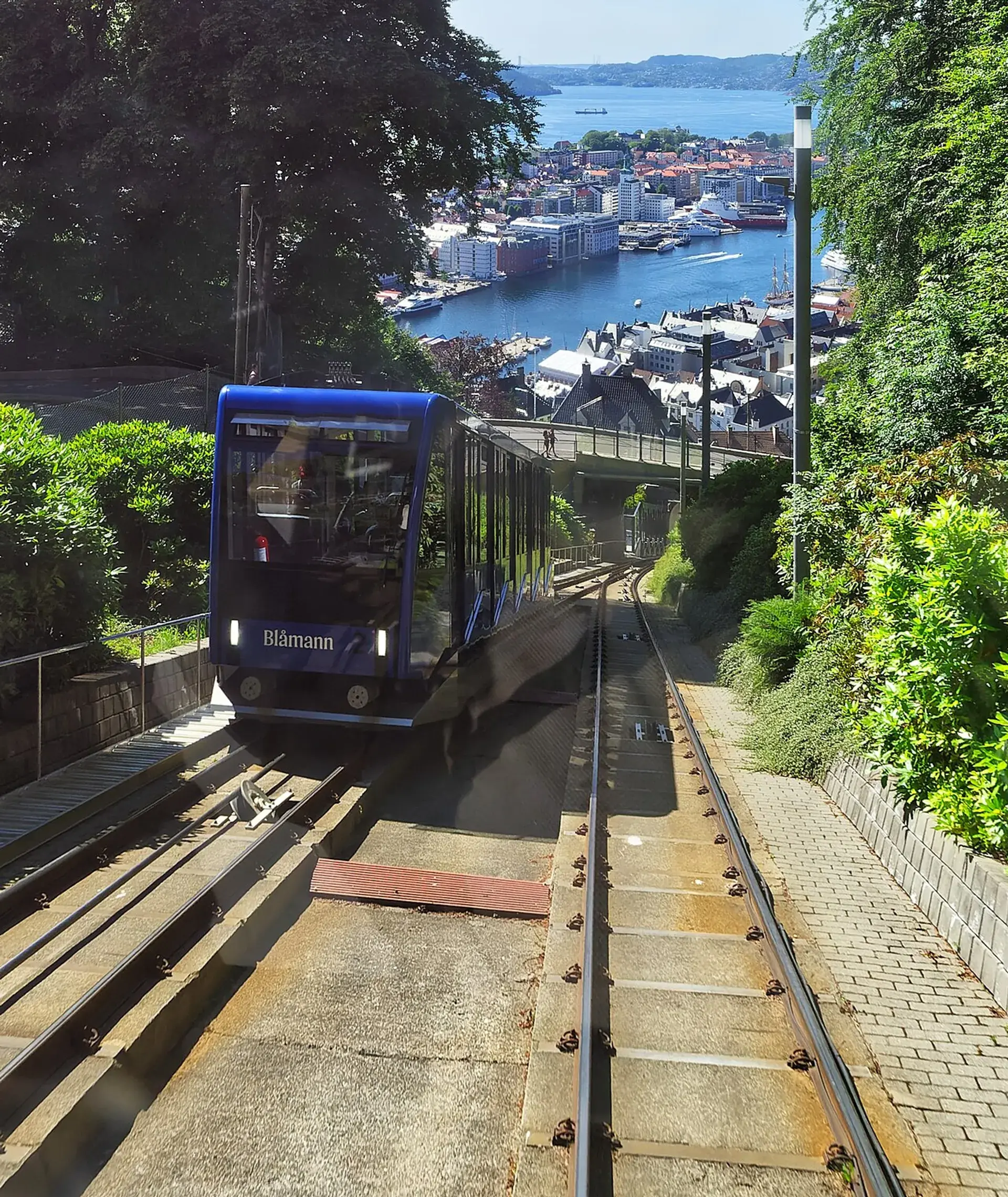
Construction began in 1914 but faced significant delays due to World War I. The Fløibanen finally opened on January 15, 1918. In a poignant gesture of national pride after World War II, the two funicular cars were painted red and blue. Combined with the white lower station, this color scheme was chosen to symbolize the Norwegian flag.
The Journey and The Machine
The Fløibanen funicular line spans 848 meters with a vertical ascent of 302 meters, navigating a gradient that varies between 15 and 26 degrees. The journey from the lower station to the upper station at 320 meters above sea level takes approximately 6 to 8 minutes. The two cars are named "Rødhette" (Little Red Riding Hood) and "Blåmann" (Blue Man), names chosen through a public competition.
Over the years, the funicular has seen five generations of cars. The current fifth-generation cars were introduced in 2022. Designed by Espen Thorup, they feature large windows and glass roofs, can carry 120 passengers each, and are powered by a 355 kW AC motor. The system transports around 2.4 million passengers annually.
Activities at the Summit
The area at the top of Mount Fløyen is a hub for both tourists and locals. Visitors are greeted with panoramic views of Bergen, the harbor, and the surrounding islands. An extensive network of marked hiking trails caters to all fitness levels, including a wheelchair-accessible path around Lake Skomakerdiket.
For families, there are several playgrounds, most notably the 'Troll Forest' with its whimsical wooden troll figures. Other recreational activities include free canoe paddling on the lake during certain periods, a calisthenics park, and mountain bike rentals. A unique feature is the 'reading booth,' a preserved red telephone booth where visitors can swap books. The area is also home to resident mountain goats that roam freely. Dining options include the Fløirestauranten and Fløistuen Café.
A Living Part of Bergen
Beyond being a major tourist attraction, the Fløibanen funicular is deeply woven into the fabric of daily life in Bergen. Residents living on the mountainside use it for their daily commute to work and school. It even serves two kindergartens located on the mountain.
The mountain also acts as a cultural venue, hosting events like the 'OperaOpptur!' opera performances during the Bergen International Festival. For those seeking a unique overnight stay, 'The Cone' treehouse offers accommodation amidst nature. The funicular's dual role as a public utility and a gateway to nature fulfills the century-old vision of connecting the city's inhabitants with their natural surroundings.
FAQ
How long does the Fløibanen funicular take to reach the top?
The journey from the city center to the upper station on Mount Fløyen via the Fløibanen funicular typically takes between 6 and 8 minutes.
What is there to do at the top of Mount Fløyen?
The summit offers panoramic views, extensive hiking trails, playgrounds like the 'Troll Forest,' dining options, free canoe paddling at Lake Skomakerdiket, and unique features like a book-swapping 'reading booth'.
When did the Fløibanen funicular open?
After construction began in 1914 and was delayed by World War I, the Fløibanen funicular officially opened to the public on January 15, 1918.
What do the colors of the funicular cars mean?
After World War II, the two cars, named "Rødhette" (red) and "Blåmann" (blue), were painted in these colors. Combined with the white lower station, this was a deliberate choice to symbolize the Norwegian flag.