Torgallmenningen: Bergen's Historic Main Square
Torgallmenningen is Bergen's main city square and a wide pedestrian avenue, bustling with activity and surrounded by prominent buildings. As the city's primary social gathering place, it is lined with shops and cafes, offering a lively atmosphere for both residents and visitors.
A Square Forged by Fire
Bergen's history is marked by numerous devastating fires due to its traditional wooden architecture. In response, the city introduced 'allmenninger'—wide streets designed as firebreaks. The concept for Torgallmenningen as a firebreak dates to after a city fire in 1582.
The square's current form is a direct result of the great fire of January 1916. The blaze destroyed 380 buildings and displaced 2,700 people in just 10 hours. Torgallmenningen was a critical line of defense where efforts were concentrated to stop the fire's spread. The subsequent reconstruction gave the square and its surrounding buildings their distinct Scandinavian neoclassical style, favoring a classical scheme over a rejected 1918 proposal by city planner Nils Grimnes.
The Sailors' Monument (Sjømannsmonumentet)
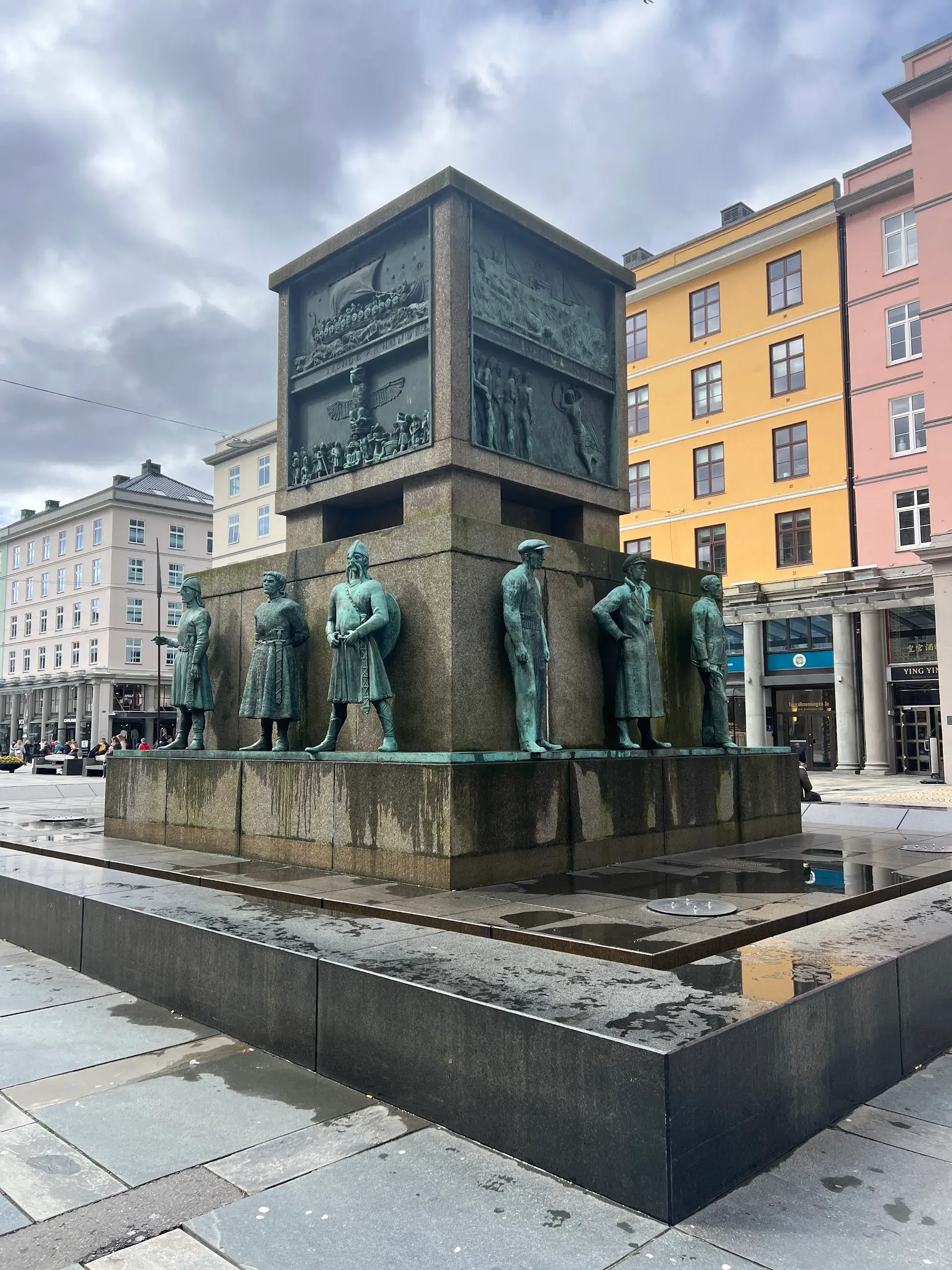
At the northern end of Torgallmenningen stands the Sailors' Monument, or Sjømannsmonumentet. Unveiled on June 7, 1950, this 7-meter-high cuboid monument was sculpted by Dyre Vaa to honor the contributions and sacrifices of Norwegian sailors throughout history.
The monument features twelve bronze figures arranged in four triads, each facing a cardinal direction. These figures represent different eras of Norwegian seafaring, from the Viking Age to the 20th century, and also depict the poor, middle, and elite classes of their respective times. Four relief panels further illustrate this maritime narrative with scenes of Viking longships, whaling, and other historical events. Notably, the monument exclusively portrays male figures and omits the later Middle Ages, a significant period in Bergen's development.
Modern Hub of Bergen
Today, Torgallmenningen is a vibrant pedestrian zone and the heart of the city. It features a fountain and the popular meeting point known as 'The Blue Stone' (Den Blå Stein), a 30-foot-long Brazilian sodalite stone. The square frequently hosts large public events, including free performances by the Bergen Philharmonic Orchestra during the Bergen Festival.
To accommodate Bergen's climate, which averages around 200 days of rain annually, new steel columns and glass roofs were installed over parts of the square in 2020. These structures offer protection from the elements, enhancing the experience for shoppers and pedestrians in this central hub.
FAQ
Why was Torgallmenningen built?
The concept of wide avenues ('allmenninger') like Torgallmenningen was developed as a firebreak to prevent the spread of fires, a frequent problem in Bergen's history. Its current neoclassical form was established during the reconstruction after the great fire of 1916.
What is the story behind the Sailors' Monument in Torgallmenningen?
Unveiled in 1950, the Sailors' Monument (Sjømannsmonumentet) honors a millennium of Norwegian maritime history. Its twelve bronze figures, sculpted by Dyre Vaa, depict sailors from the Viking Age to the 20th century.
What is the "Blue Stone" in Torgallmenningen?
The "Blue Stone" (Den Blå Stein) is a 30-foot-long Brazilian sodalite stone located at the intersection with Ole Bulls Plass. It serves as a very popular meeting spot for locals and was donated for the 100th anniversary of the Kavli Trust.
What is the architectural style of Torgallmenningen?
The buildings surrounding Torgallmenningen primarily feature a Scandinavian neoclassical architectural style, which was adopted during the city's reconstruction following the devastating fire of 1916.