Brama Grodzka: Historic Jewish Gate in Lublin
Pass through a Neoclassical archway that once bridged two distinct worlds, and now stands as the memory keeper for a vanished city. Brama Grodzka anchors the transition from the Old Town core to Lublin Castle, serving as a critical memorial to the city's destroyed Jewish quarter and its lost multicultural history.
A Gateway Between Two Worlds
Built around 1341–1342 following a royal charter by King Casimir the Great, Brama Grodzka began as a formidable medieval city gate. Originally a twelve-meter-tall rectangular stone and brick defensive tower with a drawbridge, it historically marked the physical boundary between the Catholic Old Town and the vibrant Jewish quarter that surrounded Lublin Castle.
Serving as the eastern counterpart to the western Brama Krakowska, the gate eventually integrated deeply into the quarter's commercial life. In 1873, it was sold into private hands to Jewish merchant Chaim Kleinman.
From Fortress to Townhouse
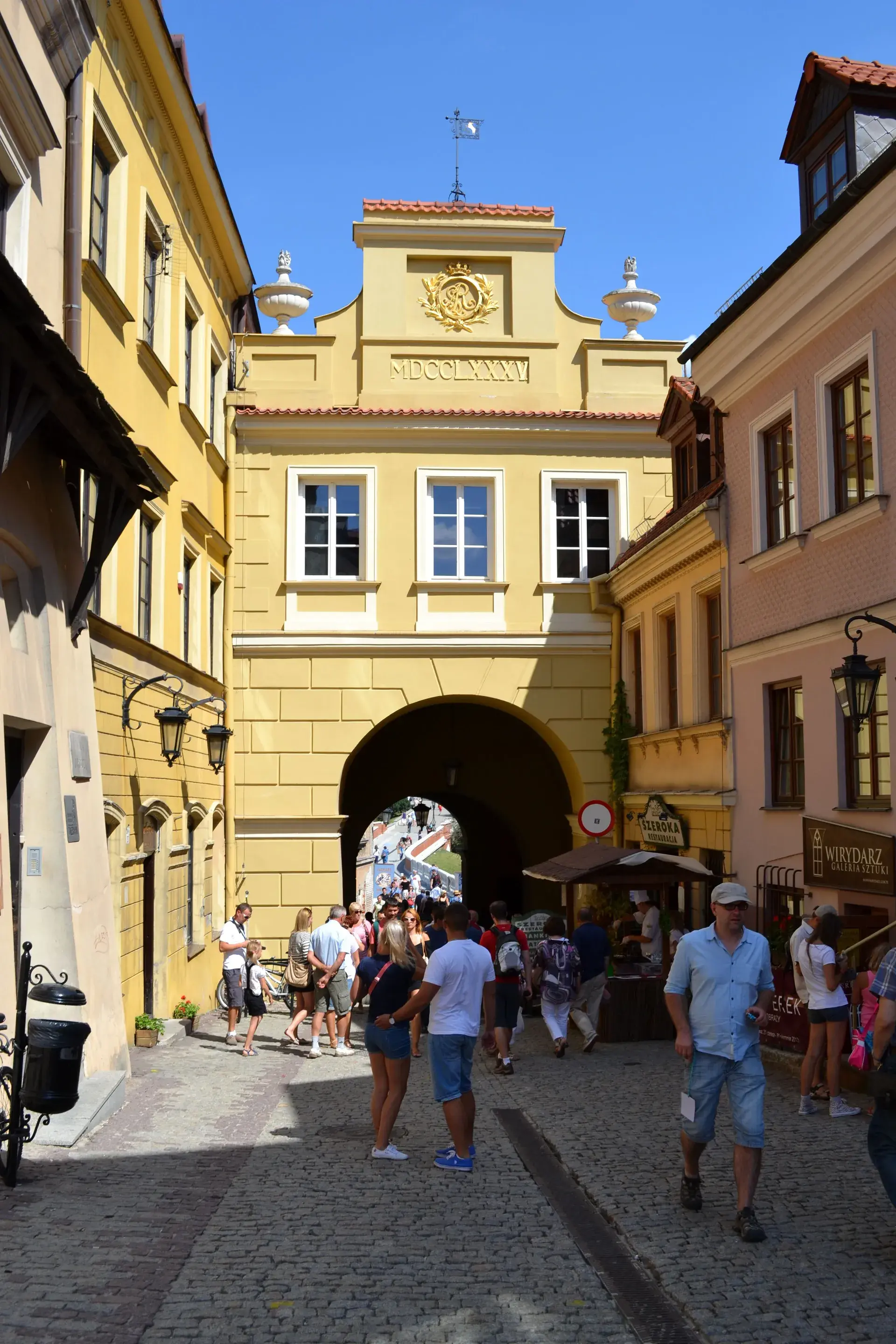
By the late 18th century, the medieval gate had fallen into severe disrepair. In 1785, royal architect Domenico Merlini completely redesigned the structure, stripping its military fortifications. Merlini leveled the gate and foregate under a single gable roof, integrating ground-floor shops and residential quarters above.
Unusually for a defensive city gate, its grandest classical facade faces inward toward the Old Town rather than outward toward approaching travelers. This design gave the building the appearance of a domestic townhouse. The upper pediment on the Old Town side features the gilded monogram SAR (Stanislaus Augustus Rex) and the date MDCCLXXXV (1785), commemorating the king's sponsorship of the reconstruction.
The Tragedy of Podzamcze
Prior to 1939, approximately 43,000 Jews lived in Lublin, representing roughly a third of the city's population. During the German occupation in World War II, the area immediately outside the gate was converted into a ghetto.
Following deportations to extermination and concentration camps like Bełżec and Majdanek, occupying forces systematically razed the surrounding Jewish district of Podzamcze to the ground. The physical gate remained, but the world it once led into was entirely destroyed.
Preserving a Vanished City
After decades of neglect, Brama Grodzka was reclaimed in the early 1990s by a local independent theater group. Realizing the structure overlooked a vanished urban quarter, the founders transformed their mission into recovering Lublin's lost Jewish heritage.
Today, the gate serves as the headquarters of the cultural and educational institution Ośrodek "Brama Grodzka – Teatr NN." Inside the gate's exhibition space, the "Lublin. Memory of the Place" installation is arranged like an endless labyrinth of dark metal shelves, files, and auditory recordings of pre-war street life.
The collection also highlights a remarkable photographic treasure. In 2012, workers renovating a nearby tenement on Rynek 4 discovered over 2,700 glass negatives wrapped in rags beneath the roof. These pre-war photographs of everyday life are now archived and exhibited by the center, ensuring the memory of Lublin's diverse past endures. Just outside the gate lies Zaułek Hartwigów, an atmospheric flight of stone stairs lined with outdoor photography and poetry displays.
FAQ
Why is Brama Grodzka also known as the Jewish Gate?
Historically, the gate served as the physical boundary and passage connecting the Catholic, Christian Old Town with the vibrant Jewish quarter that surrounded Lublin Castle.
Who is responsible for Brama Grodzka's current design?
In 1785, royal architect Domenico Merlini completely redesigned the medieval structure into a Neoclassical building, replacing its defensive fortifications with a gable roof, shops, and apartments.
What is inside Brama Grodzka today?
The gate currently serves as the headquarters for the cultural institution Ośrodek "Brama Grodzka – Teatr NN." It houses interactive archives and permanent exhibitions, including a labyrinth of dark metal shelves containing oral histories, files, and pre-war photographs.