Lithuanian Square: Lublin's Historic Heart
Spanning approximately 35,000 square meters, Lithuanian Square (Plac Litewski) serves as a physical bridge between the medieval Old Town and the modern commercial downtown of Lublin. Located along Krakowskie Przedmieście, this expansive pedestrian plaza acts as the city's grand front lawn.
A Historic Campsite
The sweeping open space takes its name from a 16th-century political event that reshaped European borders. During the 1569 Sejm sessions that forged the Polish-Lithuanian Commonwealth, the Lithuanian delegation camped on these grounds. That same year, King Sigismund II Augustus accepted the feudal homage of Albert Frederick, Duke of Prussia, on the site.
Under imperial Russian rule in the 19th century, tsarist authorities leveled an existing monastery and cemetery to create a military drill ground. They later constructed a large Russian Orthodox cathedral in the center of the square to symbolize imperial authority. Following Poland's restoration of independence, the cathedral was dismantled in the 1920s. The area was officially named Plac Litewski in 1925, although the name had appeared in print as early as 1839 in Seweryn Sierpiński's guidebook.
Monuments and Architecture
The square is surrounded by grand historic structures, including the Lubomirski Palace and the Czartoryski Palace. Several major monuments anchor the space, with the most prominent being an 1826 classicist cast-iron obelisk dedicated to the Union of Lublin. This monument, featuring a gilded bas-relief by Paweł Maliński, replaced an original 16th-century structure that was destroyed under tsarist rule. Other significant memorials include an equestrian statue of Marshal Józef Piłsudski, the Tomb of the Unknown Soldier, and a monument dedicated to the Constitution of 3 May 1791.
The Modern Civic Heart
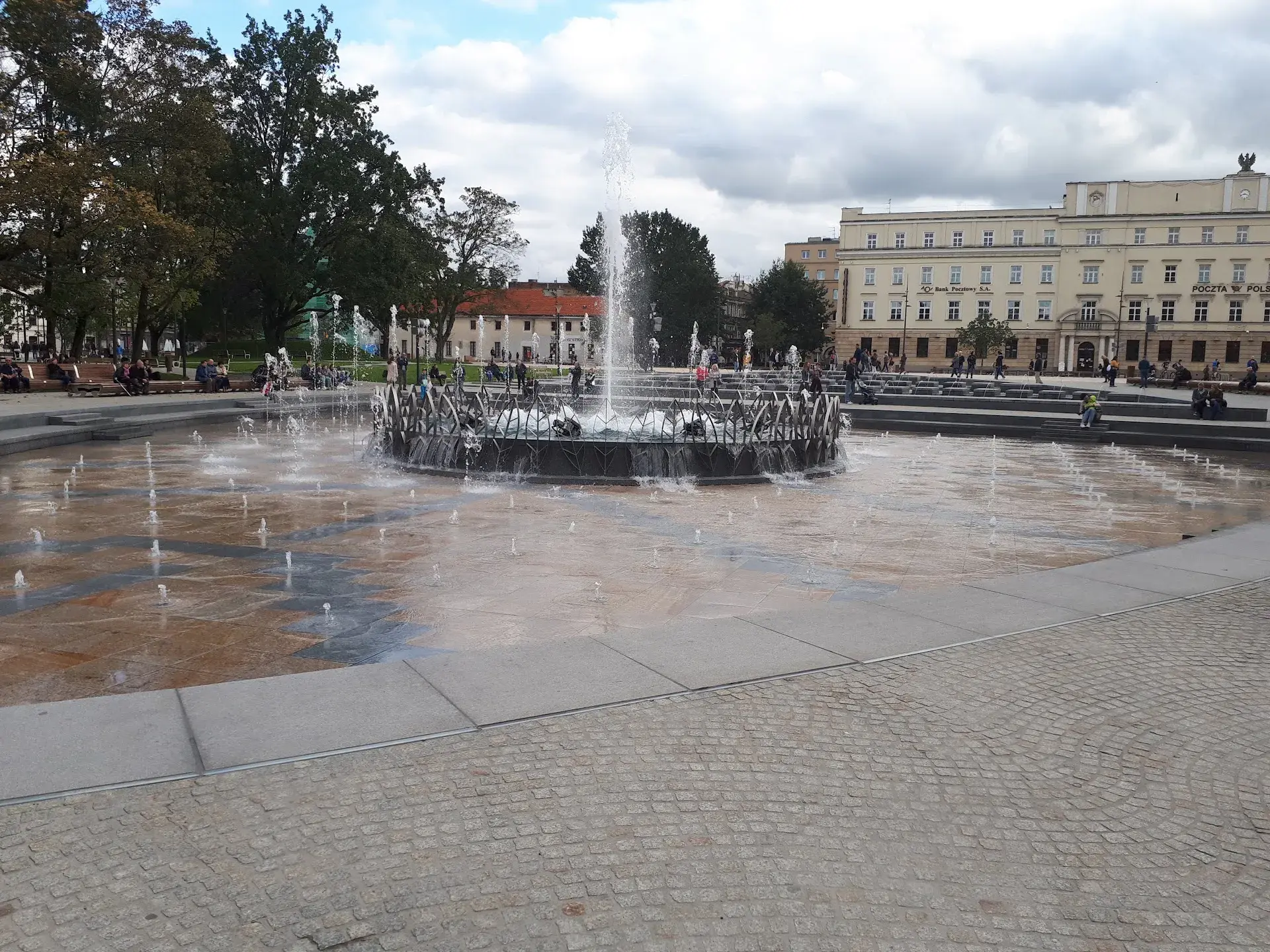
Today, Lithuanian Square serves as the primary outdoor gathering space for festivals and national commemorations. The rhythmic rushing and splashing of water fills the square during the day, emanating from a massive multimedia fountain complex. Reopened in 2017, the installation features 227 jets and hosts evening projection shows on water screens that illustrate the history of the city.
The square also houses an interactive circular digital screen known as The Portal. Unveiled in 2021, this installation broadcasts a live, continuous visual connection to Vilnius and other global cities, celebrating Lublin's historic role in multi-ethnic integration.
The Secret of the Baobab
For well over a century, the square was home to a massive black poplar locally known as the "Baobab." Planted around 1880, the tree served as a secret commemoration of the January Uprising against tsarist rule. It stood as a beloved local landmark and meeting point before eventually succumbing to disease.
FAQ
Why is it called Lithuanian Square?
The square takes its name from the 1569 Union of Lublin, when the Lithuanian delegation of nobles and envoys camped on these grounds during the negotiations that created the Polish-Lithuanian Commonwealth.
What monuments can be found in Lithuanian Square?
The square features an 1826 cast-iron obelisk dedicated to the Union of Lublin, an equestrian statue of Marshal Józef Piłsudski, the Tomb of the Unknown Soldier, and a monument honoring the Constitution of 3 May 1791.
What is the multimedia fountain complex in the square?
Reopened in 2017, the interactive fountain complex features 227 water jets, dynamic lighting, and evening projection shows on water screens that illustrate the historical narrative of Lublin.
Discover Lublin like never before
Dive into Lublin hidden stories and secret spots with Ciceru interactive tours.
Explore tour
Audioguide
Quizzes
Maps
Solo
Couples
Groups & families

© Photo by Mariusz Przebirowski via Google Maps · Google Places