Brama Krakowska: Lublin's Historic Gateway
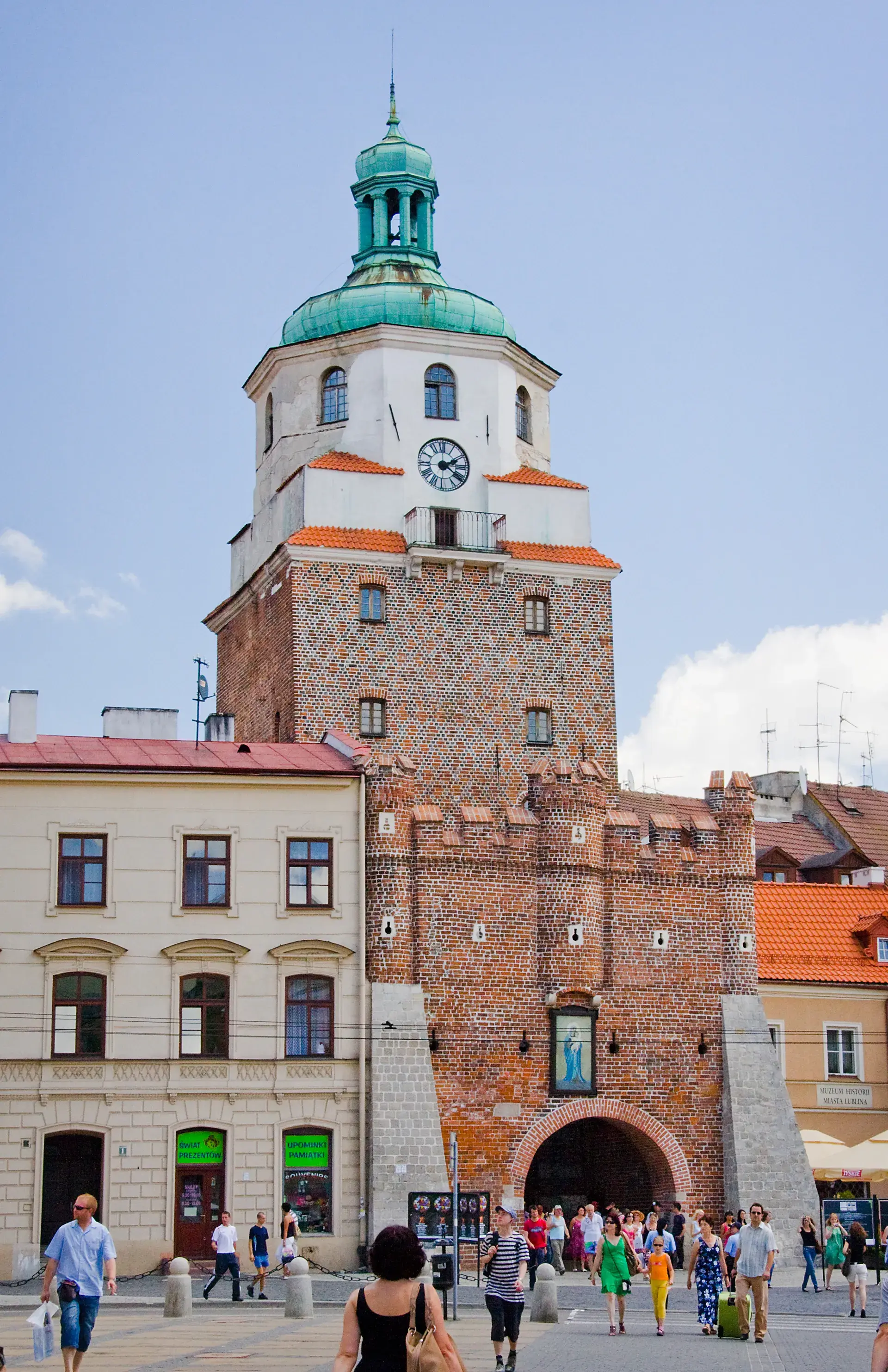
Brama Krakowska, or the Kraków Gate, stands as the primary historic gateway into Lublin's Old Town. Located at the junction of Plac Władysława Łokietka and Ulica Bramowa, the imposing structure marks the threshold between the modern pedestrian promenade of Krakowskie Przedmieście and the cobblestone streets of the Stare Miasto.
A Bastion of Medieval Defense
Constructed between 1341 and 1344 under the orders of King Casimir III the Great, the gate was erected following a devastating Tatar raid in 1341. It formed the most formidable bastion in Lublin's defensive curtain and took its name from the historic trade route connecting Kraków, Lublin, and Vilnius.
In its early years, the gateway was accessed by crossing a deep defensive moat via a wooden drawbridge. Over the centuries, the structure evolved to meet changing municipal needs. A fortified Renaissance foregate was added in the mid-16th century, and an early clockwork mechanism was integrated around 1585.
Historically, the gate functioned as the quarters for essential municipal workers. It housed the night watchmen, the official city clockmaster, and the city bugler.
Architectural Evolution and Restoration
The gateway displays a striking visual contrast resulting from centuries of architectural updates. At street level, the base features heavy, exposed Gothic checkerboard masonry composed of dark red field brick mixed with irregular chalk and limestone blocks. The vaulted pedestrian passage creates a distinct sensory compression and echo. Above this heavy base stands a smoothed, painted octagonal Baroque superstructure.
This upper tower was redesigned in 1782 by royal architect Domenico Merlini at the request of the Commission of Good Order. Merlini added the gate's characteristic copper helmet. At the very top, a weather vane bears the monogram SAR (Stanislaus Augustus Rex) and the date 1782, honoring King Stanisław August Poniatowski.
Between 1959 and 1964, the structure underwent significant post-war restorations. Extraneous layers of plaster were removed to expose the original 14th-century Gothic masonry that defines the gate's lower levels today.
Religious Icons and Museum Exhibits
The gate features opposing religious icons on its facades. The exterior wall facing the modern city displays an image of the Virgin Mary, while the interior facade facing the Old Town presents an 1839 image of Saint Anthony of Padua, the patron saint of Lublin.
Since 1979, the Kraków Gate has served as the headquarters for the Museum of the History of the City of Lublin, a branch of the National Museum. The interior houses permanent exhibitions detailing the city's urban development from its prehistoric settlements up until 1944.
The fifth level provides a public vantage point overlooking Plac Łokietka and the Krakowskie Przedmieście, offering a sweeping perspective of Lublin's historic and modern landscapes.
FAQ
What is inside Brama Krakowska today?
Since 1979, the gate has housed the Museum of the History of the City of Lublin. The museum features permanent exhibitions on the city's urban development up to 1944, and its fifth floor offers a public vantage point over the city.
Who built the Kraków Gate in Lublin?
The original Gothic structure was initiated by King Casimir III the Great between 1341 and 1344 following a Tatar raid. The upper Baroque tower was later redesigned in 1782 by royal architect Domenico Merlini.
What do the letters on the Brama Krakowska weather vane mean?
The weather vane features the monogram SAR, which stands for Stanislaus Augustus Rex. It includes the date 1782, commemorating King Stanisław August Poniatowski's patronage of the gate's late 18th-century restoration.