Kamienica Oleśnickich: Sandomierz History & Architecture
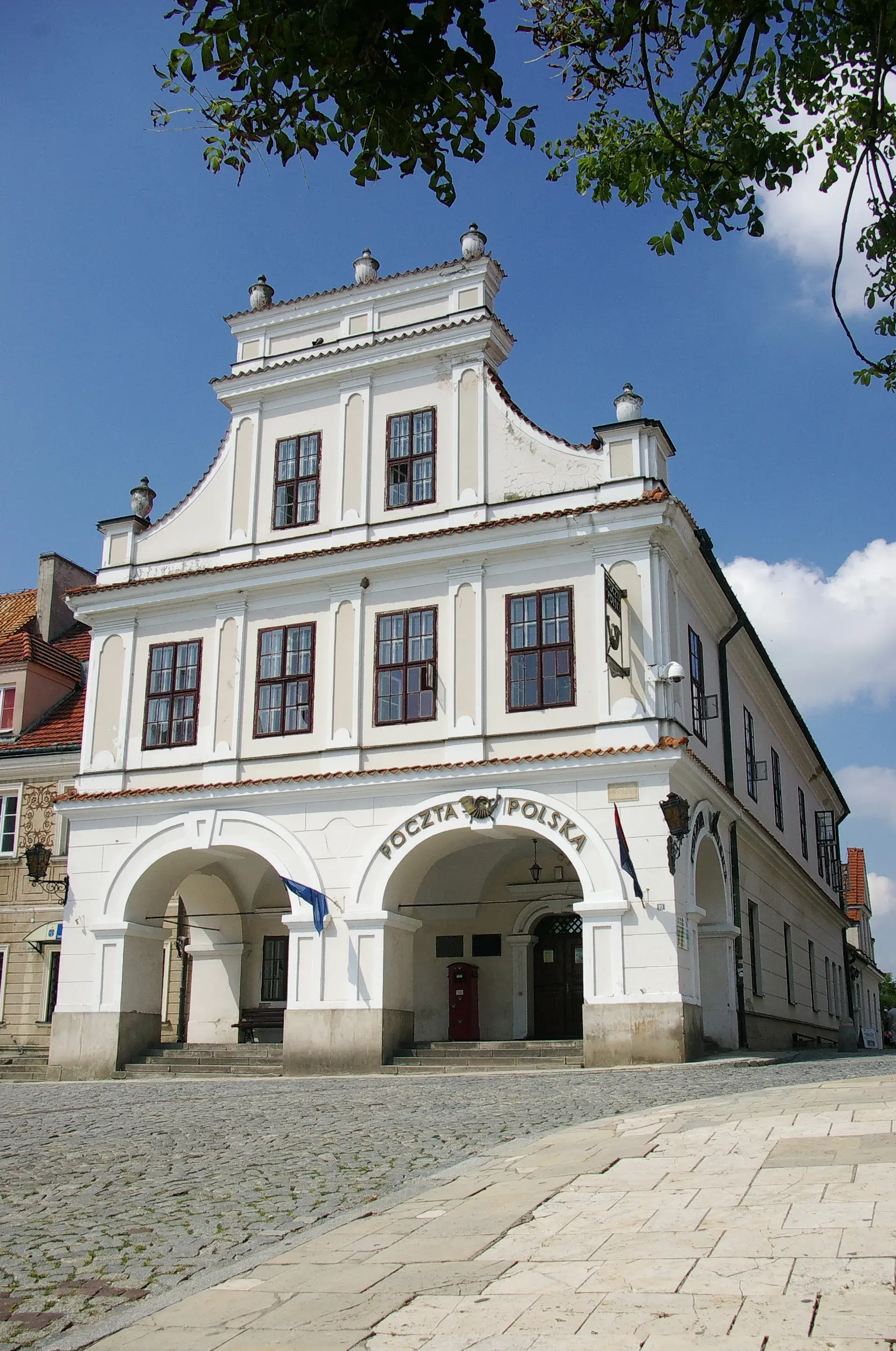
Located at Rynek 10 on the western side of the Old Town Market Square in Sandomierz, Kamienica Oleśnickich is a historic Renaissance townhouse. The structure is one of the first prominent buildings visible when entering the Market Square from the Opatów Gate, acting as an architectural anchor of the city's trade heritage.
Architectural Evolution and Design
Originating in the 16th century on older Gothic foundations, the building underwent significant changes after being heavily damaged in the 1757 city fire. The Oleśnicki family acquired the property and rebuilt it between 1770 and 1780, with designs possibly by architect-priest Józef Karśnicki. Between 1955 and 1958, architect Józef Jamróz led a reconstruction to restore its historic Baroque crown and facade following late-19th-century alterations.
The townhouse features a four-axis, two-story facade adorned with pilasters, a blind attic parapet, and a Baroque decorative gable topped with stone urns. It is one of the few merchant houses on the square with preserved exterior arcades. These deep, two-bay ground-floor stone arches cause the facade to project visibly forward from the neighboring street wall. Passing beneath the front of the house, the projecting arches cast sheltering shadows and create a distinct transition in natural light and foot-traffic echo.
A Center of Historic Agreements
Documentary records trace early ownership of the parcel to Greek merchant Jerzy Kojszor and later Voivode Andrzej Leszczyński. The location is also associated with a strong local tradition connecting it to the 1570 Consensus of Sandomierz. According to this tradition, Polish Calvinists, Lutherans, and Bohemian Brethren met at this site to conclude the historic ecumenical tolerance pact.
The Subterranean World Below
Beneath the house and its courtyard lie multi-tiered merchant storage chambers carved up to 15 meters deep into the soft, unreinforced loess ground. In the mid-20th century, water penetration weakened the loess and threatened the stability of the entire historic market square. Between 1964 and 1977, Silesian mining engineers conducted emergency stabilization efforts to secure the cavities. Today, the courtyard and outbuilding of Kamienica Oleśnickich provide the main entrance to the Sandomierz Underground Tourist Route, connecting directly to these historic cellars.
Modern Cultural Significance
The building is currently operated by the Sandomierz Cultural Center as an interactive educational and cultural facility. The interior houses exhibits such as the Time Capsule, Mechanical Theater, Mathematical Retro-Sphere, and Riddle Vault. The building also holds modern pop culture relevance; its exterior repeatedly served as the backdrop for a local bank branch in the Polish television detective series Ojciec Mateusz.
FAQ
What architectural style is Kamienica Oleśnickich?
The building is a Renaissance townhouse built on older Gothic foundations, featuring late-Baroque elements added during its 18th-century reconstruction.
Where is the entrance to the Sandomierz Underground Tourist Route?
The main entrance to the underground loess cellars is located in the courtyard and outbuilding of Kamienica Oleśnickich.
What is the historical significance of the Consensus of Sandomierz?
According to local tradition, the townhouse was the site where the 1570 Consensus of Sandomierz was signed by Polish Calvinists, Lutherans, and Bohemian Brethren, marking an early European ecumenical tolerance pact.