Opatów Gate: Sandomierz's Medieval Bastion
The Sole Survivor of Sandomierz's Defenses
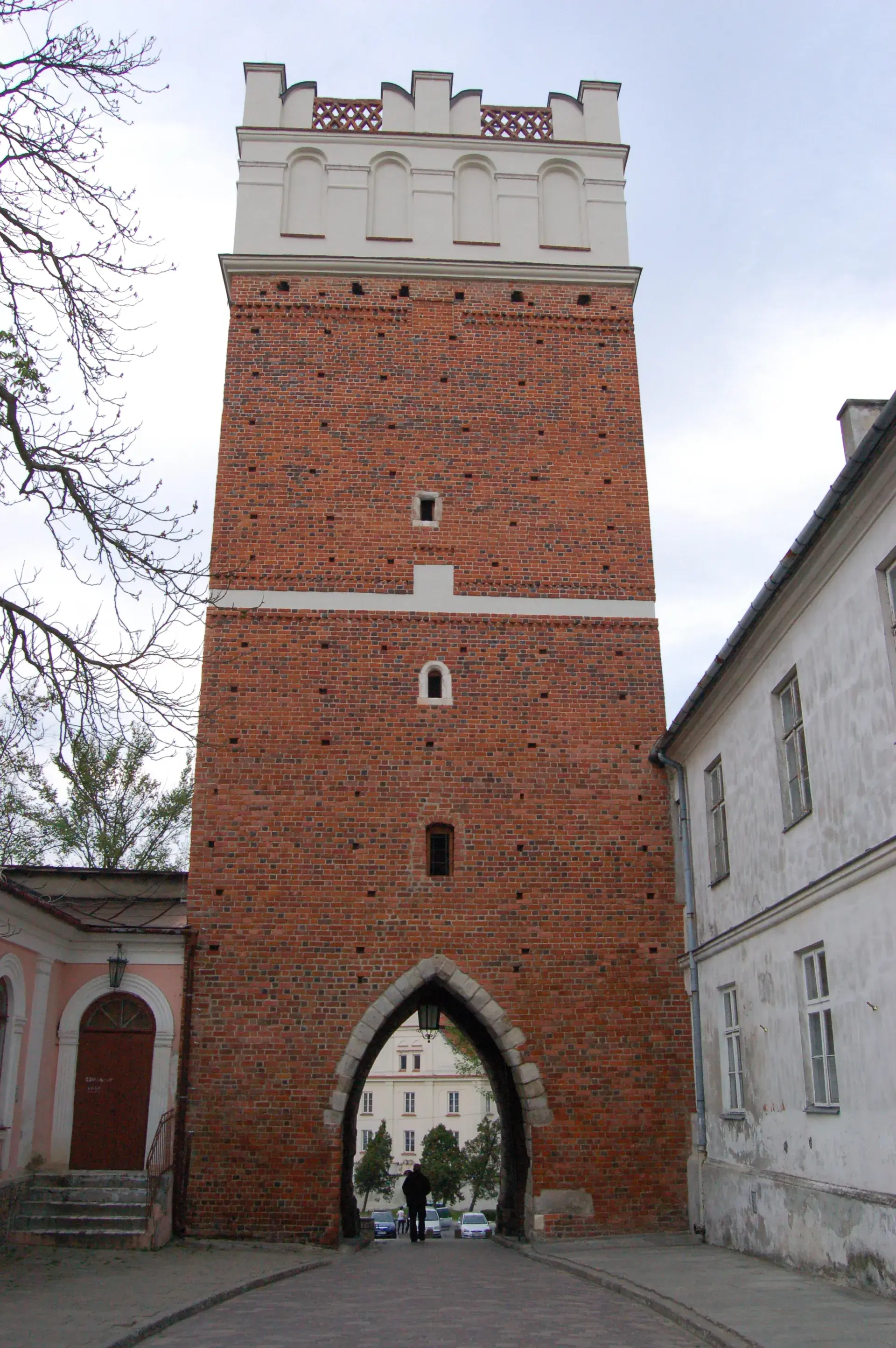
Opatów Gate (Brama Opatowska) marks the northern threshold of the historic Old Town in Sandomierz, leading directly onto Opatowska Street and the Market Square. Erected around 1362 under the reign of King Casimir III the Great, the gate formed an essential component of the town’s defensive reconstruction following devastating Lithuanian raids in 1349.
During the Middle Ages, the gateway anchored a 1,700-meter wall circuit equipped with 21 bastions, guarding the primary overland trade route toward Opatów and Ruthenia. Sandomierz was originally fortified with four entrance gates—Opatów, Zawichojska, Lubelska, and Krakowska. Today, Opatów Gate stands as the only full gatehouse still standing, making it an integral element of the town's designated Polish Monument of History urban complex.
Gothic Architecture and Renaissance Reinvention
The structure is a Gothic brick tower constructed on a square footprint measuring roughly 9 by 9.75 meters, rising to a height between 30 and 32 meters. The lower walls exceed two meters in thickness, gradually tapering to between 0.6 and 0.8 meters near the top. At the ground level, travelers passed through a pointed-arch portal flanked by stone ashlar projections. Visible vertical stone guide slots carved into the exterior masonry reveal where a heavy, iron-bound oak portcullis once dropped to seal the town against invaders.
In its original medieval defensive arrangement, the tower featured no permanent internal staircases; garrison defenders accessed arrow loops and platforms exclusively by pulling up wooden ladders and ropes. In the 16th century, the gate was crowned with a Renaissance brick attic parapet featuring swallowtail merlons, an arcaded frieze, and openwork tracery. This addition was financed by royal physician Stanisław Bartolon the Elder, both to deflect flaming arrows and to update the skyline. Bartolon, who served King Sigismund II Augustus, was so renowned that his practice inspired the historical Polish idiom for terminal illness: ‘Even the Sandomierz doctor can no longer help him.’
Centuries of Military and Civic Use
Beyond medieval warfare, the tower served varied civic and military roles through the centuries. During the 19th century, the gatehouse provided living quarters for the town executioner, and in later years housed a municipal trumpeter stationed to sound bugle calls from the top.
The gate witnessed violent conflict during the January Uprising on February 8, 1863. Polish insurgent forces retreating from the nearby Battle of Słupcza barricaded themselves inside the masonry tower to stall advancing Russian and Cossack troops before the position was ultimately breached. In 1928–1929, the structure was secured with a reinforced concrete ceiling and repurposed as a public municipal viewpoint.
Modern Observation Deck and Exhibits
Today, Opatów Gate operates as an active observation platform. Ascending approximately 130 internal stairs leads past intermediate levels containing cultural exhibits. These displays highlight regional heritage, including local striped flint (krzemień pasiasty), as well as Sandomierz’s history as a prominent cinematic filming location.
The climb culminates at an open-air rooftop terrace. From this vantage point, visitors can view a 360-degree panorama of the preserved Old Town, the winding Vistula River valley, and the ancient Pepper Mountains (Góry Pieprzowe). Suspended high across the street outside the gate hangs Little Rafter with an Oar, a balancing bronze sculpture by Jerzy Kędziora installed in 2017 to commemorate the historic river trade along the Vistula.
FAQ
Why was Opatów Gate built?
It was built around 1362 under King Casimir III the Great as part of a defensive wall circuit following Lithuanian raids against Sandomierz in 1349.
What is visible from the top of Opatów Gate?
The rooftop terrace provides a 360-degree panorama overlooking the Sandomierz Old Town, the Vistula River valley, and the Pepper Mountains.
How did defenders move inside the gate during medieval times?
The tower originally had no permanent internal stairs; defenders moved between upper platforms and arrow loops using removable ladders and rope systems.
Who funded the Renaissance top of the tower?
The Renaissance brick attic parapet with swallowtail merlons was funded in the 16th century by royal physician Stanisław Bartolon the Elder to deflect flaming arrows.