Palace Under the Globe: Szczecin's Historic Gem
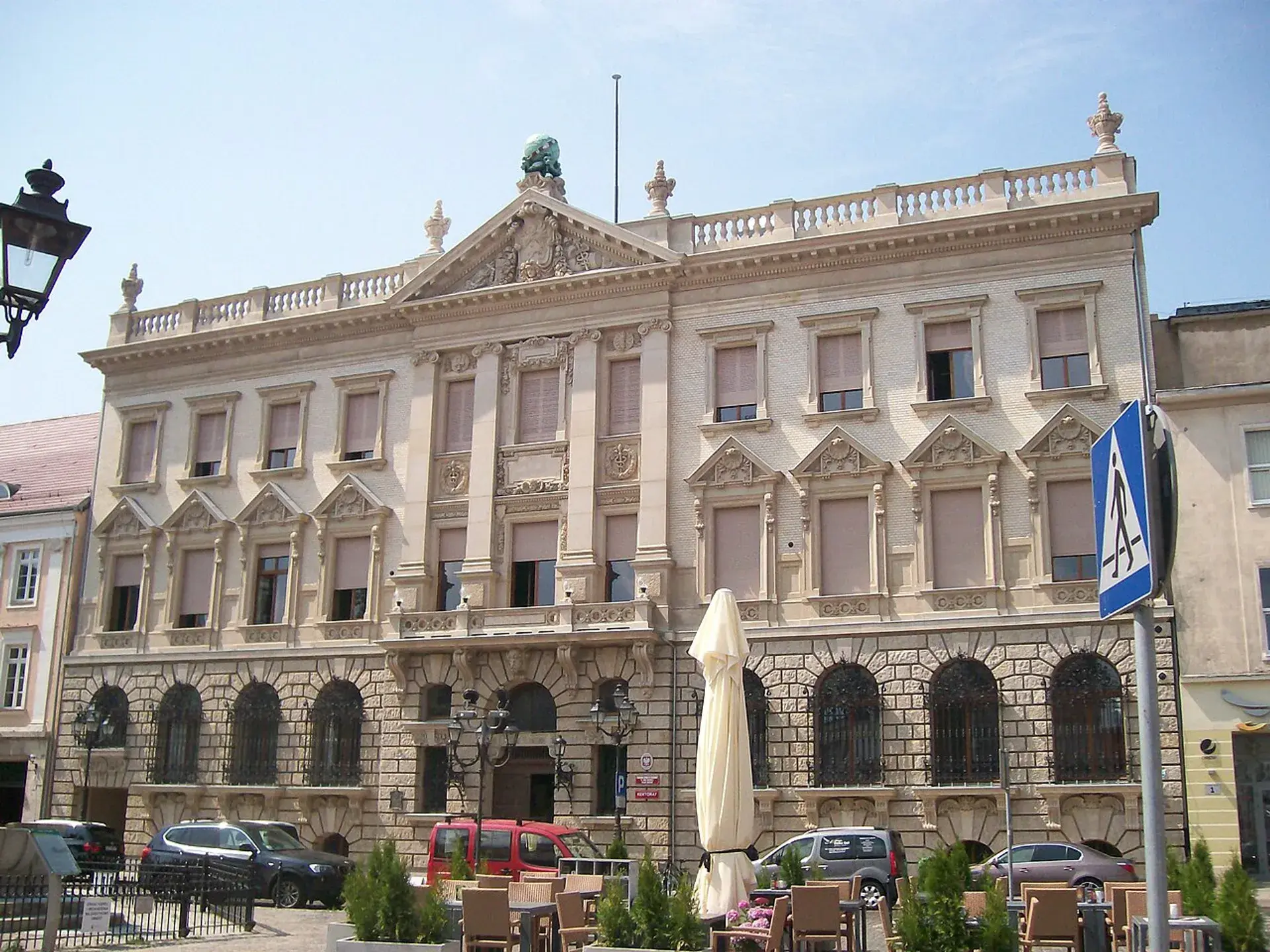
The Palace Under the Globe, historically known as the Grumbkow Palace, stands as a foundational landmark of Plac Orła Białego (White Eagle Square) in the historic core of Szczecin, Poland. With its beige and white facade and heavy rusticated stonework, the building anchors an open space lined with 18th-century noble townhouses.
An Aristocratic Residence
Originally, the structure was built between 1723 and 1726 for Philipp Otto von Grumbkow, President and Chancellor of the Pomeranian Province. Financed by the Prussian crown, it was the grandest private townhouse on the square at the time. The residence was designed by French military architect Peter de Montargues and royal architect Philipp Gerlach, featuring sculptural details by Berlin court sculptor Johann Georg Glume.
During the Seven Years' War, Duke Frederick Eugene of Württemberg resided in the palace. In October 1759, his daughter, Princess Sophie Dorothea of Württemberg, was born within its walls. She later married Russian Tsar Paul I and became Empress Maria Feodorovna. Because Catherine the Great was born just down the street, Szczecin holds the rare distinction of being the birthplace of two consecutive Russian tsarinas.
A Corporate Makeover and the Iconic Globe
In 1890, the building was purchased by the "National" Insurance Company. The corporation commissioned Berlin architect Franz Wichards to remodel the building into a Neo-Baroque corporate headquarters. This 1890–1891 redesign introduced the palace's architectural signature: a monumental facade with a central avant-corps, four pilasters, and a sculptured triangular pediment.
The most striking addition was the crowning copper-patinated globe supported by two sculpted lions. Despite the building's stately palatial appearance, this emerald-green rooftop globe is not a royal or astronomical emblem. It was installed purely as corporate marketing iconography to symbolize the insurance company's worldwide reach.
Survival and Modern Rebirth
While the surrounding Old Town of Szczecin suffered catastrophic destruction during World War II bombings, the Palace Under the Globe survived with minimal damage. Today, it remains a well-preserved piece of the city's architectural heritage.
Since 2010, the palace has served as the main seat and rectorate of the Academy of Art in Szczecin. Following a comprehensive renovation completed in 2014, the building transformed into an active public arts hub hosting over 300 cultural events annually. It now houses the ZONA and R+ student art galleries, a presentation theater, and a digital media library known as the Mediateka. The cobblestone square frequently resonates with the echoes of student conversations, rehearsals, and musical instruments filtering out from the academy.
Surrounding Historic Context
The Palace Under the Globe sits directly on a historic route connecting the Pomeranian Dukes' Castle to the Cathedral Basilica of St. James. It shares White Eagle Square with other notable structures, including the Ionic Palace, Bartz Palace, and Velthusen Palace.
The square also features the Baroque sandstone statue of Flora. Originally carved in 1724 by Johann Georg Glume specifically for the palace's garden or attic balustrade, the allegory of abundance now stands in the middle of the plaza, serving as a lasting piece of the palace's 18th-century origins.
FAQ
Why is there a globe on top of the Palace Under the Globe?
The copper-patinated globe is not a royal crest. It was added during an 1890–1891 Neo-Baroque renovation as a marketing symbol for the 'National' Insurance Company to represent their worldwide reach.
Who was born in the Palace Under the Globe?
Princess Sophie Dorothea of Württemberg was born in the palace in October 1759. She later married Tsar Paul I and became Empress Maria Feodorovna of Russia.
What is the Palace Under the Globe used for today?
Since 2010, the palace has served as the main seat of the Academy of Art in Szczecin. It operates as a public arts hub with student galleries, a digital media library, and a theater, hosting over 300 cultural events a year.