House of Nicolaus Copernicus: Toruń Birthplace
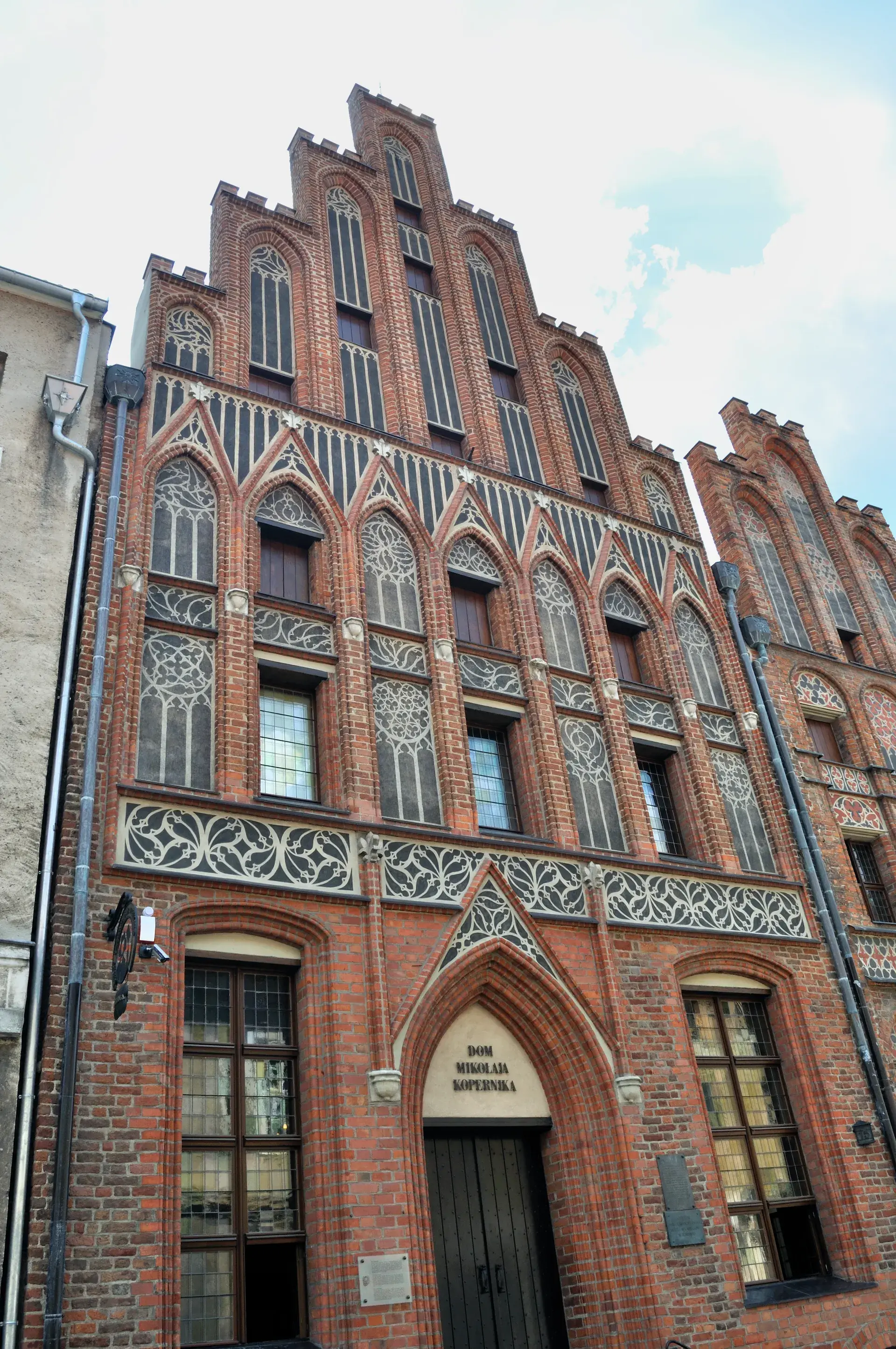
The authentic Gothic merchant house facades at ul. Kopernika 15/17 mark the probable birthplace of the man who reordered the cosmos. Built not as an academic sanctuary but as a heavy-lifting Hanseatic warehouse, the buildings anchor the classic Toruń Old Town route, situated between the Old Market Square and the Vistula riverside.
A Hanseatic Granary House
Dating to the late 14th and early 15th centuries, the two interconnected late-Gothic brick tenement houses feature characteristic stepped gables. Unlike purely residential townhomes, the structures were designed as Hanseatic "granary houses" that combined living quarters with secure commercial storage. The upper floors functioned as working storehouses, where heavy merchandise and grain were winched directly up through hatch doors on the street-facing Gothic facade.
The Copernicus Family Legacy
In 1459, Lucas I Watzenrode acquired the property and transferred it to his daughter Barbara and her husband, Nicolaus Copernicus senior. Local tradition and historical research identify this site as the probable 1473 birthplace of the famous astronomer, though historical debate notes the family also owned a property on the Old Market Square.
The site's historic legacy drew notable visitors early on. When Napoleon Bonaparte made a pilgrimage to view the astronomer's birthplace in 1807, he mistakenly visited house no. 40. Nineteenth-century scholars later corrected this error, confirming the actual family holdings at numbers 15 and 17. The complex was designated a Historic Monument of Poland in 1994 and is protected under Toruń's 1997 UNESCO World Heritage Old Town inscription.
Exploring the Medieval Interior
The interior of the home is defined by stark volumetric contrast. The lower level features a towering, high-ceilinged Gothic entrance hall complete with an open kitchen flue and domestic hearth. From this expansive ground floor, steep wooden staircases lead up to intimate upper living chambers, illustrating the daily reality of a late-medieval Hanseatic burgher family.
The Modern Museum Experience
Operating today as the House of Nicolaus Copernicus, the site is a permanent branch of the Toruń District Museum. The modernized facility features interactive multimedia exhibitions covering Copernicus's scientific breakthroughs, his life, and the broader history of astronomy. In the attic, an authentic, preserved medieval wooden roof truss remains intact. The museum enhances this historic architectural element by illuminating the space with starry sky visual projections, blending medieval craftsmanship with the astronomer's celestial legacy.
FAQ
Was Nicolaus Copernicus definitely born at this exact house?
Local tradition and historical research identify ul. Kopernika 15/17 as his probable birthplace in 1473. However, there is some historical debate, as the Copernicus family also owned a property on Toruń's Old Market Square at the time.
What was the original purpose of the Copernicus House?
Built in the late 14th and early 15th centuries, the buildings were Hanseatic "granary houses." They combined residential living spaces on the lower floors with secure commercial storehouses on the upper levels, where goods were winched up through street-facing hatch doors.
What is inside the House of Nicolaus Copernicus today?
Today, it operates as a branch of the Toruń District Museum. It houses interactive multimedia exhibitions on Copernicus's life, astronomy, and medieval burgher life. The interior features a towering Gothic entrance hall, steep wooden staircases, and a preserved medieval roof truss illuminated with starry sky projections.