Toruń Old Town Hall: Medieval Architecture & Museum
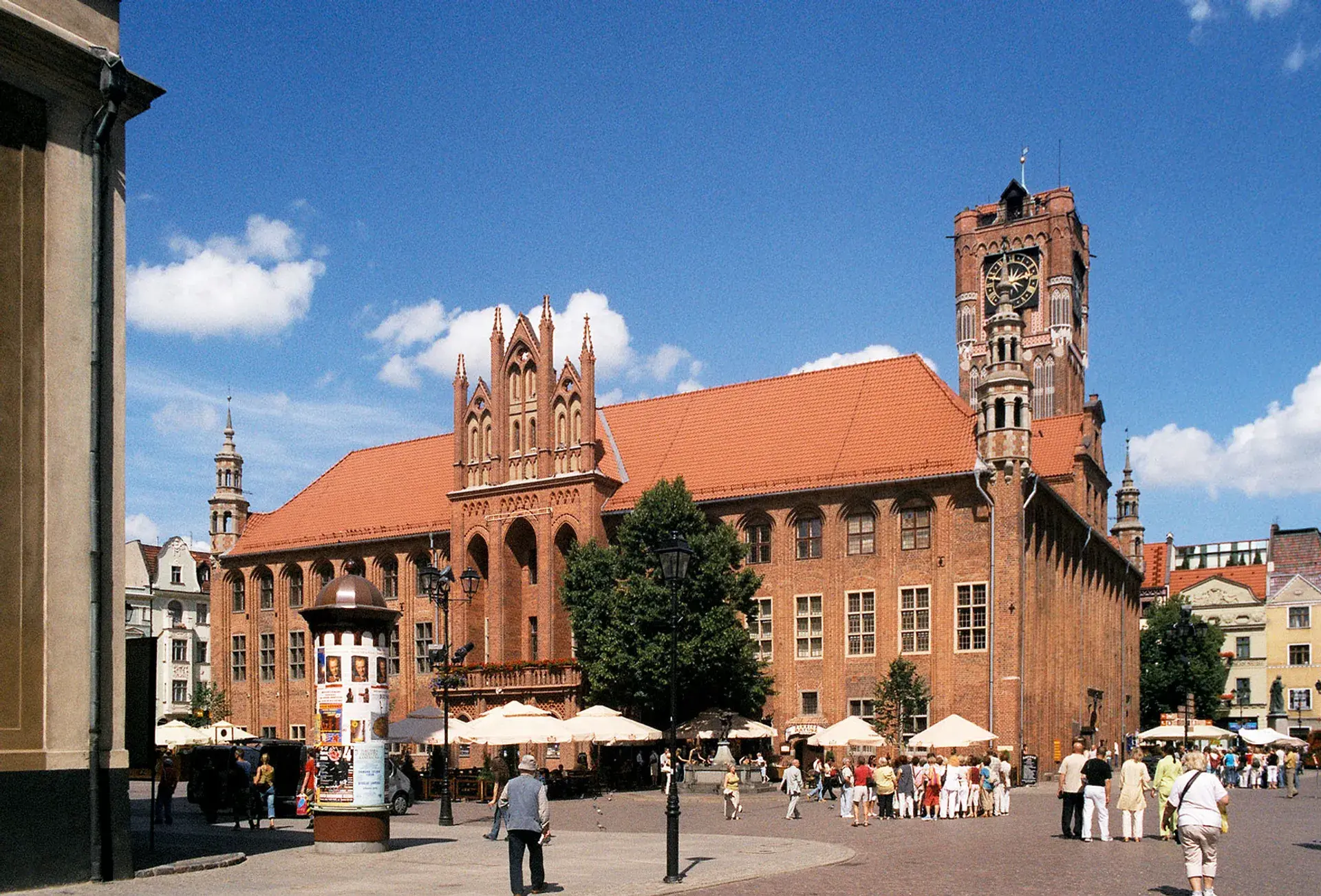
Toruń’s Old Town Hall was uniquely designed to bring the city's entire civic and commercial life together under one massive, monumental roof. Located in the center of the Old Market Square, the four-winged Gothic brick structure measures 44 by 52 meters and was added to the UNESCO World Heritage list in 1997.
A Gothic Civic Masterpiece
The complex evolved from separate 13th-century commercial structures, including a cloth hall and market stalls. Between 1391 and 1399, master builder Andrew consolidated these disparate buildings into a unified monumental Gothic quadrangle. The design drew heavily from Flemish civic architecture. In 1602 and 1603, Flemish architect Antoni van Obbergen expanded the hall, adding a third floor and striking Mannerist corner turrets while maintaining its overarching Gothic character.
During the Great Northern War in 1703, Swedish artillery bombardment sparked a fire that destroyed the building's high roofs, decorative gables, and the slender Gothic spire crowning the tower. The hall was later reconstructed with the squatter profile seen today. Heavy red Gothic brick walls stand in sharp contrast to the lighter sandstone corner turrets and decorative stone window dressings.
The Legend of the Architectural Calendar
Local tradition maintains that the Old Town Hall was intentionally designed as an immense architectural calendar. According to the legend, the single integrated tower represents the year. Four wide carriage gates that open into the cobblestone interior courtyard represent the four seasons. Inside, twelve large reception halls correspond to the months of the year, while 365 windows reflect the days.
The District Museum Collections
Today, the building serves as the headquarters of the District Museum in Toruń. The interior galleries display Gothic art, including 14th-century stained-glass panels, alongside regional archaeological finds and local guild handicrafts. The museum's Royal Hall features historical portraits of Polish monarchs, as well as an iconic anonymous portrait of Nicolaus Copernicus.
The chambers also hold a somber royal history; Polish King Jan I Olbracht died inside the town hall in 1501. His body was transported to Wawel Cathedral in Kraków, but his heart was buried locally in Toruń’s Cathedral of St. John the Baptist and St. John the Evangelist.
The Observation Tower and Market Square
The building's integrated square tower stands 40 meters tall and is open to the public as a viewing deck. From this elevated vantage point, visitors can observe the orthogonal grid of Toruń's medieval streets, a sea of clay-tile rooftops, the Vistula River, and the surrounding Old Market Square. Laid out in the mid-13th century, the square serves as the civic heart of the city, bordered by historical landmarks like the House Under the Star, the Artus Court, and the 1853 bronze Nicolaus Copernicus Monument.
FAQ
What is inside the Old Town Hall in Toruń?
The building houses the District Museum in Toruń. Its collections include a Gallery of Gothic Art, local guild handicrafts, an anonymous portrait of Nicolaus Copernicus, and the Royal Hall featuring historical portraits of Polish monarchs.
Can visitors climb the tower of the Old Town Hall?
Yes, the integrated 40-meter square tower is open to the public as a viewing deck, offering panoramic views of Toruń's medieval streets, the Vistula River, and the Old Market Square.
What is the calendar legend of the Old Town Hall?
According to local legend, the town hall was designed as an architectural calendar. The single tower represents the year, the four gates represent the seasons, the twelve halls represent the months, and the 365 windows represent the days.