Cathedral of St. Mary Magdalene in Wrocław
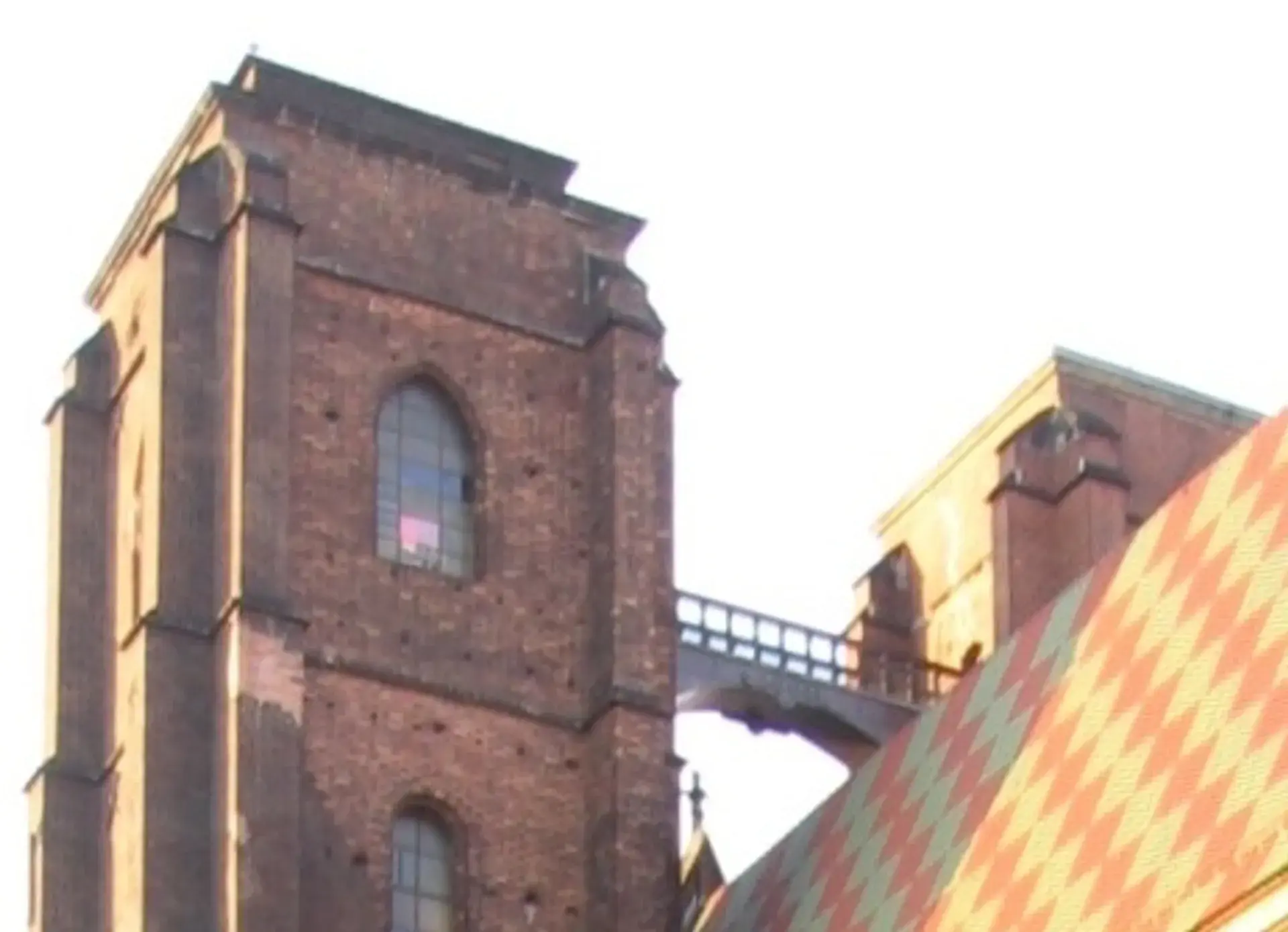
The Cathedral of St. Mary Magdalene is a fourteenth-century brick Gothic basilica in Wrocław, situated between Szewska and Łaciarska streets, just east of the Main Market Square. Located along the historical route connecting the central square to the eastern Dominican quarter, the basilica historically served alongside St. Elizabeth as one of the two grand civic parish churches that anchored medieval municipal life. Today, it remains celebrated for its soaring twin towers, an elevated connecting footbridge, and a rare Romanesque portal set directly into its Gothic facade.
Medieval Foundations and the Reformation
An early Romanesque predecessor stood on the site and was documented in 1226 when it received parish rights, but the Mongol raid of 1241 destroyed this original building. Following a major city fire in 1342, construction began on the present Gothic basilica. Master mason Peschke completed the high interior vaults around 1359–1360, and the twin towers reached completion in the late fifteenth century.
In the sixteenth century, the church became a landmark of the Protestant Reformation in Silesia. In October 1523, reformer Johann Heß preached the region's first Protestant sermon from St. Mary Magdalene, establishing the parish as a significant religious focal point for the changing civic landscape.
The Romanesque Ołbin Portal
The church's most notable architectural element is the Ołbin Portal, mounted into the exterior southern wall. Carved from pale sandstone in the late twelfth century, the portal offers a stark visual contrast against the surrounding dark red Gothic brickwork. Its recessed opening is framed by six sculpted columns on each side, decorated with plant and animal motifs, Old Testament depictions of the fall and expulsion from Eden, and New Testament archivolt carvings.
The portal is an example of architectural spolia. In 1529, Wrocław's municipal authorities dismantled the suburban Abbey of St. Vincent in the Ołbin district out of concern that advancing Ottoman troops might occupy and fortify the complex against the city. City leaders salvaged the Romanesque portal, preserved the stones for seventeen years, and incorporated the entrance into the basilica's southern wall in 1546.
The Penitent Bridge and Post-War Recovery
Suspended forty-five meters above the street between the twin towers is the Penitent Bridge, first documented in 1459. Historically, the elevated walkway was used as an open-air staging platform for brass orchestras and civic fireworks displays during municipal celebrations. Local folklore also associated the span with spirits, claiming that the ghosts of vain women who avoided marriage and labor were condemned to sweep the walkway endlessly with brooms.
In May 1945, an ammunition explosion damaged the south tower, destroyed the original footbridge, and caused Silesia's largest bell—the 1386 Sinner's Bell—to fall and fracture. A comprehensive rebuilding project lasted from 1947 to 1970, and the connecting bridge was reconstructed around the year 2000. Since May 1972, the building has served as the cathedral of the Polish Catholic Church, an Old Catholic denomination independent of Rome. The restored Penitent Bridge serves as an open public observation deck, reached via a 247-step staircase in the north tower.
FAQ
What is the Penitent Bridge?
The Penitent Bridge is a walkway suspended 45 meters above the ground between the twin towers of the cathedral. First recorded in 1459, it was reconstructed around the year 2000 and now operates as an open observation deck accessed by a 247-step climb inside the north tower.
Why does a Gothic church have a Romanesque doorway?
The 12th-century Ołbin Portal was salvaged from the Abbey of St. Vincent when the monastery was demolished in 1529 to keep invading Ottoman forces from using it as a defensive base. City officials preserved the portal and installed it into the southern wall of St. Mary Magdalene in 1546.
Which denomination uses the Cathedral of St. Mary Magdalene?
Since May 1972, the church has served as the cathedral for the Polish Catholic Church, an Old Catholic denomination independent of the Roman Catholic Church.