Wrocław Old Town Hall: History and Architecture
The Gothic Focal Point of Wrocław's Rynek
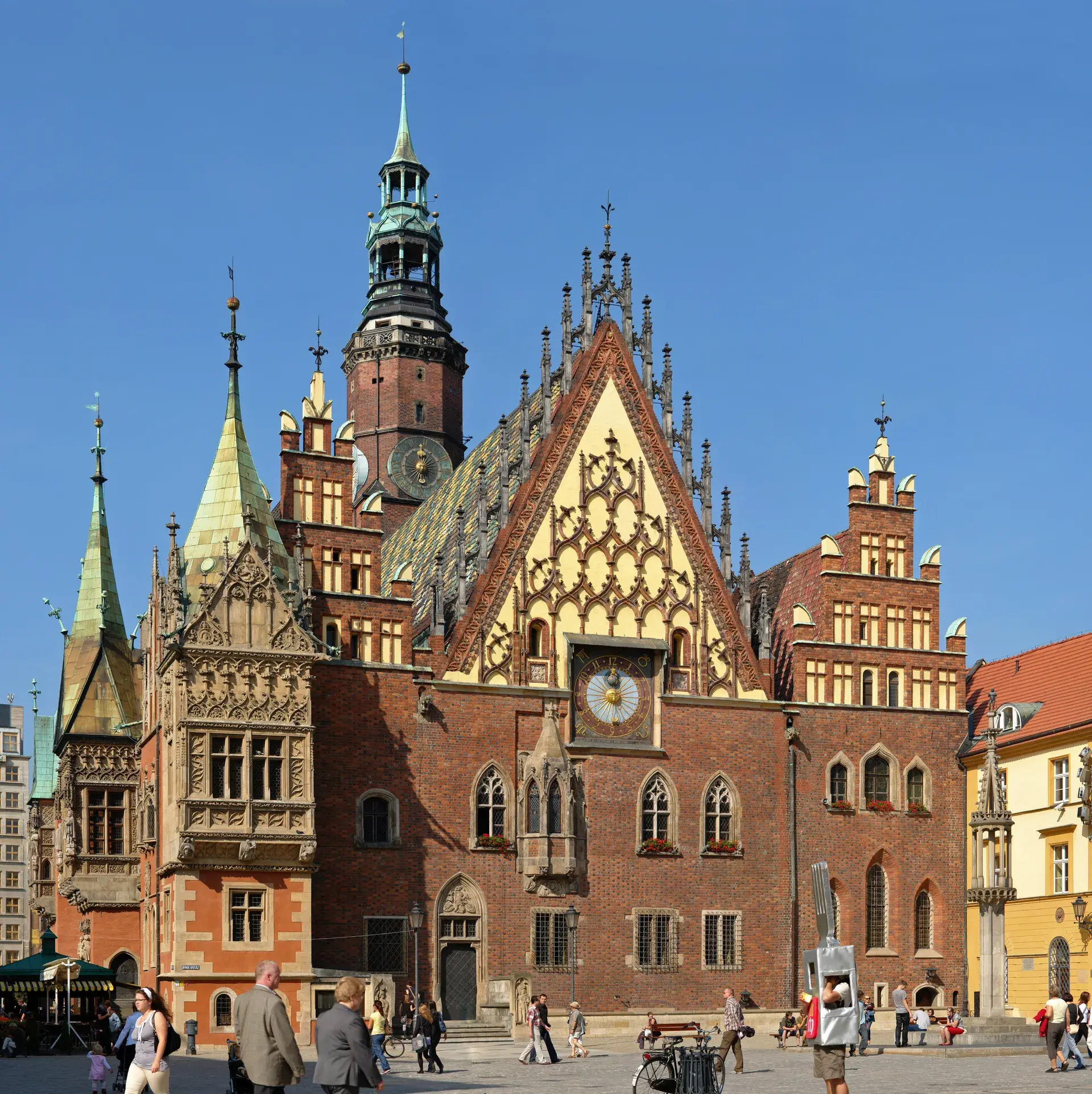
Standing centrally within Wrocław's Rynek—one of Europe's largest medieval market squares, established after the 13th-century Mongol invasions—the Old Town Hall (Stary Ratusz) is a striking example of secular bourgeois Gothic architecture. Constructed across roughly 250 years between the late 13th and mid-16th centuries, the building features an asymmetric layout enriched by early Renaissance decorative additions. It historically served as the administrative core of the city and remains the principal reference point linking Wrocław's commercial center to Ostrów Tumski and the historic university district.
Centuries of Civic Expansion
The complex originated between 1299 and 1301 as a single-storey merchant hall and consistory (Consistorium). As Wrocław's civic administration grew more independent, the building expanded vertically and horizontally across the 14th and 15th centuries with the addition of upper floors, the city council chamber, and the aldermen's court (Sala Wójtowska).
Major decorative work culminated during the mid-16th century under Bohemian and Habsburg rule, establishing the ornate stone gables, traceried windows, and bay elements seen today. In the 19th century, municipal bureaucracy outgrew the medieval interiors, leading to the construction of the adjacent New Town Hall (Nowy Ratusz) in the 1860s. While widespread devastation leveled central Wrocław during the 1945 Siege of Breslau, the Old Town Hall survived relatively intact. Post-war preservation stabilized the structure and replaced its damaged timber roof supports with steel.
Distinctive Exterior Features
The exterior presents a complex architectural collage. The eastern façade exhibits a distinct asymmetry, transitioning abruptly from the plain brickwork of the older early-Gothic northern section to intricate stone filigree and Renaissance detailing on the south. Embedded in this eastern gable is an astronomical clock installed in 1580, whose dark larch-wood dial and gilded indicators contrast against the weathered sandstone and red brick masonry.
The town hall's main tower rises to 66 metres and houses a civic clock bell cast in 1368, recognized as one of the oldest operating municipal bells in Poland. Paved directly outside the eastern façade stands the Pillory (Pręgierz), a 1985 sandstone reconstruction of the original 1492 executioner's post topped by a carved figure, historically used for judicial punishment and public shaming.
Burgher Caricatures and Piwnica Świdnicka
Beneath the building lie the vaulted brick cellars of Piwnica Świdnicka. Documented as an operating tavern since 1273, it is one of the oldest functioning dining and drinking establishments in Europe.
Above the southern portal leading down to the cellar, stone carvers added humorous 15th-century vignettes of burgher tavern life. These carved scenes depict the consequences of excess, including a tipsy tradesman staggering home, an angry wife brandishing a wooden clog, and an intoxicated woman being wheeled in a barrow.
Interior Halls and Modern Use
Today, the Old Town Hall operates as the Museum of Bourgeois Art (Muzeum Sztuki Mieszczańskiej), a primary division of the City Museum of Wrocław. The permanent collection displays historical municipal silverware, guild crafts, council chambers, and the Gallery of Famous Wrocław Citizens.
On the upper floor, the Great Hall (Wielka Sala) spans over 650 square metres. Defined by late-Gothic ribbed vaults, decorative keystones, and medieval stone portals, this vast civic chamber regularly hosts official city receptions, award ceremonies, and classical music concerts. Below ground, Piwnica Świdnicka continues its centuries-old tradition as a restaurant and cellar brewery.
FAQ
What is the historical significance of the Old Town Hall's tower bell?
Housed in the 66-metre tower, the Old Town Hall's clock bell was cast in 1368 and is one of the oldest operational civic bells in Poland.
What is Piwnica Świdnicka?
Piwnica Świdnicka is a historic tavern and brewery situated in the vaulted cellars beneath the Old Town Hall, documented as operating since 1273.
How is the Old Town Hall used today?
The building houses the Museum of Bourgeois Art, showcasing municipal silverware and guild artifacts. The Great Hall hosts civic receptions and concerts, while the cellar functions as a restaurant.