Alexander Fredro Monument in Wrocław: History & Guide
An Emblem of Post-War Wrocław
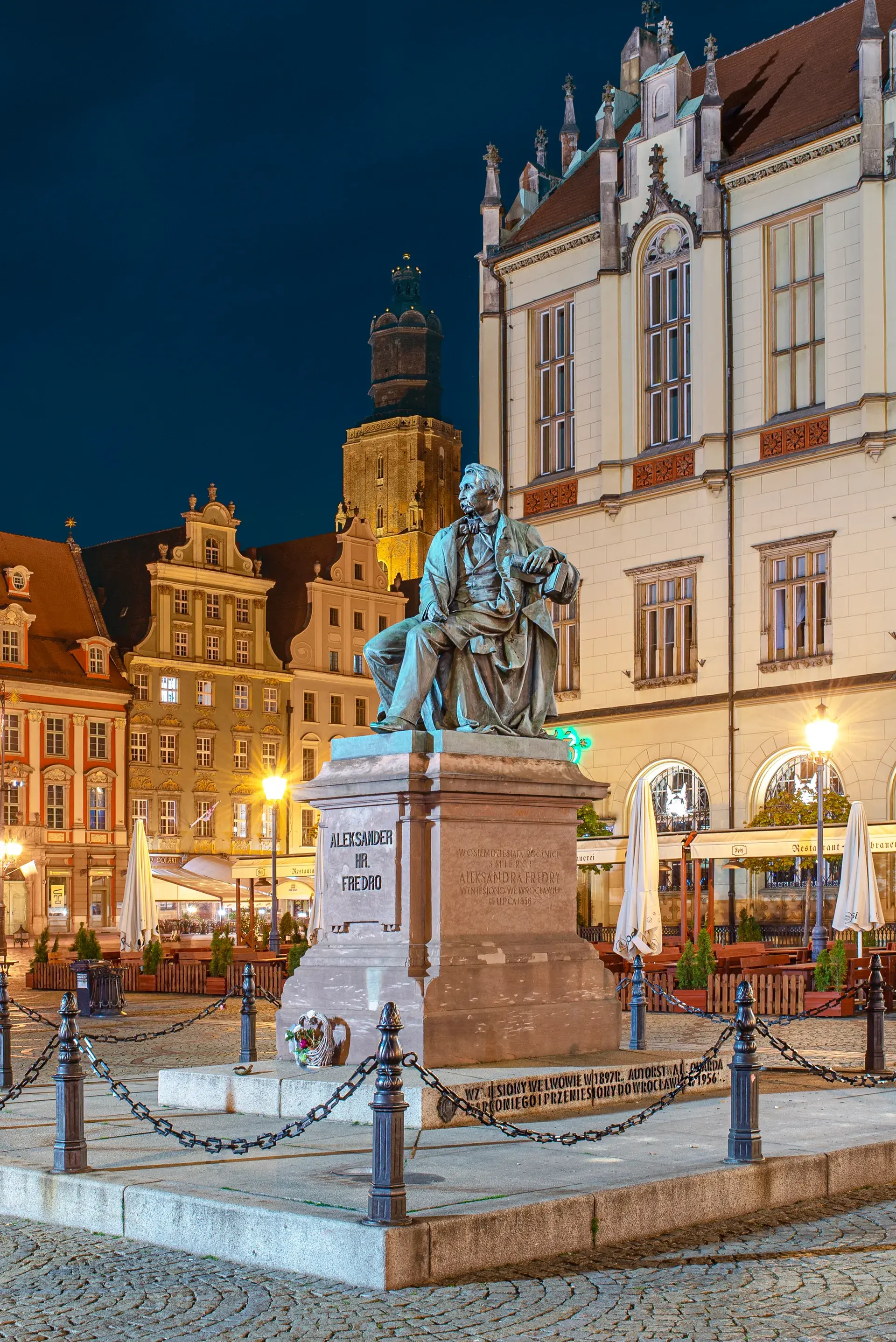
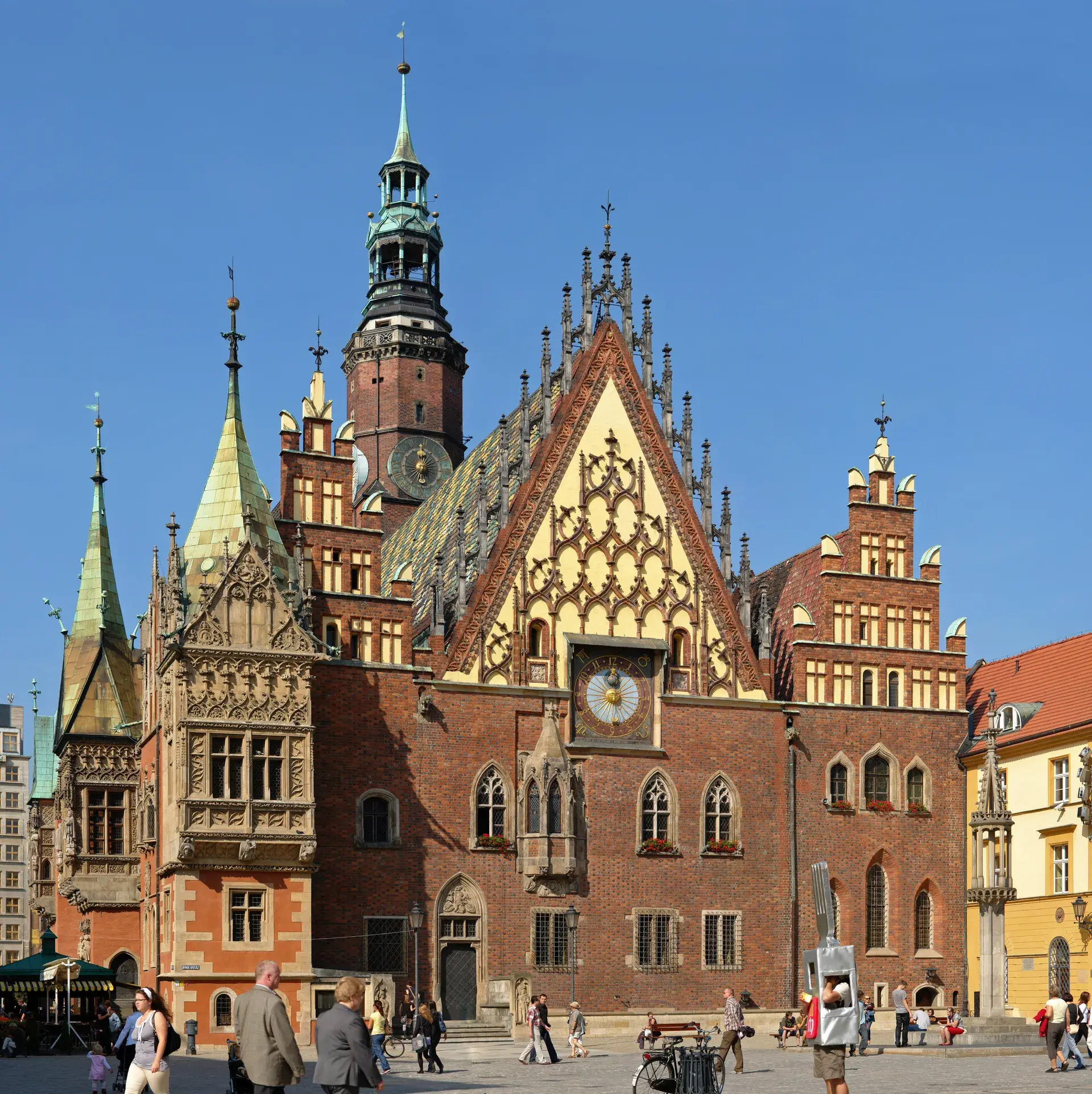
Standing on the southern side of the Main Market Square (Rynek) directly in front of the Old Town Hall (Stary Ratusz), the Monument of Alexander Fredro is one of the most recognizable landmarks in Wrocław. While today it serves as a central meeting point and a backdrop for public events, the bronze sculpture carries a complex history tied to post-World War II European border revisions and population shifts.
The statue honors Count Aleksander Fredro (1793–1876), a renowned Polish Romantic-era comedic playwright and poet. Seated in an armchair atop a pale sandstone pedestal, the bronze figure wears a traditional Polish nobleman's coat (czamara) while holding a rolled sheet of parchment and a quill. The dark, weathered patina of the sculpture contrasts directly with the colorful, ornate late-Gothic facades of the town hall behind it.
The Journey from Lwów to Wrocław
Designed by sculptor Leonard Marconi and commissioned by the Lwów Artistic and Literary Society, the monument was originally unveiled on October 24, 1897, in Plac Akademicki in Lwów (now Lviv, Ukraine). For decades, it stood as a prominent cultural anchor in Galicia, celebrating the writer's deep civic and creative ties to the region.
Following World War II and the border shifts dictated by the Yalta agreements, Lwów became part of the Soviet Union. Under a 1945 bilateral repatriation agreement, several Polish national monuments were relocated westward. Along with statues of King Jan III Sobieski (sent to Gdańsk) and Kornel Ujejski (sent to Szczecin), Fredro's monument was transferred to Poland in 1950 and temporarily stored in the park of Wilanów Palace outside Warsaw.
The statue's final destination in Wrocław held deep symbolic value. After the war, a large proportion of the city's new Polish population consisted of displaced academics, artists, and citizens from Lwów. Erecting the Fredro monument in the heart of Wrocław on July 15, 1956, provided a tangible link of cultural continuity for the transplanted community. It was placed precisely where a monumental bronze equestrian statue of Prussian King Frederick William III had stood until its destruction in 1945.
Historical Details and Local Traditions
The base of the monument retains an authentic historical trace on its rear side: the original 1897 Galician inscription, "Staraniem Koła Literacko-Artystycznego we Lwowie 1897" ("Through the efforts of the Literary and Artistic Society in Lwów 1897").
Over the decades, the monument has also integrated into modern civic traditions. Every January, graduating high school seniors (maturzyści) assemble in front of Fredro to dance the Polonaise. According to regional student lore, performing the dance before the playwright ensures good fortune and a "light pen" (lekkie pióro) during the upcoming maturity exams. The statue also gave its name to Wrocław's "Fredruś" open-top cultural tour bus.
One persistent feature of the statue's modern life is the theft of Fredro's writing utensil. The quill pen is frequently stolen or broken off by vandals, requiring the municipal road and maintenance authority (ZDiUM) to maintain a regular inventory of lightweight composite replicas to replace the missing accessory.
FAQ
Where was the Alexander Fredro Monument originally located?
The monument was originally unveiled in 1897 on Plac Akademicki in Lwów (modern-day Lviv, Ukraine) before being transferred to Poland after World War II.
What stood on this spot in Wrocław before the Fredro Monument?
Prior to 1945, the site was occupied by a large equestrian statue of Prussian King Frederick William III, which was dismantled and destroyed at the end of the war.
Why is the quill on the monument frequently replaced?
The quill in the playwright's hand is a repeated target of vandalism and theft, requiring the city's municipal road and maintenance authority (ZDiUM) to keep lightweight replacement replicas in stock.
What tradition do students celebrate at the monument?
Every January, graduating high school seniors gather before the statue to dance the traditional Polonaise, a ritual meant to bring luck and a 'light pen' for their upcoming final exams.