Jaś and Małgosia: Wrocław's Medieval Houses
The Medieval Houses of Market Square
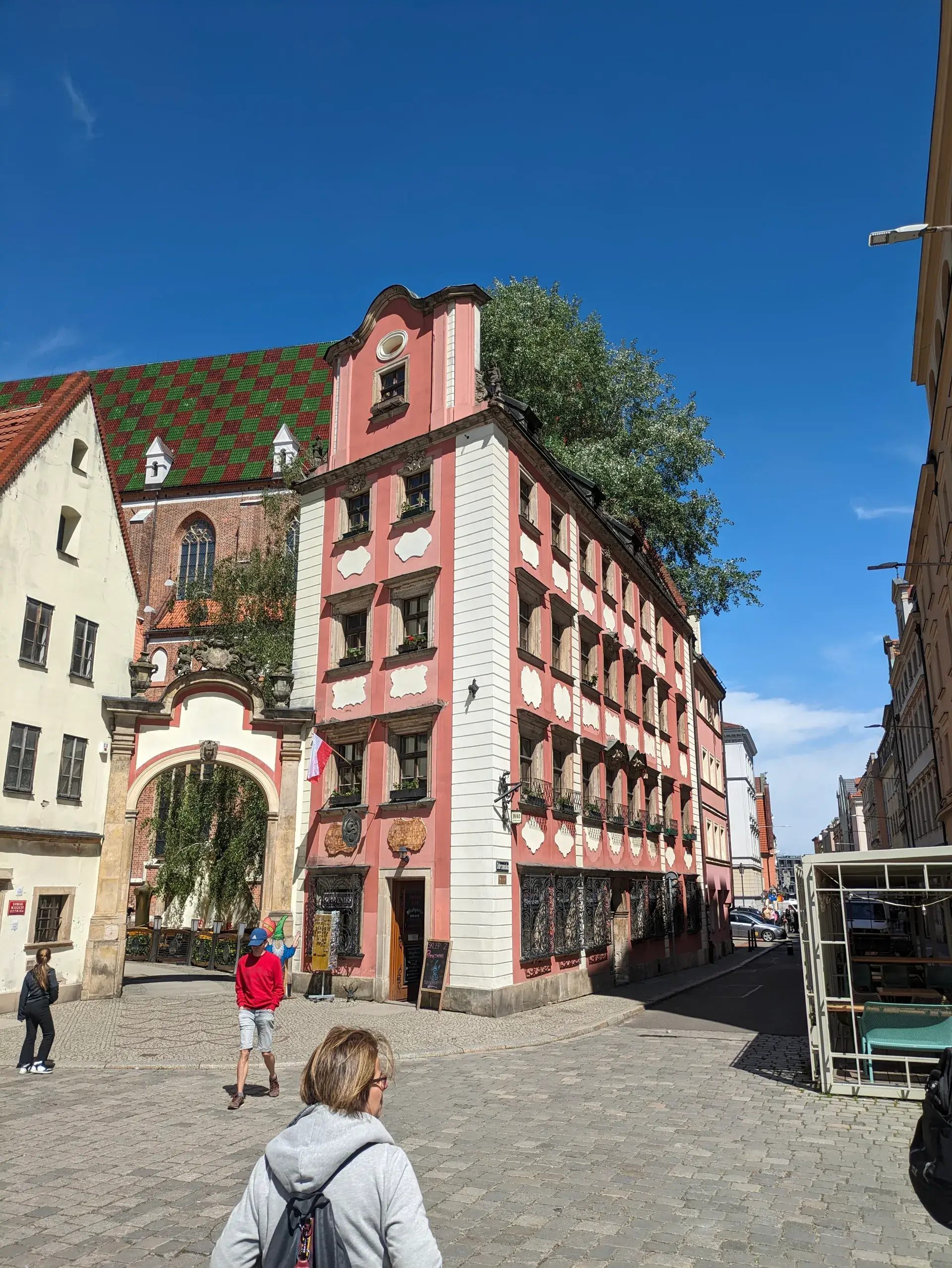
Standing at the northwestern corner of Wrocław's Market Square (Rynek), the two conjoined medieval tenements known as Kamieniczki "Jaś i Małgosia" mark the historical boundary between the city's civic marketplace and the Gothic church precinct. Located at the intersection of ul. św. Mikołaja and ul. Odrzańska, the pair consists of two structures of contrasting scales. The smaller residence is Jaś (ul. św. Mikołaja 1), while the larger, three-storey building is Małgosia (ul. Odrzańska 39/40).
Connecting the two structures is a stone Baroque archway redesigned in 1728 by Silesian architect Christoph Hackner. At the center of the span sits a Latin cartouche inscribed with the phrase Mors Ianua Vitae ("Death is the gate of life"). Passing beneath this portal marks a distinct spatial transition, as the open ambient noise of the cobblestone Market Square recedes into the quiet shade beside the soaring brick walls of St. Elizabeth's Basilica.
From Altarist Residences to Fairy-Tale Namesakes
Constructed during the 15th century, the buildings originally served as domy altarystów (altarist houses). They accommodated Catholic clergymen charged with tending the altars inside the adjacent St. Elizabeth's Church. During this era, the connecting archway served as the formal gateway to the parish cemetery that enclosed the basilica. This cemetery remained active until 1772, when it was closed and cleared under Prussian sanitary regulations.
Despite their solemn origins, the buildings gained a whimsical identity following World War II. Incoming Polish residents likened the unequal, linked houses to the folk-tale siblings Hansel and Gretel holding hands across the street, giving rise to the popular monikers Jaś and Małgosia.
Cultural Heritage and Present Use
Today, both buildings remain active cultural anchors in Wrocław's Old Town. Małgosia serves as the headquarters of the Society of Friends of Wrocław (Towarzystwo Miłośników Wrocławia) and houses commercial food and drink establishments.
Jaś functions as the Domek Miedziorytnika (Copperplate Engraver's House). It preserves the former living quarters and workshop of the renowned graphic artist and sculptor Eugeniusz Get-Stankiewicz. Inside, the space maintains printing presses, original engraving plates, and collections of graphic art.
Art, Spolia, and Street Curiosities
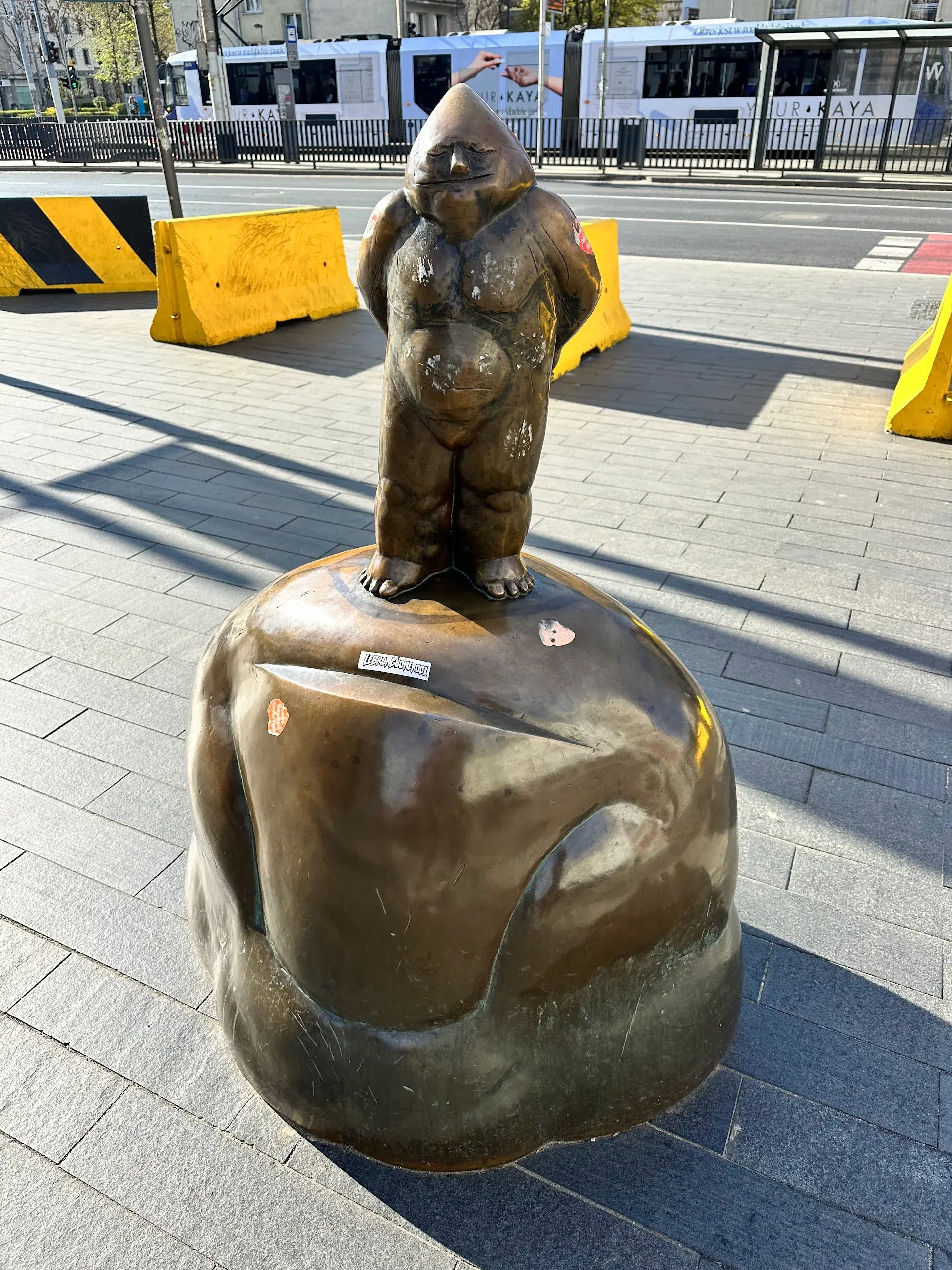
The exterior walls of both houses feature several notable details. Embedded into a corner of Małgosia is an architectural spolio: a preserved carved fragment of an ancient Romanesque column. Around the bases of the buildings, visitors can spot several of the city's bronze dwarf sculptures, including Wroclovek and Śpioch (the Sleeper).
The facade of Jaś features irregular patches of paint applied by Get-Stankiewicz, often viewed either as a satirical commentary on unrenovated buildings or as visual markers of the artist's shifting moods. Mounted directly onto an exterior wall of Jaś is another of Get-Stankiewicz's well-known works: an installation titled Zrób to sam ("Do It Yourself"). Displaying a cross, a figure of Christ, a hammer, and nails, the piece forms a subversive commentary referencing Adam Słodowy's popular 1970s DIY television broadcast from the communist era.
FAQ
Why are the houses named Jaś and Małgosia?
After World War II, new Polish settlers noted that the two uneven buildings linked by an arch resembled Hansel and Gretel (Jaś and Małgosia) holding hands.
What is the meaning of the inscription on the arch?
The Baroque archway bears the Latin inscription 'Mors Ianua Vitae' ('Death is the gate of life'), which dates back to its historical role as the entrance to the former parish cemetery of St. Elizabeth's Church.
What is inside the Jaś and Małgosia houses today?
Małgosia houses the Society of Friends of Wrocław along with dining venues, while Jaś is preserved as the Domek Miedziorytnika, displaying the former studio, presses, and works of artist Eugeniusz Get-Stankiewicz.