Museum of the University of Wrocław: Baroque Landmark
The Grand Baroque Edifice on the Oder
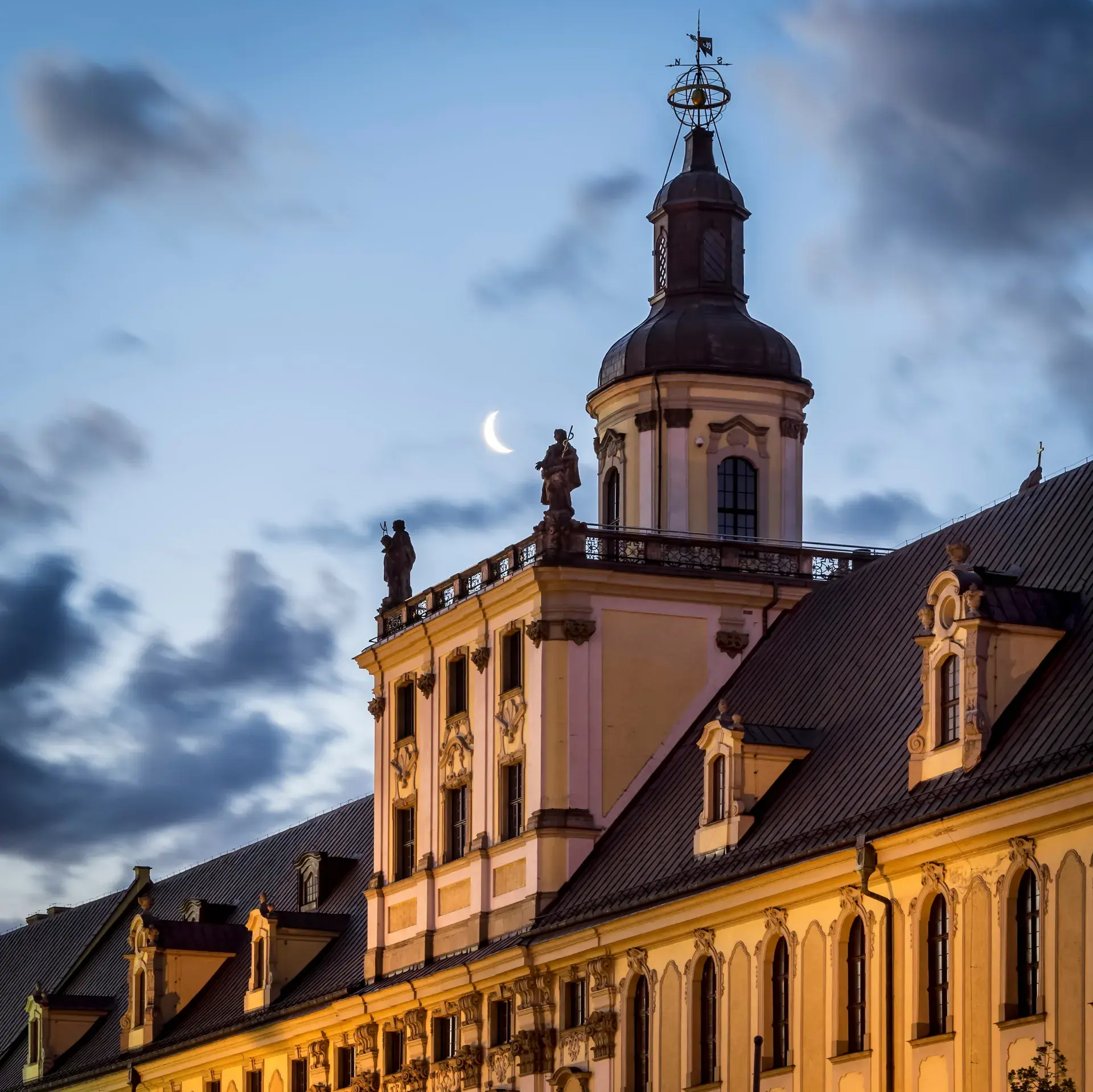
The Main Building of the University of Wrocław (Gmach Główny Uniwersytetu Wrocławskiego) stands on Plac Uniwersytecki along the southern embankment of the Oder River. Serving as the primary architectural face of the city's riverfront, the monumental complex anchors the northern edge of Wrocław's historic Old Town, situated midway on the walking route connecting the central Market Square (Rynek) to the bridges leading toward Ostrów Tumski. Today, the complex operates as the administrative headquarters and official seat of the university rector while housing the University of Wrocław Museum (Muzeum Uniwersytetu Wrocławskiego).
Habsburg Origins and the Counter-Reformation
The institution traces its origin to October 1, 1702, when Holy Roman Emperor Leopold I issued the "Golden Bull" charter establishing a Jesuit academy known as the Leopoldina. Erected on the grounds of a ruined 13th-century imperial castle formerly belonging to the Silesian Piast dynasty, the academy was established under Habsburg rule as an instrument of the Counter-Reformation to educate Catholic elites in a predominantly Protestant Silesia. Between 1728 and 1739, the Baroque edifice rose according to designs by Jesuit architect Christoph Tausch, a pupil of Andrea Pozzo.
An Unfinished Vision and Wartime Disruptions
Christoph Tausch's original architectural plans called for a grand, symmetrical complex featuring three towers and a matching western wing. However, construction came to an abrupt and permanent halt in 1740 with the outbreak of the Silesian Wars, leaving the complex frozen at roughly half its intended scale and with only the Mathematical Tower built. During the Silesian and Seven Years' Wars, Prussian troops requisitioned unfinished areas of the building for military use, converting them into a hospital, a depot for food stores, and a prison.
Secularization and Postwar Reconstitution
Following Prussian secularization reforms in 1811, the academy merged with the Viadrina University of Frankfurt an der Oder to create a royal state university. The institution later developed deep academic traditions associated with nine Nobel Prize laureates, including Theodor Mommsen, Philipp Lenard, Eduard Buchner, and Paul Ehrlich. In 1945, following the siege of Breslau and postwar territorial realignment, German institutional history concluded. The university was re-established as a Polish institution by displaced scholars and faculty from the University of Jan Kazimierz in Lwów.
Aula Leopoldina and Oratorium Marianum
The interior houses two of the region's most noted historic assembly halls. The Aula Leopoldina is recognized as one of Poland's most significant surviving secular late-Baroque interiors. Designed with vault frescoes by Johann Christoph Handke, sculptures by Franz Joseph Mangoldt, and stucco work by Ignazio Provisore, the hall utilizes quadratura—an illusionistic painting technique where painted columns and arches blend with architecture to create the illusion of extending into the heavens. After a multi-stage restoration completed in March 2022, the hall remains reserved for official university ceremonies, matriculations, and academic symposia. Nearby, the Oratorium Marianum, a former chapel, functions as an active classical concert hall prized for its acoustics.
The Mathematical Tower and Plac Uniwersytecki
Rising 42 meters, the Mathematical Tower originally operated as an astronomical observatory. From its open-air observation terrace, river winds and water sounds from the Oder accompany panoramic sightlines across the river islands toward the cathedral spires on Ostrów Tumski. In 1791, Jesuit astronomer Longinus Anton Jungnitz installed an astronomical meridian line on the tower floor to measure solar noon, a feature often mistakenly conflated in local lore with the 17th terrestrial meridian. Outside on Plac Uniwersytecki stands Hugo Lederer's 1904 bronze Fencer Fountain (Fontanna Szermierza). Depicting a naked swordsman, campus lore portrays the statue as a cautionary tale of a student who gambled away his clothing and possessions during a drinking duel, saving only his blade. Due to frequent student pranks and thefts, the original weapon is stored safely inside the university, while a detachable replica is mounted on the statue.
FAQ
Why was the University of Wrocław's main building never completed?
Architect Christoph Tausch designed a symmetrical Baroque layout featuring three towers and a matching western wing. However, construction ceased permanently when the Silesian Wars erupted in 1740, leaving only the eastern wing and the Mathematical Tower standing.
What is the historical significance of the Aula Leopoldina?
The Aula Leopoldina is a secular late-Baroque ceremonial hall featuring illusionistic quadratura frescoes by Johann Christoph Handke, sculptures by Franz Joseph Mangoldt, and stucco by Ignazio Provisore. Following a restoration finished in March 2022, it hosts university ceremonies and symposia.
What is the meridian line inside the Mathematical Tower?
Marked on the floor in 1791 by Jesuit astronomer Longinus Anton Jungnitz, the line is an astronomical meridian designed to measure solar noon. Local folklore often incorrectly identifies it as the 17th terrestrial meridian.
Why does the Fencer Fountain statue have a detachable sword?
The bronze statue on Plac Uniwersytecki, sculpted in 1904 by Hugo Lederer, was a frequent target of student pranks and thefts. To prevent permanent loss, the original sword was moved inside the university, and a detachable replica is placed on the sculpture.