Church of Our Lady on the Sand: Wrocław’s Gothic Gem
An Iconic Brick Sanctuary on Sand Island
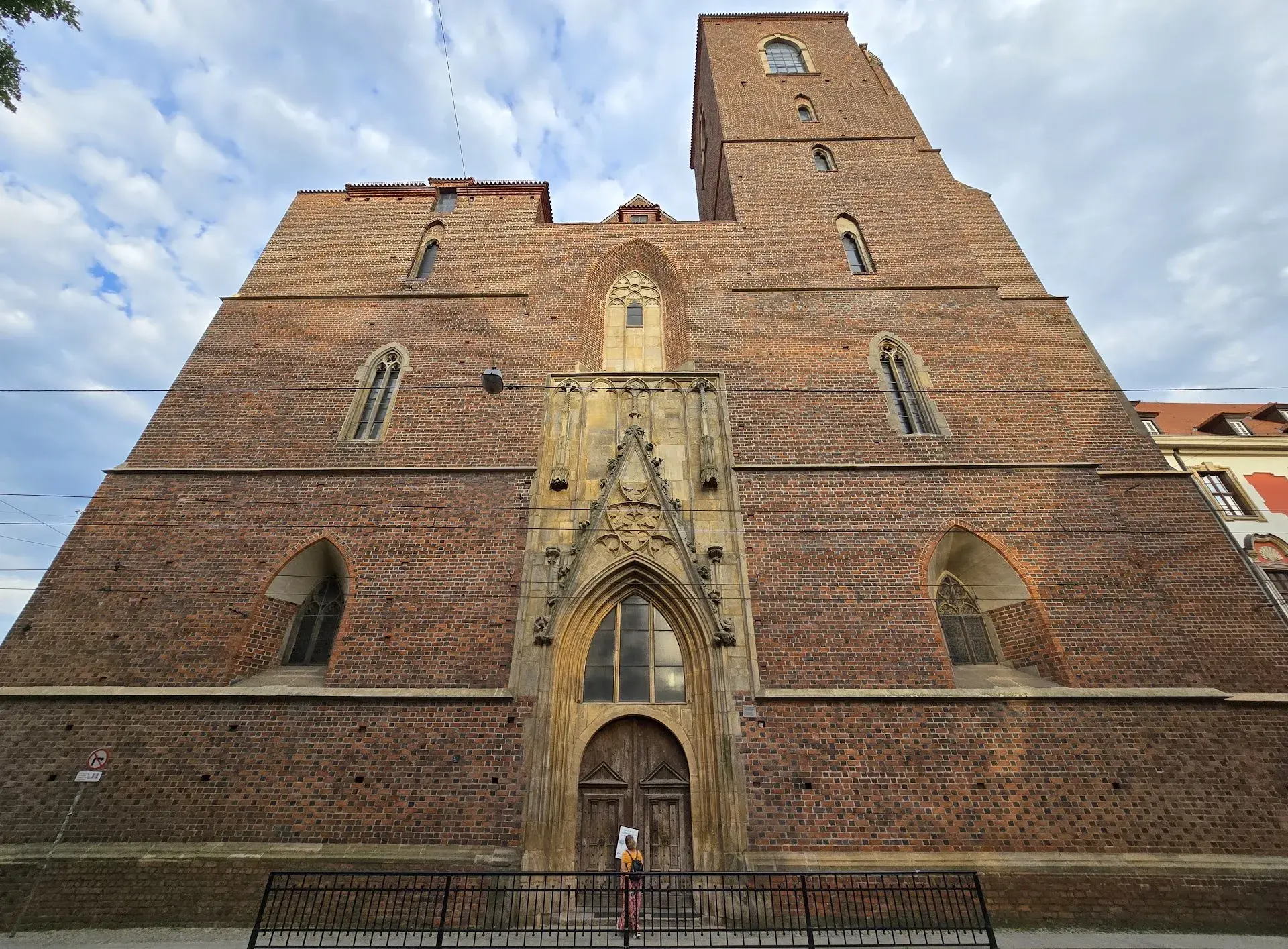
The Church of Our Lady on the Sand (Kościół Najświętszej Maryi Panny na Piasku) stands on Sand Island (Wyspa Piasek) along the Oder River in Wrocław. Functioning as a key historic anchor connecting the Old Town (Stare Miasto) to Cathedral Island (Ostrów Tumski), the monumental brick edifice sits directly at the approach to the historic iron Tumski Bridge.
The island and the church trace their unique names to a literal translation. The original Latin dedication was Sancta Maria in Arena, named after an ancient church situated on the site of a Roman arena in Padua, Italy. Translating arena directly into Polish and German as "sand" (piasek) ultimately established the name for both the sanctuary and the river island surrounding it.
Architectural Evolution and History
The origins of the site date to the first half of the 12th century, when Count Palatine Piotr Włostowic, his wife Maria, and their son Świętosław established the initial foundation. Around 1150, regular Augustinian canons were relocated here from Mount Ślęża.
Between 1334 and roughly the 1430s, the early Romanesque structure was demolished to make way for a monumental, three-aisled brick Gothic hall church without an ambulatory. Master Pieszko (magister Pesco murator) served as the primary master builder behind the design. The church spans approximately 78 meters in length, 25 meters in width, and reaches an interior vault height of roughly 24 meters. Although two western towers were planned, only the southern tower was completed. In January 1730, a lightning strike ignited the southern tower's 35-meter Dutch-style spire and burned the roof timbers, leaving the tower truncated beneath the low emergency roof that remains in place today.
Wartime Destruction and Restoration
Following Prussian secularization in 1810, the former monastery complex was repurposed for state university library storage. During World War II, the site suffered catastrophic damage. In the 1945 Siege of Breslau, German fortress commander General Hermann Niehoff established his military headquarters within the complex. Ensuing artillery barrages and fires collapsed the church vaults, destroyed its historic interior furnishings, and incinerated an estimated half-million library books and manuscripts stored in the adjacent wing.
A comprehensive, phased reconstruction took place between 1946 and 1963, restoring the soaring brick hall church to its medieval structural lines while preserving surviving architectural elements.
Interior Highlights and Historic Relics
Inside the austere brick interior, daylight filters through extensive modern stained-glass panels created by Teresa Maria Reklewska, casting colored light across the nave. Among its surviving treasures is a 12th-century Romanesque foundation tympanum, mounted above the sacristy entrance in the southern aisle. This carved stone relief depicts foundress Maria Włostowicowa and her young son kneeling as they present an architectural scale model of the original Romanesque church to an enthroned Virgin Mary.
Additional interior fixtures include a late-Gothic baptismal font dating from around 1464–1472, alongside historic altarpieces rescued from damaged churches across Lower Silesia. The church also houses the 16th-century painting of Our Lady of Mariampol (Matka Boska Mariampolska), an icon brought to Wrocław in 1945 by displaced Polish expellees from Kresy and formally enthroned in the church in 1965.
The Moving Nativity and Modern Community Role
A distinctive feature of the church is its Moving Nativity Scene (Ruchoma Szopka), situated in a side chapel within the southern aisle. Built in 1967 by Father Kazimierz Błaszczyk, the kinetic display was designed to help deaf and hearing-impaired children experience the Christmas narrative through movement and visual cues. The installation features over 2,000 moving figures, dynamic model trains, windmills, and donated toys, including recognizable figures like Mickey Mouse and Donald Duck.
Today, the Church of Our Lady on the Sand operates as an active parish within the Archdiocese of Wrocław, hosting religious services, organ performances, and choral concerts. It serves as the institutional center for the pastoral care of deaf and blind communities (Duszpasterstwo Niesłyszących i Niewidomych), while its adjoining former monastic wing houses academic departments of the University of Wrocław.
FAQ
Why is the church named "on the Sand"?
Its formal Latin dedication was Sancta Maria in Arena, modeled after a church built on the site of a Roman arena in Padua. The literal translation of "arena" as "sand" (piasek) provided the name for both the church and the island.
What is the Moving Nativity Scene?
Created in 1967 by Father Kazimierz Błaszczyk for deaf children, the Ruchoma Szopka is a kinetic nativity display in the south aisle featuring over 2,000 moving components, mechanical trains, and donated toys.
What happened to the church during the Siege of Breslau in 1945?
German commander General Hermann Niehoff used the complex as his headquarters. Heavy artillery shelling and fires destroyed the interior vaults, historic furnishings, and approximately 500,000 library books and manuscripts before the church was rebuilt between 1946 and 1963.