Wrocław Cathedral: History, Spires & Ostrów Tumski
The Architectural Heart of Ostrów Tumski
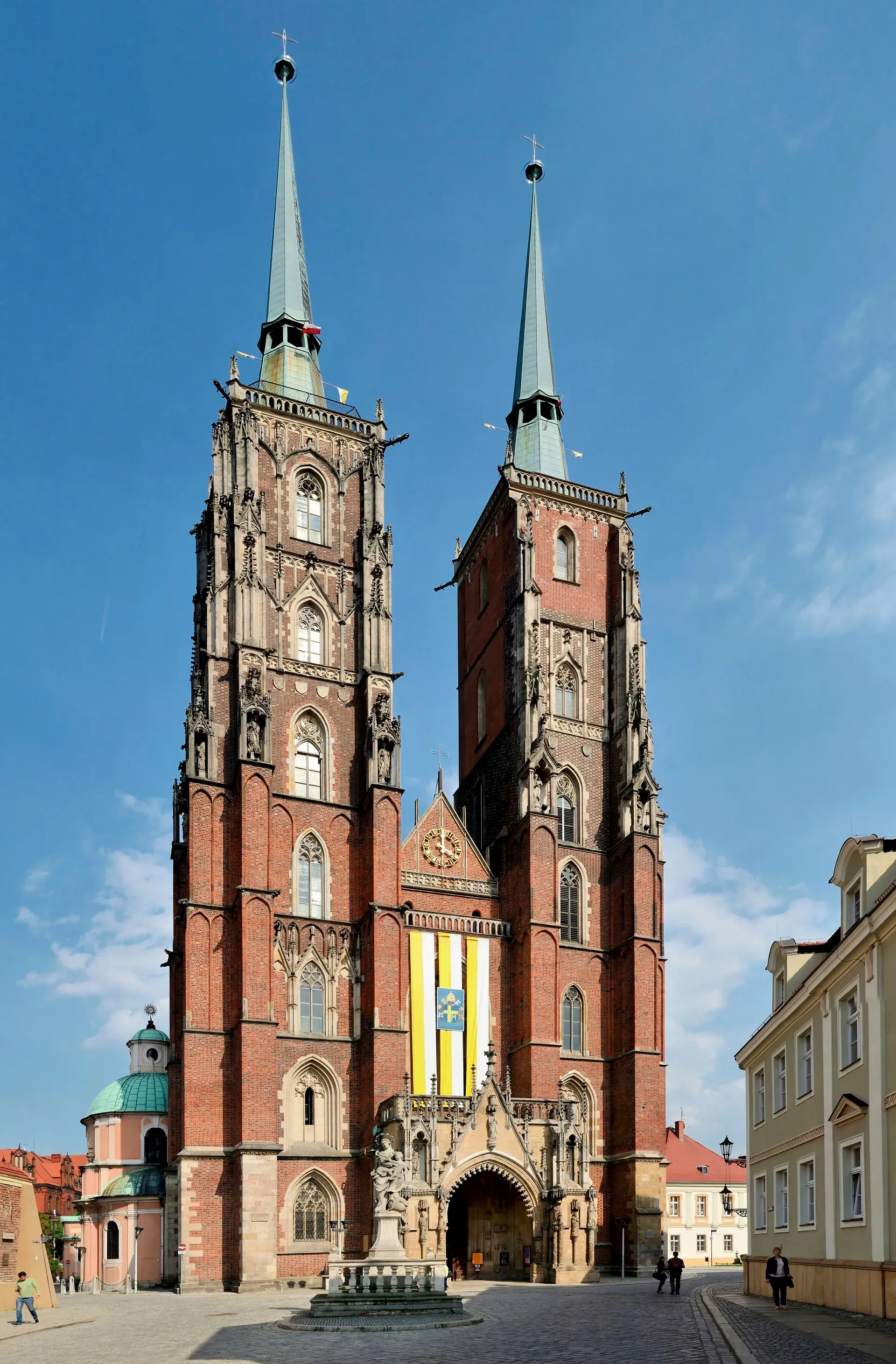
The Archcathedral Basilica of St. John the Baptist serves as the seat of the Roman Catholic Archdiocese of Wrocław and the mother church of Lower Silesia. Rising above Ostrów Tumski—the historical cradle and oldest settled quarter of the city—the cathedral stands in an area that existed as an island until the northern arm of the Odra River was filled in during the 19th century. Traffic-calmed cobblestone lanes surround the cathedral precinct, where municipal gas lanterns are still illuminated by hand each evening by a traditional lamplighter.
Constructed primarily of red brick, the three-nave Gothic basilica measures roughly 98 meters in length and 44.5 meters in width. Its western facade is dominated by twin towers that reach heights of approximately 97 to 98 meters. St. John the Baptist, the cathedral's patron, is also the patron saint of Wrocław, with his head depicted on a platter at the center of the city's official coat of arms.
A Millennium of Building and Renewal
The current basilica is the fourth church to stand on this site. Its origins date back to the establishment of the diocese of Wrocław in the year 1000, which spurred the construction of Pre-Romanesque and Romanesque predecessors in the 10th and 11th centuries. The Gothic structure began taking shape in the 13th and 14th centuries with the construction of the presbytery and nave, followed by the completion of the western towers in the 15th century. Later additions included grand Baroque chapels, such as the Chapel of St. Elizabeth and the Elector's Chapel, which were integrated into the ambulatory during the 17th and 18th centuries.
In 1945, during the Siege of Breslau at the close of World War II, catastrophic bombing destroyed approximately 70 percent of the cathedral. The vaults collapsed, the interior furnishings were devastated, and the roofs of the towers burned away. Although basic repairs between the late 1940s and 1951 allowed the basilica to reopen for worship, Wrocław's skyline remained incomplete for decades. It was not until 1991 that newly reconstructed Gothic-style tower helmets were hoisted into position, restoring the cathedral's signature twin-spired silhouette.
Sacred Art and Masonry Curiosities
Among the cathedral's artistic treasures is its Mannerist silver high altar, commissioned in 1591 by Bishop Andreas Jerin. In 1945, church authorities dismantled and concealed the altar to prevent its seizure by the Red Army. After remaining disassembled for decades, its surviving components underwent extensive conservation and were finally reinstalled in the presbytery in December 2019.
The exterior walls preserve unique fragments of regional history. Embedded in the southern exterior brickwork is a Hebrew gravestone (matzevah) dating to 1203, commemorating a cantor named David. Uncovered during building repairs in 1917, the stone represents the earliest material evidence of a Jewish community in Wrocław. Higher up on the south tower wall, a carved stone human head appears with an open mouth. While architectural historians classify the feature as medieval spolia incorporated into later repairs, local folklore claims the face belonged to a goldsmith's apprentice who was turned to stone while watching a fire he had ignited.
Visiting the Archcathedral
Wrocław Cathedral remains an active Catholic parish and the venue for major archdiocesan liturgies. The nave is open daily to worshippers and tourists without an entry fee. For visitors seeking elevated views, the northern tower features an observation platform accessible via an elevator and a short flight of stairs. From the viewing deck, visitors can observe the surrounding channels of the Odra River and the rooftops of Wrocław's Old Town. Separate admission tickets are required to access the tower observation deck and the historic chapels.
FAQ
Is admission to Wrocław Cathedral free?
Access to the main nave of the cathedral is free of charge for worshippers and visitors. Entry to the historic chapels and the tower observation deck requires a paid ticket.
How do visitors reach the viewing platform at Wrocław Cathedral?
The observation platform is located in the northern tower and is accessible by an elevator followed by a short flight of stairs, offering panoramic views over the Odra River and the Old Town.
What is the stone head on the exterior wall of the cathedral?
High on the south tower's exterior, a stone head with an open mouth is embedded in the masonry. Architectural historians identify it as medieval spolia reused during repairs, though local folklore associates it with an apprentice goldsmith turned to stone.
When were the cathedral spires restored after World War II?
Although the cathedral sustained heavy damage in 1945 and was reopened for services in 1951, its distinctive Gothic-style tower helmets were not rebuilt and installed until 1991.