Brama Lwowska in Zamość: History & Architecture
Renaissance Architecture and Design
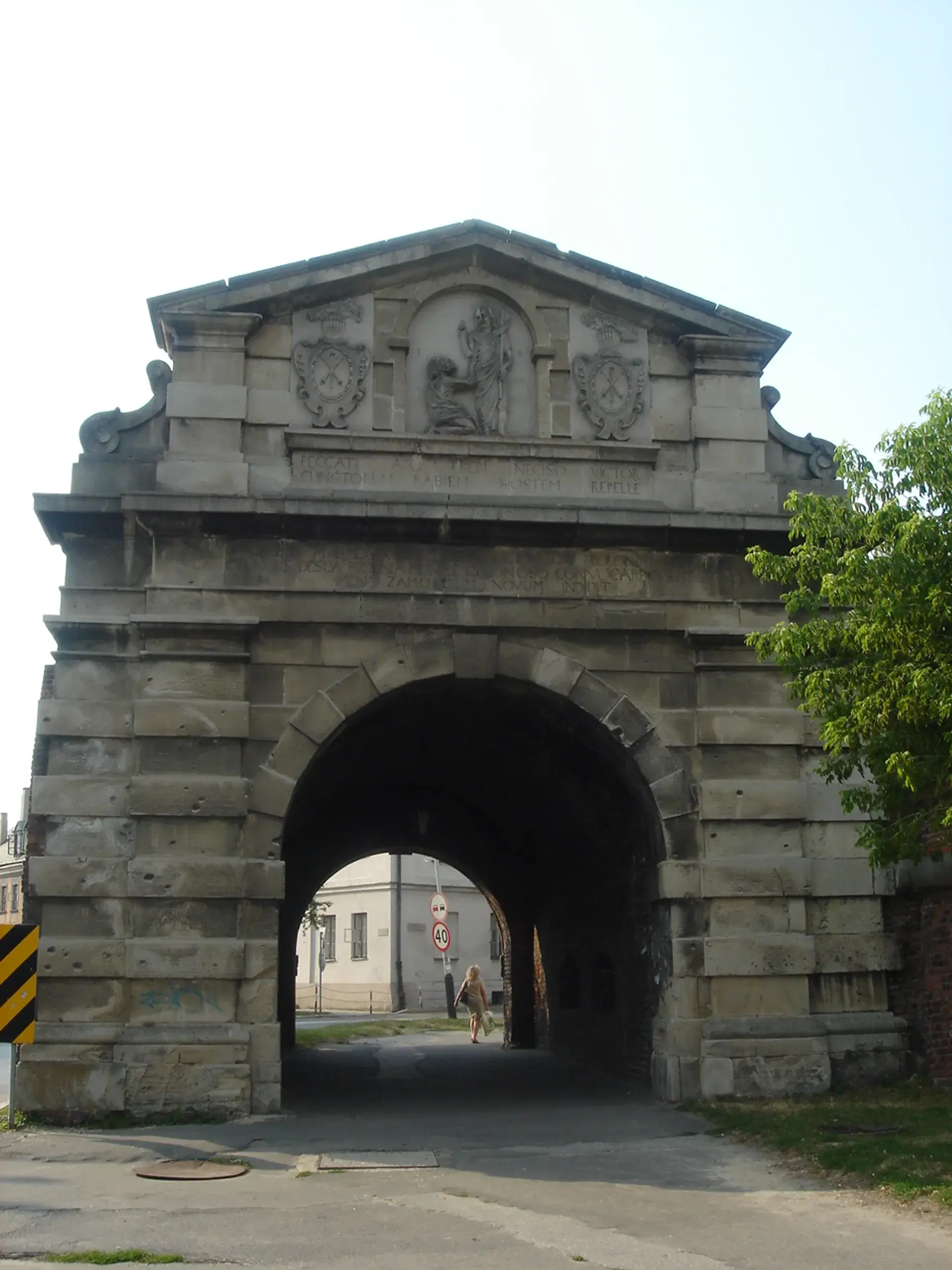
Designed by the Italian architect Bernardo Morando and constructed between 1598 and 1603, the Old Lviv Gate (Stara Brama Lwowska), historically known as the Tomaszów Gate, was one of three original monumental portals guarding Zamość. Facing east and southeast toward Tomaszów and Lviv, the portal anchors the eastern terminus of the city’s Renaissance street grid, balancing the Lublin Gate to the north and the Szczebrzeszyn Gate to the southwest.
Sixteenth-century construction plans initially envisioned a monumental triple-arched gate with dedicated side portals for pedestrians. Due to financial limits and practical defense considerations, Morando scaled the design down to a single passageway spanned by a barrel vault with lunettes. The structure reflects a Mannerist interpretation of a classical triumphal arch, heavily inspired by the architectural treatises of Sebastiano Serlio. Smooth Tuscan pilasters contrast with deeply grooved rustic stonework, while the interior passage walls contain diagonal loop holes engineered for musketry defense and observation from adjacent casemates.
The eastern pediment features a detailed sculpted relief by Jerzy Pałczyński depicting Saint Thomas the Apostle, the patron saint of both Zamość and town founder Jan Zamoyski, kneeling before the Risen Christ. Two cartouches bearing the Zamoyski family Jelita coat of arms flank the central carving. Latin inscriptions carved into the stone frame the relief, containing a spiritual plea to repel enemy assaults and an official dedication marking Jan Zamoyski's 1580 founding and fortification of New Zamość.
Military Encounters and Civic Governance
Built directly adjacent to Bastion VII—the largest surviving defensive bastion in the fortress—the gate served as a heavily guarded barrier on a vulnerable eastern route. Beyond its military utility, the passage functioned as a ceremonial gate and an administrative checkpoint where official decrees (uniwersały) from the town council and the Zamoyski estate were posted. Minor offenders were also subjected to public humiliation here; an iron convict's collar (kuna) was mounted on the exterior wall to expose lawbreakers to travelers arriving from eastern trade routes.
The gate played a direct role in regional military conflicts. In 1706, during the Great Northern War, invading Russian forces attempted to capture Zamość by breaching the Lviv Gate through trickery, but fortress defenders repulsed the assault. In 1772, Austrian forces marched through the portal during the First Partition of Poland, and Holy Roman Emperor Joseph II entered the city through its arch on two separate occasions.
From Imperial Prison to Architectural Restoration
Between 1818 and 1821, Russian imperial authorities undertook a sweeping modernization of Fortress Zamość. The surrounding road network was reconfigured, and the Old Lviv Gate was bricked shut, concealing its Renaissance facade. The vaulted passageway was divided into casemates and penal cells for a correctional military unit.
From October 1824 to November 1825, Polish patriotic conspirator Major Walerian Łukasiński was imprisoned within these casemates. The portal remained sealed for over a century until conservation architect Jan Zachwatowicz initiated excavation and preservation work between 1937 and 1939 to unblock the archway. Although World War II interrupted the project, comprehensive restoration in 1978 and 1979 reconstructed missing facade ornaments using historic drawings. Subsequent conservation between 2022 and 2024 stabilized the stone masonry, revitalized the green roof, and used non-invasive laser cleaning on Pałczyński’s pediment relief.
The Gateway Today and the New Lviv Gate
The Old Lviv Gate functions as an open pedestrian thoroughfare connecting the historic urban center and Bastion VII's elevated cavalier (nadszaniec) to the fortress moat and park system. Moving from the open air into the stone barrel-vaulted passage produces a sudden shift in acoustics and cooler, shaded air. Directly beside the portal, the former penal quarters are preserved as Łukasiński's Cell (Cela Łukasińskiego), an open arcade courtyard featuring a commemorative plaque depicting the chained officer.
Roughly 40 meters away across ulica Partyzantów stands the New Lviv Gate (Nowa Brama Lwowska). Erected in 1820 by military engineer Jan Paweł Lelewel to replace the walled-up original, the Classical structure still displays the imperial monogram of Tsar Alexander I under a radiating sunburst. Unlike its older Renaissance counterpart, the 19th-century gate was repurposed as Zamość's first municipal electrical plant in 1919, and since 1980 it has housed the concert hall of the Karol Namysłowski Symphony Orchestra.
FAQ
Who designed the Old Lviv Gate in Zamość?
The gate was designed by Italian architect Bernardo Morando and constructed between 1598 and 1603 under the patronage of Jan Zamoyski.
Why was the Old Lviv Gate walled shut in the 19th century?
During Russian imperial modernizations of Fortress Zamość between 1818 and 1821, road routes were shifted, causing the gate to be bricked up and converted into military prison casemates.
Who was imprisoned in the gate's casemates?
Polish independence conspirator Major Walerian Łukasiński was held in the converted casemates of the gate from October 1824 to November 1825.
What is the New Lviv Gate located nearby?
Built in 1820 to replace the walled-up Renaissance portal, the New Lviv Gate stands about 40 meters away and now serves as the concert hall for the Karol Namysłowski Symphony Orchestra.