Armenian Khachkar in Zamość: History and Symbolism
Commemorating Zamość’s Armenian Legacy
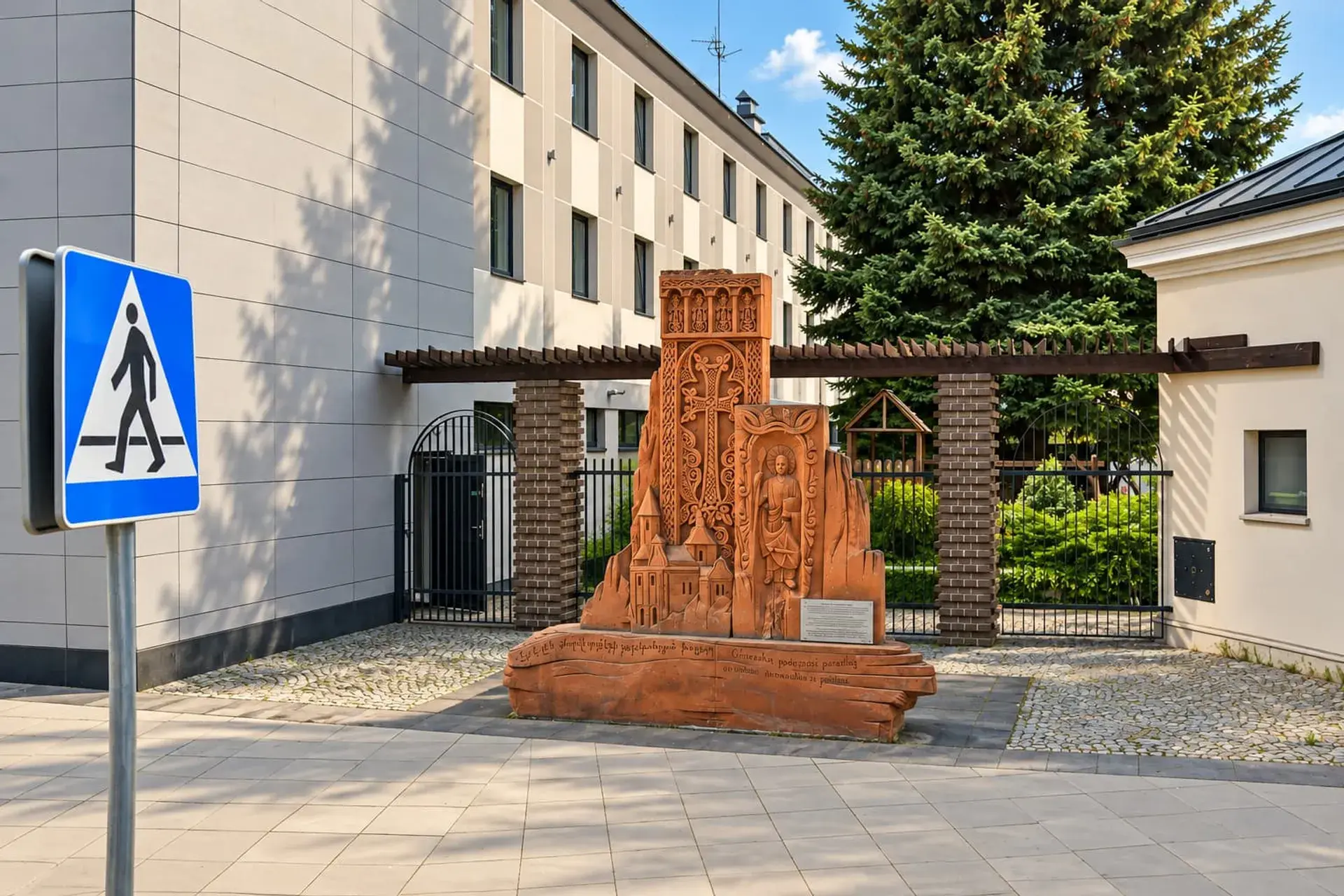
The Armenian Khachkar (pomnik ormiański) is a traditional carved stone cross monument situated on ulica Waleriana Łukasińskiego along the perimeter of the Old Town in Zamość. Unveiled and consecrated on September 16, 2018, the monument marks Polish-Armenian friendship and commemorates more than four centuries of Armenian heritage in the city. While the ornate, colorful Armenian Tenement Houses on the Great Market Square reflect the historic merchant wealth of the community, the khachkar provides a lasting spiritual and communal counterpart.
The Lost Church of the Assumption
The location of the khachkar holds significant historical weight. It stands directly over the footprint of the former Armenian Church of the Assumption of the Virgin Mary, which was originally established in the late 16th century alongside a parish cemetery and hospital.
Armenian integration in the city began when founder Jan Zamoyski granted settlement privileges on April 30, 1585. These privileges allowed the Armenian community internal legal self-governance, commercial rights, and freedom of worship. By 1678, Armenians made up approximately 15 percent of Zamość's population, working as artisans such as goldsmiths and leatherworkers and facilitating vital trade between the Polish-Lithuanian Commonwealth, Persia, and the Ottoman Empire.
The parish was dissolved under Austrian rule in 1786, leading to the auctioning of its church fittings and the demolition of the building in the 1820s. Its foundations remained hidden beneath the surface until 1968, when excavation work began for Hotel Renesans. Fifty years after that discovery, the khachkar was erected on the site to restore a physical marker of the lost church and cemetery.
Artistry and Civic Symbolism
Standing approximately 3.5 meters tall, the khachkar is sculpted from porous, matte pinkish-terracotta Armenian volcanic tuff. Its textured surface and warm color contrast against the surrounding green lawn and grey paving stones. The monument was carved in Yerevan by Armenian master stonemason Varazdat Hambardzumyan, featuring dense, lace-like shallow-relief carvings, including palmettes radiating from the base, interlaced geometric knots, and leaf motifs expanding from the arms of the central winged cross.
Departing from strict medieval Armenian traditions, the monument incorporates local civic iconography. It depicts Saint Thomas the Apostle holding a lance—the emblem featured on the Zamość coat of arms—alongside a sculptural bas-relief recreating the architectural form of the demolished 17th-century Armenian church. Inscriptions are carved in Polish, Armenian, and English.
Origins and Consecration
The creation of the memorial was initiated by former Armenian Ambassador to Poland Edgar Ghazaryan and financed by philanthropist Arsen Ovsepyan, president of the Polish-Armenian Foundation. After its completion in Armenia, the 3.5-meter stone monument was transported overland across Russia and Belarus to reach Zamość.
The monument was consecrated on a date coinciding with the Feast of the Exaltation of the Holy Cross and the centenaries of both Polish independence and the First Republic of Armenia. Attendees at the September 2018 dedication ceremony included Mirosław Hermaszewski, the first Polish cosmonaut. Today, the monument serves as a permanent open-air memorial highlighting the multi-confessional origins of Zamość.
FAQ
Where is the Armenian Khachkar located in Zamość?
The monument is located on ulica Waleriana Łukasińskiego near Hotel Renesans, directly on the site where the 16th-century Armenian Church of the Assumption of the Virgin Mary and its cemetery once stood.
What material is the monument made of?
It is carved from pinkish-terracotta volcanic tuff brought from Armenia and sculpted by master stonemason Varazdat Hambardzumyan in Yerevan.
What unique carvings appear on the Zamość khachkar?
Alongside traditional Armenian winged cross motifs and knotwork, it includes a carving of Saint Thomas the Apostle with a lance (from the Zamość coat of arms), a bas-relief of the demolished 17th-century Armenian church, and inscriptions in Polish, Armenian, and English.
Gallery