Castelo dos Mouros: Sintra's Historic Moorish Castle
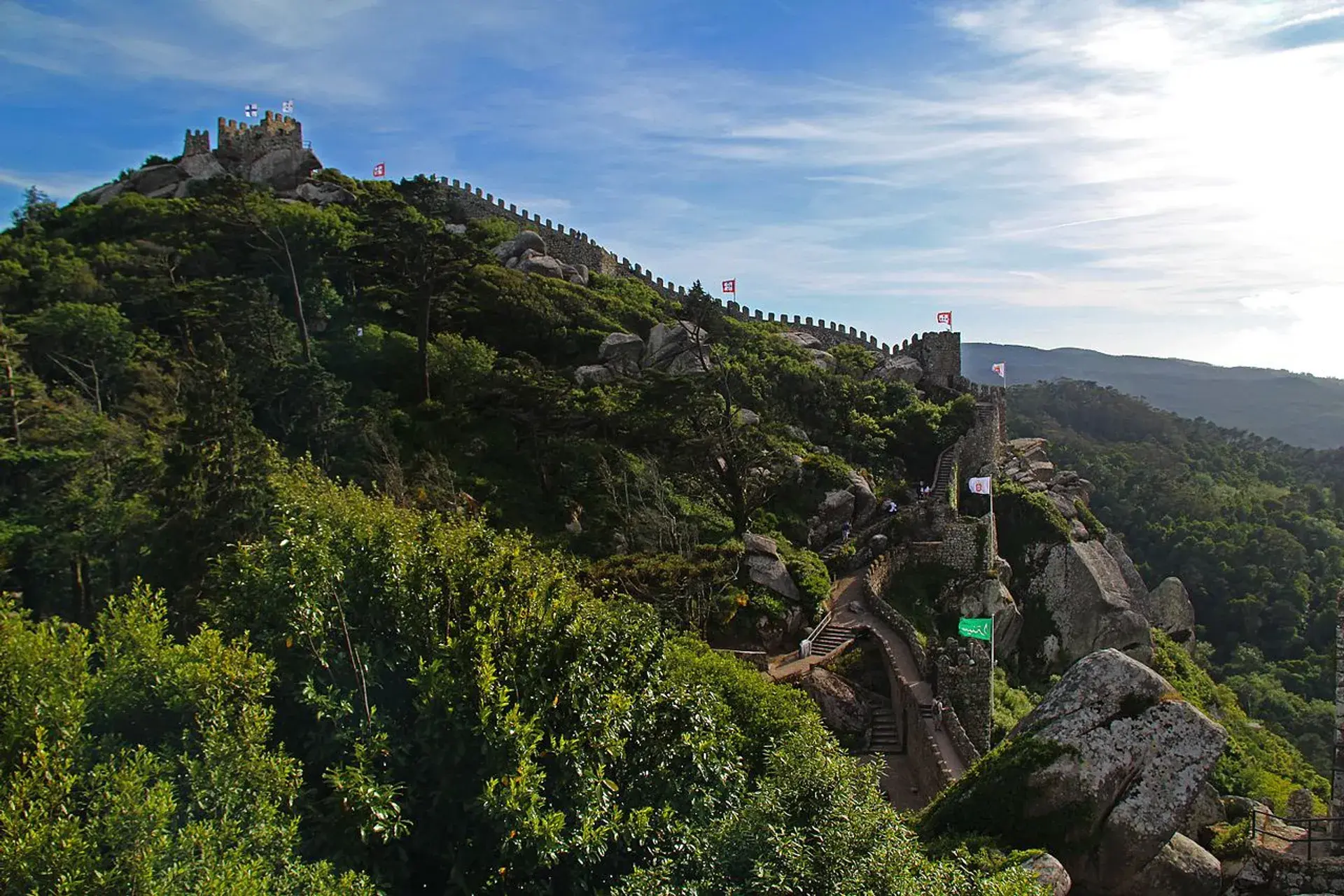
Midway between the historic town center of Vila de Sintra and the heights of Pena Palace sits Castelo dos Mouros, an imposing 10th-century fortress preserved as a 19th-century romantic ruin. Founded under Islamic rule between the 8th and 10th centuries, the Moorish Castle serves as the oldest surviving military landmark in the area, bridging Sintra's medieval origins with its later Romantic transformation.
Architectural Features and Natural Defenses
The fortress spans roughly 450 meters of double-ring curtain walls that seamlessly integrate giant natural granite boulders into the fortifications. The high elevation creates a windswept, mist-prone environment on the ridge. The site features dense, moss-draped forest canopies that give way to sheer, open-air battlement stairs offering sweeping views of the Atlantic Ocean and surrounding valleys. Key structural elements include the Royal Tower, an intact vaulted subterranean cistern, grain silos carved directly into the rock, and the Romanesque ruins of the Church of São Pedro de Canaferrim.
Strategic Origins and Legends
Originally established as an agricultural refuge and strategic watchpoint monitoring access routes, the garrison maintained control of the region until the Christian Reconquest. In 1147, following the fall of Lisbon and Santarém, the Muslim defenders voluntarily surrendered to King Afonso Henriques. Local tradition claims that as Christian troops approached, the Moorish garrison vanished into secret underground mountain tunnels, leaving behind only an elderly guardian holding the keys to the gates. By 1154, a charter granted the fortress to 30 Christian settlers, and custody subsequently passed to the Knights Templar.
Decline and Romantic Revival
As regional conflicts moved southward, populations gradually relocated to more accessible lowland settlements, leading to the castle's abandonment by the 16th century. The structure suffered significant damage from a lightning strike in 1636 and the devastating 1755 Lisbon earthquake. In 1839, King Ferdinand II acquired the site and initiated a project to restore the ramparts and towers as picturesque ruins, designed to complement the views from his nearby Pena Palace.
A Monument of Shared History
During Ferdinand II's 19th-century restorations, workers disturbed several medieval burials surrounding the Christian chapel. Unable to distinguish between the remains of Christian and Muslim inhabitants buried over the centuries, the king commissioned a single communal tomb to inter the mixed bones. The ossuary bears the inscription: 'O que o homem ajuntou, só Deus poderá separar' (What man has joined together, only God can separate).
Modern Preservation
Classified as a National Monument in 1910, Castelo dos Mouros was inscribed as a fundamental component of Sintra's UNESCO World Heritage designation in 1995. Today, the site is managed by Parques de Sintra - Monte da Lua and is open daily. The restored Church of São Pedro de Canaferrim now functions as an interpretation center, exhibiting archaeological artifacts spanning from the Neolithic era through the medieval period.
FAQ
When was Castelo dos Mouros built?
The fortress was founded under Islamic rule between the 8th and 10th centuries as a strategic watchpoint and agricultural refuge.
Who restored the castle ruins?
King Ferdinand II acquired the site around 1839 and restored the ramparts, pathways, and towers as a picturesque ruin to complement the views from Pena Palace.
What is the communal tomb at Castelo dos Mouros?
During 19th-century restorations, medieval Christian and Muslim remains were disturbed. King Ferdinand II created a single communal tomb for the mixed bones, inscribed with a message stating that what man has joined together, only God can separate.
What is inside the Church of São Pedro de Canaferrim?
The restored Romanesque church currently houses an interpretation center that displays archaeological artifacts ranging from the Neolithic era to the medieval period.