Guide to Pena Palace: Sintra's Colorful Castle
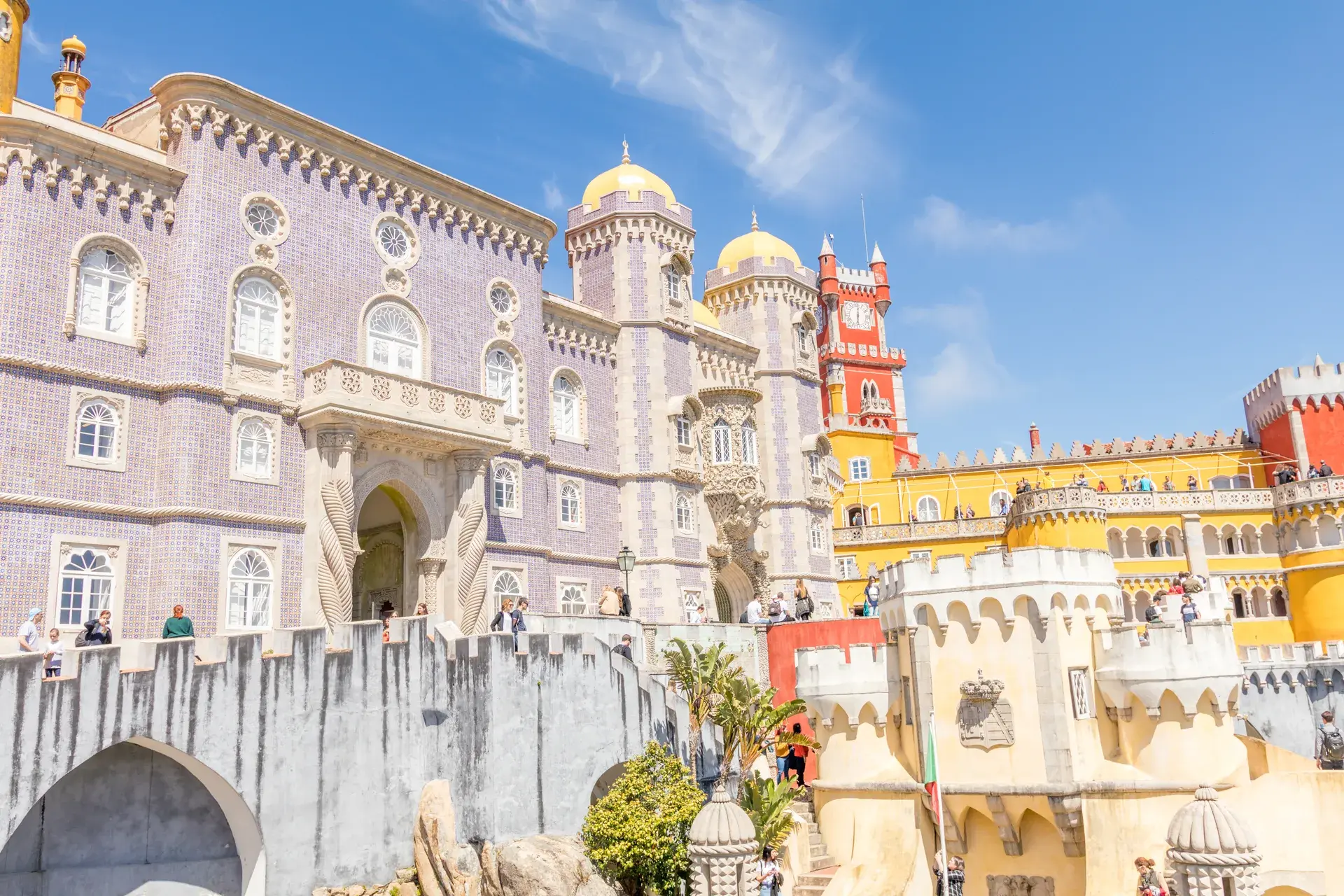
Sintra's brightly colored crown jewel was entirely dull grey just a few decades ago. By the late 20th century, years of neglect had weathered the exterior of the Palácio Nacional da Pena into a uniform fade. When conservation teams restored its bold yellow and red paint in the mid-1990s, many locals protested, mistakenly believing the vibrant colors were a modern embellishment rather than the building's original scheme. Today, the restored palace functions as the visual crown of Sintra, towering approximately 500 meters above sea level over the historic town center and the neighboring Castle of the Moors. In 1995, the site was officially inscribed as a UNESCO World Heritage site.
From Hermitage to Royal Retreat
The summit of the Serra de Sintra originally hosted a hilltop hermitage, which local tradition claims was founded following a miraculous apparition of the Virgin Mary on a high rocky crag. In 1503, King Manuel I commissioned a Royal Monastery for the Hieronymite Order on the site to celebrate the Portuguese Age of Discovery.
The complex suffered severe damage during the 1755 Lisbon earthquake and fell into complete abandonment following the 1834 abolition of religious orders in Portugal. In 1838, King Consort Ferdinand II purchased the ruined monastery and surrounding lands at public auction with the goal of transforming the site into a royal summer retreat. The palace later served as the final residence for Queen Amélia, who spent her last night in Portugal here in October 1910 before fleeing into exile following the proclamation of the Republic.
A Masterpiece of Romantic Revivalism
Constructed between 1838 and 1854, the palace was designed by Baron Wilhelm Ludwig von Eschwege under the commission of Ferdinand II. The resulting structure is a premier global example of 19th-century Romantic revivalism, blending Neo-Manueline, Neo-Gothic, Neo-Moorish, and Neo-Renaissance architectural styles.
The vibrant exterior colors serve as a historical map of the building's phases. Terracotta-red paint covers the restored 16th-century Manueline monastery and clock tower, while vivid yellow marks the 19th-century "New Palace" wing. A defining feature of the inner archway is the Triton Portal. This intricate stone carving depicts a mythological half-man, half-fish monster emerging from a conch shell, symbolizing the creation of the world and Portugal's maritime voyages.
The Palace and Park Today
Perched atop the peaks of the Serra de Sintra, the high elevation of the palace frequently traps Atlantic ocean moisture. This generates dense, swirling mists that regularly roll over the peak, abruptly shrouding the brightly colored facades in a tangible fog.
Classified as a National Monument in 1910, the state-owned property is now managed by Parques de Sintra – Monte da Lua. It operates year-round as a museum and is surrounded by an extensive 200-hectare botanical park. As one of Portugal's most visited national monuments, the palace welcomes approximately 1.5 million visitors annually and occasionally hosts official state receptions.
FAQ
Why is Pena Palace painted red and yellow?
The exterior colors act as a historical map of the building's construction phases. Terracotta-red covers the restored 16th-century monastery and clock tower, while vivid yellow marks the 19th-century "New Palace" wing added by Ferdinand II.
Who built the Pena Palace?
The palace was commissioned by King Consort Ferdinand II as a royal summer retreat and designed by German engineer and amateur architect Baron Wilhelm Ludwig von Eschwege between 1838 and 1854.
What is the Triton Portal at Pena Palace?
The Triton Portal is a prominent stone carving located on an inner archway of the palace. It depicts a mythological half-man, half-fish creature emerging from a conch shell, which symbolizes the creation of the world and Portugal's historical maritime voyages.