Dealul Mitropoliei: Bucharest's Spiritual & Historic Heart
Dealul Mitropoliei, also known as Metropolitan Hill or Patriarchate Hill, is a prominent landmark in Bucharest, Romania, holding deep historical, religious, and architectural significance. Once covered in grapevines around 1650, the hill evolved into a fortified monastic complex that now serves as the spiritual heart of the Romanian Orthodox Church. The site offers a peaceful retreat from the city and a profound look into the nation's past, featuring the Romanian Patriarchal Cathedral, the Patriarchal Palace, and a historic Bell Tower.
Architectural Landmarks of the Hill
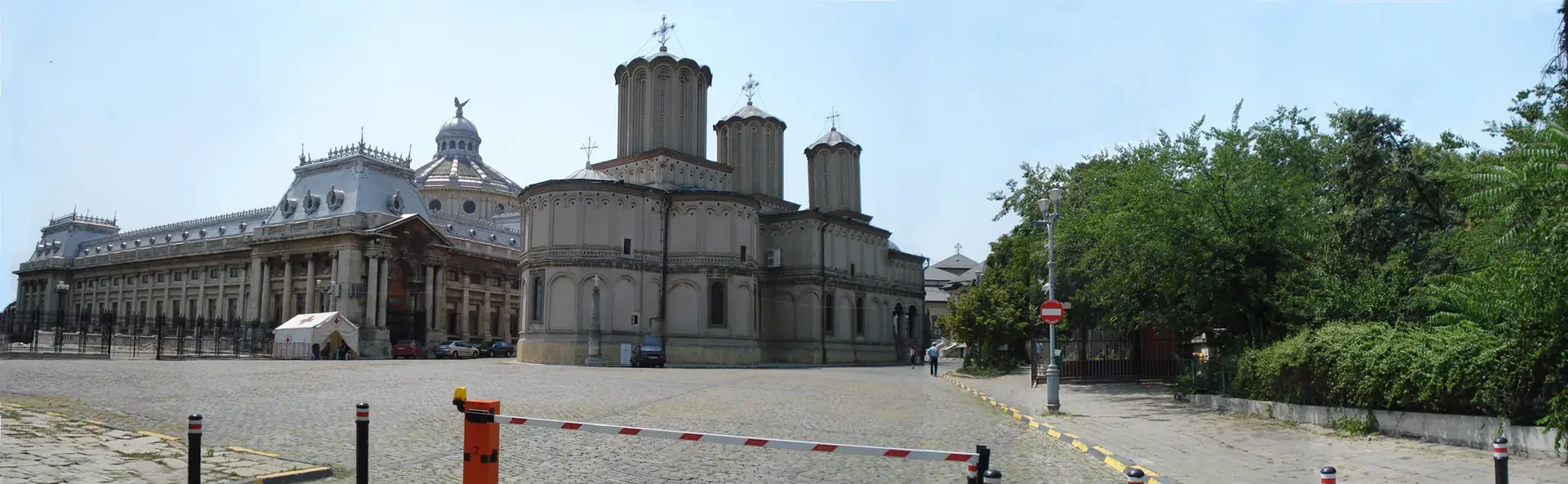
The complex on Dealul Mitropoliei showcases several distinct architectural styles and historical layers. The centerpiece is the Romanian Patriarchal Cathedral, dedicated to Saints Constantine and Helen. It was constructed between 1654 and 1658 under the patronage of Prince Constantin Șerban and his wife, Bălașa, and consecrated in 1658. The cathedral's design, with a Brâncovenesc facade, is largely considered a copy of the Curtea de Argeș Cathedral, though its original builder remains unknown.
Providing access to the complex is the Bell Tower, built in 1698 by Prince Constantin Brâncoveanu. This structure underwent significant restoration between 1956 and 1958, during the height of Romania's communist regime.
Nearby stands the impressive Patriarchal Palace. Originally built as the Palace of the Chamber of Deputies from 1907 to 1908, it was designed by architect Dimitrie Maimarolu in a Neo-classical style. Its 80-meter facade is distinguished by six Ionic columns. In a remarkable feat for its time, this edifice was Romania's first building constructed using reinforced concrete.
A Stage for Romanian History
Dealul Mitropoliei has been the backdrop for pivotal moments in Romanian history. The hill witnessed the 1655 revolt of the seimeni (mercenary soldiers) against the boyars, an event commemorated by a stone cross on the site. A wooden cross was also raised by the father of Papa Brâncoveanu in memory of his son, who was killed during the revolt.
On January 24, 1859, the hill was central to the formation of the modern Romanian state. Inside the Princely Divan building, Alexandru Ioan Cuza was elected Prince of both Moldavia and Wallachia, a crucial step toward the unification of the Romanian Principalities, as over 30,000 supporters gathered outside. The site also hosted the proclamations of Romanian Independence in 1878 and the Kingdom of Romania in 1881. In a more tragic event, Romania's first Prime Minister, Barbu Catargiu, was assassinated beneath the bell tower on June 20, 1862.
The Hill in Modern Times
Today, Dealul Mitropoliei is the primary seat of the Romanian Orthodox Church, housing the residence of the Patriarch since the Metropolitanate was elevated to the rank of Patriarchate in 1925. The Romanian Patriarchal Cathedral remains an active place of worship, known for hosting major religious holidays like the annual Palm Sunday pilgrimage. Its Divine Liturgy is particularly noted for its a cappella choir, a common practice in Orthodox services.
The Patriarchal Palace now serves administrative functions for the church, containing salons and event spaces. The entire hill is a popular destination for tourists, pilgrims, and locals. The original paved road leading up the hill, laid during the interwar period, is still in use and stands as a rare example of preserved interwar paving in Bucharest.
FAQ
What are the main buildings on Dealul Mitropoliei?
The main structures on Dealul Mitropoliei are the Romanian Patriarchal Cathedral, the Patriarchal Palace, and the Bell Tower.
Why is Dealul Mitropoliei historically significant for Romania?
It was the site of key events in the formation of modern Romania, including the 1859 election of Alexandru Ioan Cuza which led to the union of the Principalities, and the proclamations of Independence in 1878 and the Kingdom in 1881.
What is architecturally unique about the Patriarchal Palace?
The Patriarchal Palace, originally the Palace of the Chamber of Deputies, was built between 1907 and 1908 and was Romania's first building constructed with reinforced concrete.
What is Dealul Mitropoliei used for today?
It serves as the center of the Romanian Orthodox Church, housing the Patriarch's residence and administrative offices. The cathedral is an active place of worship and a popular site for tourists and pilgrims.