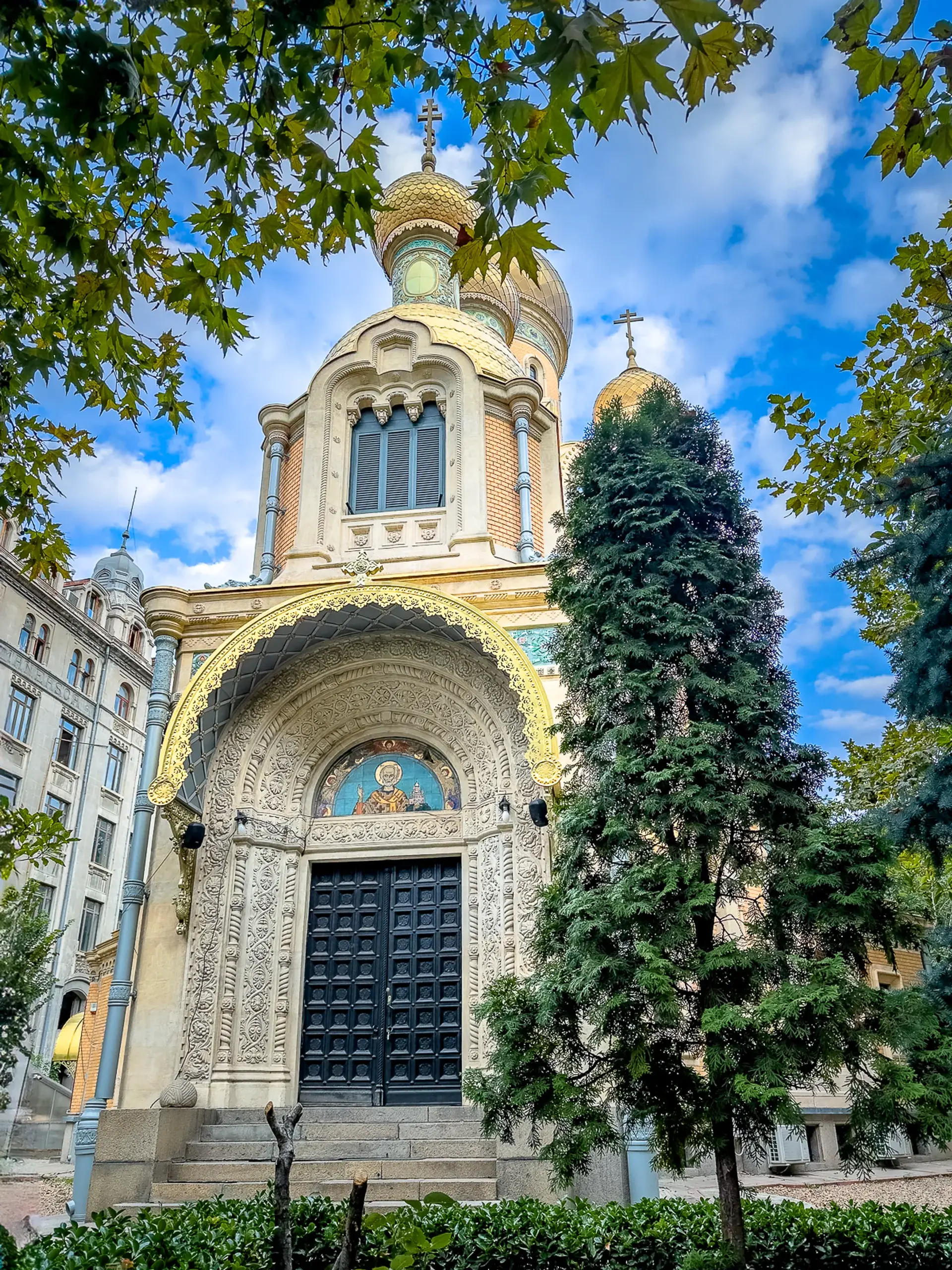
Saint Nicholas Russian Church: A Gem in Bucharest
Marvel at the distinctive onion domes and vibrant tile work of the Saint Nicholas Russian Church, a striking architectural gem that brings a piece of Moscow to Bucharest. This unique structure stands as a testament to the complex historical ties between Romania and Russia.
Imperial Origins and Construction
The Saint Nicholas Russian Church, also known as Biserica Rusă, was built between 1905 and 1909. The project was initiated by the Russian Ambassador, Mikhail Nikolaevich Giers, to serve the Russian legation and community in Bucharest. Its primary benefactor was Emperor Nicholas II of Russia, who provided a substantial sum of 600,000 gold rubles with the explicit instruction that no expense be spared on its construction.
Designed by Russian architect M. Preobrajenski, the building is a rare example of Russian Revival style in Romania, featuring distinct Art Nouveau influences. Its most prominent feature is the seven iconic onion-shaped domes that distinguish it from the surrounding architectural landscape.
A Tumultuous History
The church's history mirrors the political shifts of the 20th century. During World War I, it was closed, and its valuables and archives were moved to Saint Petersburg, where they were lost during the 1917 Russian Revolution. In 1934, the church was transferred to the Romanian government and became a chapel for the University of Bucharest.
Jurisdiction shifted again in 1947 when it reverted to the Moscow Patriarchate at the request of Soviet authorities. This lasted until 1957, when Patriarch Alexius I of Moscow passed it back to the Romanian Orthodox Church. The structure suffered damage during the 1977 earthquake, with the great tower cracking, and restoration efforts have faced delays.
Interior Artistry
Inside, the church originally featured oil frescoes painted by the Russian artist Vasiliev. This work is believed to be his only known creation outside of Russia. Following damage, the paintings were restored and completed in 1948 by Anatolie Cudinov in a Neo-Byzantine style.
The 'Students' Church' Today
In 1992, the church was once again designated as the chapel for the students and professors of the University of Bucharest, solidifying its popular name, 'The Students' Church' (Biserica Studenților). It functions as an active spiritual center, open to all Christians, with a focus on serving the city's youth. In a notable decision reflecting ecclesiastical tensions, services conducted in Russian were halted in 1992 and have not resumed.
FAQ
Why is the Saint Nicholas Russian Church also called 'The Students' Church'?
Since 1992, the church has served as the official chapel for the students and professors of the University of Bucharest, earning it this popular nickname.
Who paid for the construction of the Russian Church in Bucharest?
Emperor Nicholas II of Russia provided the primary funding of 600,000 gold rubles, instructing that no expense should be spared on its construction.
What is the architectural style of the Saint Nicholas Russian Church?
The church was designed in a distinctive Russian Revival style with Art Nouveau influences, characterized by its seven iconic onion-shaped domes.
Are religious services still held in Russian at the church?
No, services conducted in Russian were halted in 1992 due to tensions between the Romanian and Russian Orthodox Churches over the Metropolis of Bessarabia.
Discover Bucharest like never before
Dive into Bucharest hidden stories and secret spots with Ciceru interactive tours.
Explore tour
Audioguide
Quizzes
Maps
Solo
Couples
Groups & families

© Photo by Adam Welber via Google Maps · Google Places