House of the National Assembly: Belgrade Landmark Guide
A Monument Built Across Dynasties and Decades
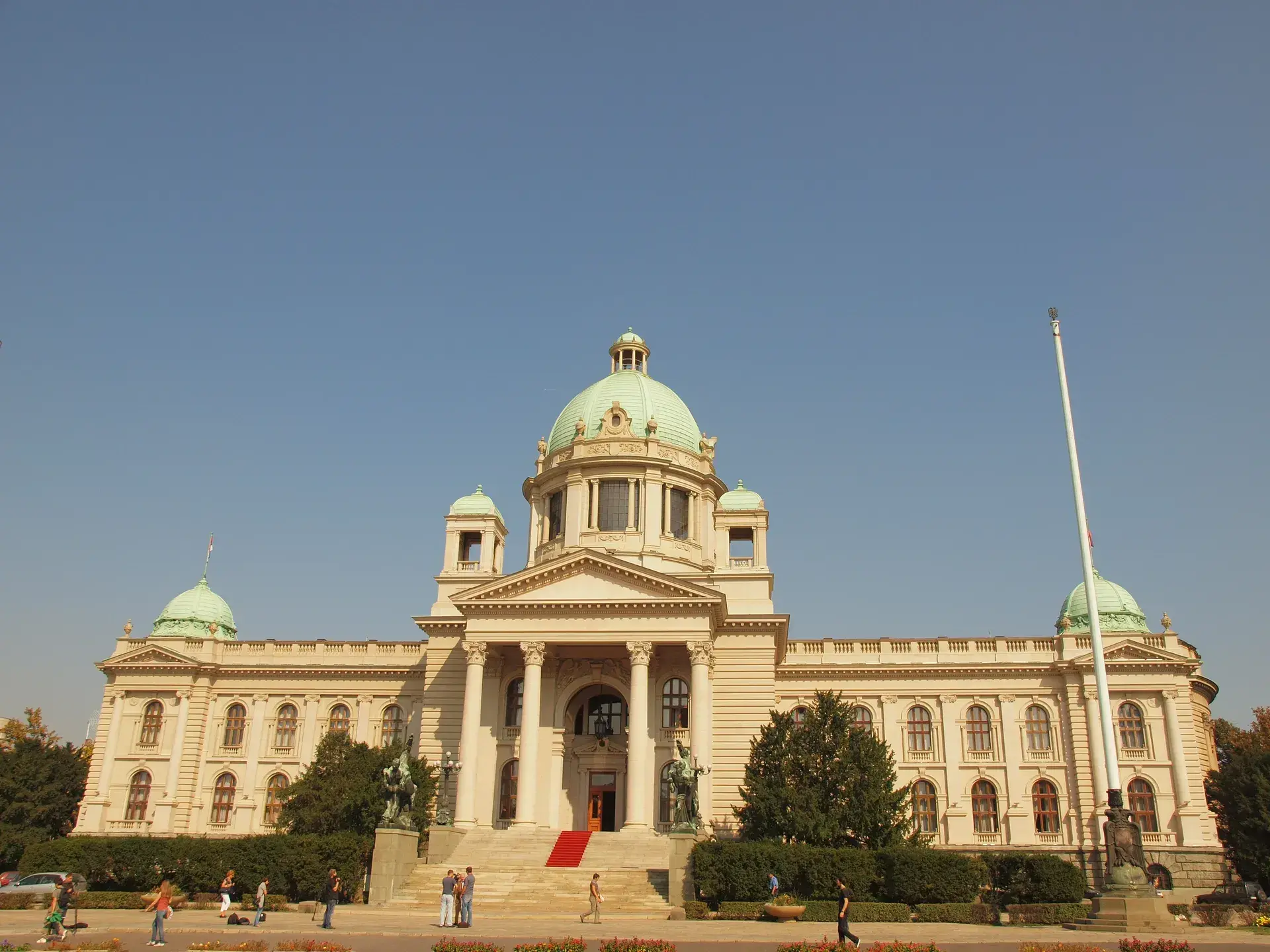
The House of the National Assembly of the Republic of Serbia stands on Nikola Pašić Square as an enduring symbol of Belgrade's twentieth-century political transformations. Commissioned by the Kingdom of Serbia to replace an older parliament building on Kneza Miloša Street, the structure was shaped by a kingdom that ceased to exist before the building was ever completed.
Its construction spanned 29 years. The foundation stone was laid on August 27, 1907, by King Peter I Karađorđević, but the building was not formally dedicated until October 18, 1936, in the presence of King Peter II. The opening parliamentary session took place days later, on October 20–21, 1936. The nearly three-decade delay was driven by the turmoil of the Balkan Wars, World War I, state reorganizations—including restructuring into a bicameral system under the Kingdom of Serbs, Croats and Slovenes—and ongoing budget constraints.
Belgrade walking tour with audio and quizzes: frontier to capital
2 hours8 stopsAudio guideStart any day, at your own paceTicket on your phone · 30-day refundAncient Grounds and Civic Landscape
Designated a cultural monument of exceptional importance in 1984, the assembly anchors Belgrade's institutional heart. Positioned opposite Pionirski Park and within direct sight of the Old Palace and New Palace, it connects the Terazije commercial ridge with Tašmajdan Park, St. Mark's Church, and the Knez Miloš government corridor.
The ground beneath the monumental complex carries centuries of history. Archaeological surveys revealed that the building and adjoining square sit atop an ancient Roman necropolis dating from the Singidunum period. During the Ottoman era, the location held the ruins of the 16th-century Batal Mosque, which was demolished in the late 19th century. The adjacent field also served as the site where the Sultan’s 1830 Hatt-i Sharif, which granted autonomous principality status to Serbia, was officially proclaimed.
Beaux-Arts Architecture and Krasnov’s Watercolors
The exterior of the assembly reflects the monumental academic Beaux-Arts tradition, accented with Neo-Renaissance and Neo-Baroque details. Conceived initially by Konstantin Jovanović in 1891–1892, the primary structural design was won in a 1901 architectural competition by Jovan Ilkić. Following the devastation of World War I, Ilkić’s son, Pavle Ilkić, resumed supervision of the construction.
The exterior features rigorous bilateral symmetry, an elevated stone plinth reached by broad stairs, a classical Corinthian portico, and a central copper dome flanked by corner cupolas.
Between 1934 and 1938, the interior was entrusted to Nikolay Krasnov, a Russian émigré architect who had formerly served the Romanov imperial family. Krasnov approached the interior not with standard technical drafts, but with detailed hand-painted watercolor renderings. He personally designed every feature of the ceremonial spaces, including custom bronze chandeliers, carved woodwork, heating grilles, and specialized furnishings.
Statues, Superstitions, and Political Turning Points
At the foot of the monumental entrance stairs stand two dynamic bronze sculptural compositions installed in the late 1930s by sculptor Toma Rosandić. Officially titled Black Horses at Play, and with Them Great Heroes, the statues depict muscular human figures wrestling with wild steeds. While Rosandić intended the work to represent human willpower and reason overcoming brute nature, enduring local tradition interprets the figures as citizens resisting authoritarian state oppression.
The prolonged construction also sparked the urban superstition known as the "King's Curse," which held that whichever monarch finished the parliament building would not survive to see its legacy. King Alexander I Karađorđević aggressively pushed for its final completion in the 1930s, only to be assassinated in Marseille in 1934, two years prior to its consecration.
Across the twentieth and early twenty-first centuries, the building mirrored Belgrade’s volatile history. During World War II, it was commandeered as the German military headquarters for Southeastern Europe from 1941 to 1944. Later, it served as the Federal Assembly for socialist Yugoslavia and the subsequent federal republic. On October 5, 2000, during the Bulldozer Revolution, demonstrators stormed the building, resulting in interior fires, extensive property damage, and the theft of historic artifacts. Following the dissolution of the State Union of Serbia and Montenegro in 2006, it became the dedicated seat of the sovereign Serbian parliament.
Current Role and Access
Today, the landmark operates as the functioning seat of the unicameral National Assembly of the Republic of Serbia, regularly holding legislative sessions, official press briefings, and formal state receptions. Because it remains an active, high-security government facility, general interior access is not open for walk-in visitation. Entry is restricted to scheduled civic programs, formal open days, or guided group heritage tours arranged in advance through the Tourist Organization of Belgrade.
FAQ
Can the public tour the interior of the National Assembly?
Because the assembly is an active high-security government site, public visits are limited to scheduled civic events, official open days, or pre-arranged guided group tours organized via the Tourist Organization of Belgrade.
Why did the building take 29 years to construct?
Construction started in 1907 but was suspended and prolonged by the Balkan Wars, World War I, national restructuring into the Kingdom of Serbs, Croats and Slovenes that required adapting the floorplan for a bicameral parliament, and budgetary limits.
What do the horse sculptures at the front entrance represent?
Created by Toma Rosandić under the title 'Black Horses at Play, and with Them Great Heroes,' the bronze statues were designed to signify reason and willpower subduing raw nature, though local tradition often views them as symbols of citizens resisting state power.