
Skadarlija: Belgrade's Bohemian Quarter Guide
The Emergence of Belgrade's Bohemian Epicenter
Skadarlija originated in the 1830s as Ciganska Mala, an informal settlement established in abandoned defensive trenches along the Bibija stream outside Belgrade's fortress walls. In 1872, the curved roadway was integrated into the city's official street grid and renamed Skadarska Street after the medieval town of Skadar.
The district's transformation into a cultural focal point accelerated at the turn of the century. Following the 1901 demolition of the famed Dardaneli tavern on Republic Square to make room for the National Museum, artists, writers, and theatrical performers moved downhill into Skadarska's taverns. To protect its architectural and cultural identity from post-war modernization, the street underwent an extensive revitalization between 1966 and 1968 led by architect Uglješa Bogunović alongside prominent cultural figures including Zuko Džumhur and Momo Kapor. Designated a legally protected spatial cultural-historical unit in 1967, Skadarlija officially twinned with the Montmartre district of Paris in October 1977.
Belgrade walking tour with audio and quizzes: frontier to capital
2 hours8 stopsAudio guideStart any day, at your own paceTicket on your phone · 30-day refundHistoric Kafanas and Culinary Traditions
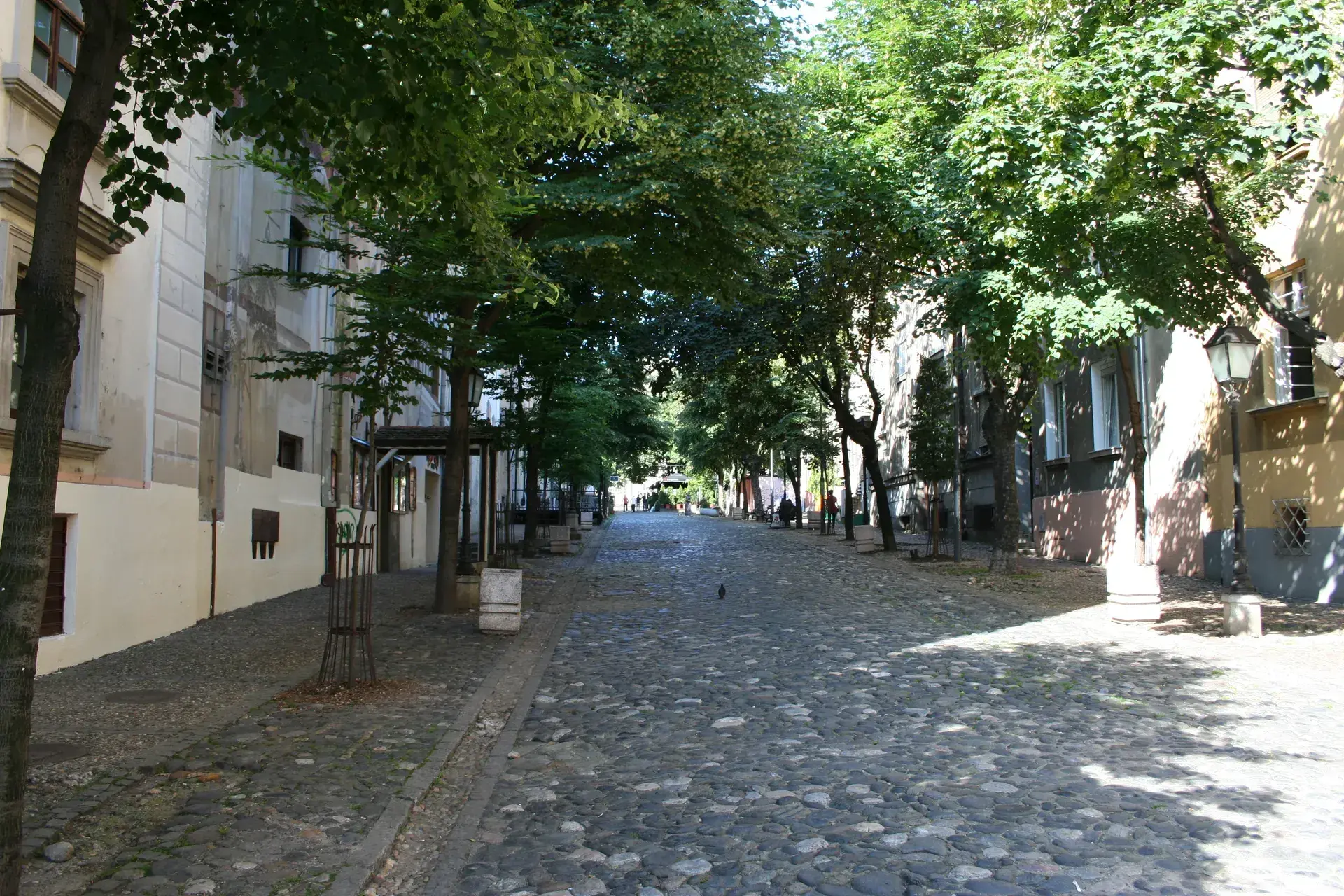
Running between 400 and 590 meters from Bulevar Despota Stefana down to Dušanova Street near the Bajloni market, Skadarlija serves as a pedestrian link connecting Belgrade's central administrative ridge with the lower Dorćol neighborhood. The street is anchored by its historic kafanas (traditional taverns), which have preserved culinary and musical customs for well over a century.
The oldest operating tavern on the street is Tri Šešira ("Three Hats"), open since 1864. The business adopted its name from a hatmaker’s workshop that previously stood on the site, which displayed a tin sheet painted with three hats as its trade sign. Another historic institution, Dva Jelena ("Two Deer"), was established shortly after in 1867. The air along the street carries aromas of charcoal-grilled meats (roštilj), spiced stews, and traditional fruit brandies (rakija). Inside and across outdoor dining terraces, wandering acoustic ensembles play starogradska muzika (old urban folk songs) on unamplified violins, accordions, and tamburicas.
Literary Heritage and Cultural Landmarks
During its bohemian heyday, Skadarlija attracted prominent Serbian writers, including playwright Branislav Nušić, author Bora Stanković, and actor Čiča Ilija Stanojević. Serbian Romantic poet and painter Đura Jakšić lived, wrote, and died on the street. His former residence at No. 34 now serves as the House of Đura Jakšić, a municipal cultural center that hosts literary evenings, poetry readings, and art exhibitions.
Directly outside the residence stands a bronze sculpture of the seated poet created by sculptor Jovan Soldatović in 1990. Local patrons and visitors observe a continuing custom of leaving a lit cigarette or a glass of wine at the foot of the statue. At the lower terminus of Skadarska Street sits an Ottoman-style wooden sebilj (drinking fountain). The structure is a full-scale replica presented to Belgrade in 1989 as a diplomatic gift from Sarajevo during the 9th Non-Aligned Movement Summit.
Cobblestone Ambiance and Living Customs
Skadarska Street is paved with rounded river cobblestones known as turska kaldrma, which enforce a deliberate, uneven walking pace. Retro street lanterns, facade murals mimicking historic windows, and overflowing flower boxes frame the corridor's low 19th-century buildings.
The quarter maintains active heritage standards and official symbols: a walking cane, a top hat, and a carnation. Taverns follow a code of conduct regarding period-appropriate server attire, traditional tableware, and strictly acoustic musical performances. Each spring since 1993, the district marks the official opening of the summer season with the ceremonial raising of the Bohemian Flag outside the Zlatni Bokal tavern.
FAQ
Why is the tavern Tri Šešira named "Three Hats"?
Tri Šešira took its name from a craft hatmaker's workshop that operated on the property before the tavern opened in 1864, which used a tin sign painted with three hats.
What is the wooden fountain located at the lower end of Skadarlija?
The wooden fountain is a full-scale Ottoman-style sebilj presented to Belgrade as a gift from the city of Sarajevo in 1989 for the 9th Non-Aligned Movement Summit.
What ritual is associated with the statue of Đura Jakšić?
Visitors and local bohemians maintain a tradition of leaving a glass of wine or a cigarette at the base of Jovan Soldatović's 1990 bronze statue of the poet, located outside his former home.