Terazije Square: Belgrade's Ridge of Water Towers
The Ottoman Water Towers and Belgrade's Zero Point
Terazije functions as Belgrade's central boulevard-square and serves as the city's official geographical zero point, from which street numbering traditionally originates. Covering approximately 23 hectares, the surrounding architectural zone was designated a protected Spatial Cultural-Historical Unit in January 2020.
The square derives its name from the Ottoman Turkish word terazije, meaning water balances. During the Ottoman era, high stone water towers were used along the ridge to regulate hydrostatic pressure and distribute piped spring water through the city's conduits. One of the principal water towers stood directly on the site of the modern fountain. Urban development of the district began in earnest during the 1840s, when Prince Miloš Obrenović ordered craftsmen and merchants to relocate their workshops and homes from Savamala to Terazije.
Belgrade walking tour with audio and quizzes: frontier to capital
2 hours8 stopsAudio guideStart any day, at your own paceTicket on your phone · 30-day refundArchitectural Anchors: The Fountain, Hotel Moskva, and Palace Albania
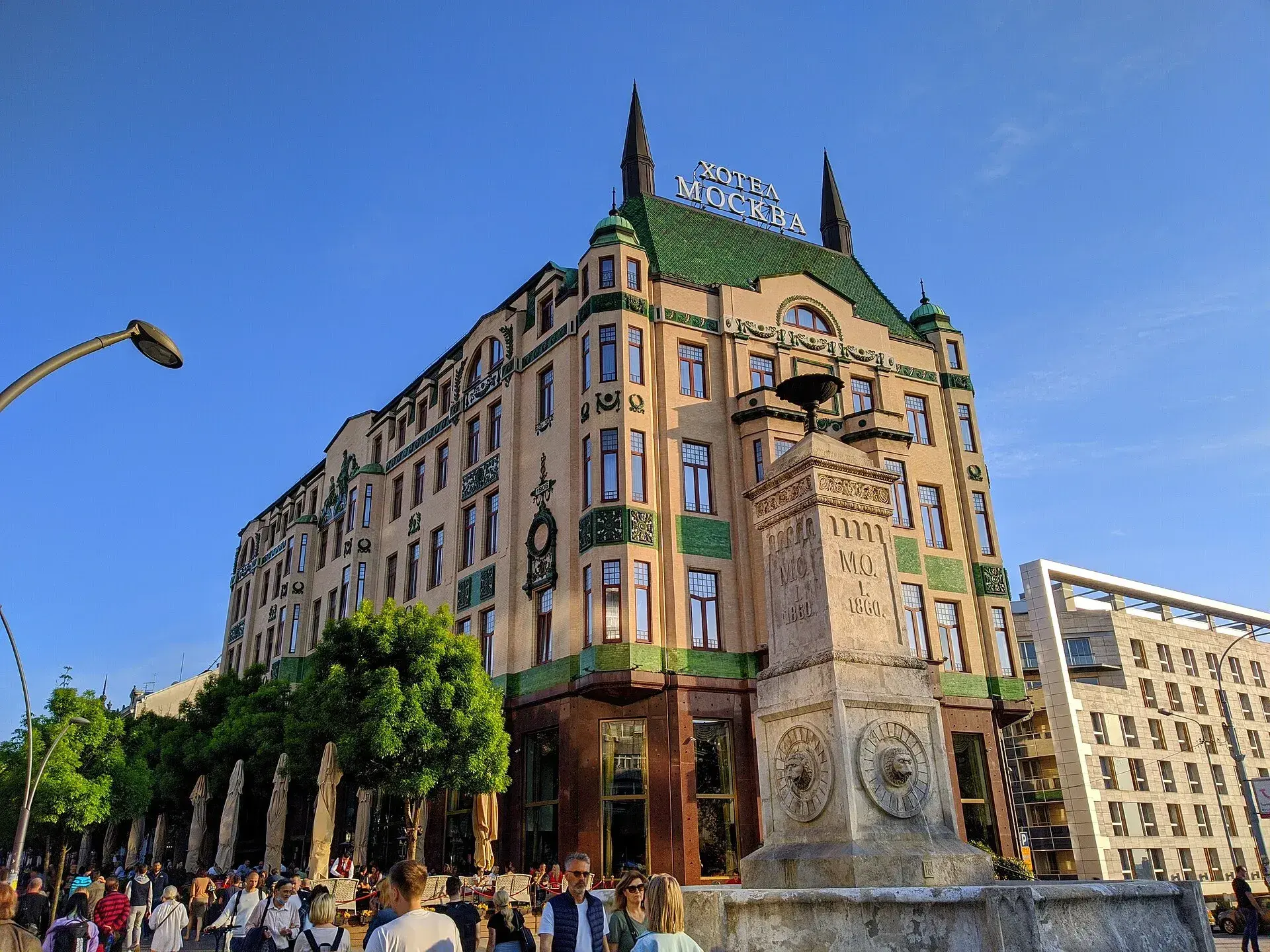
In 1860, Prince Miloš commissioned sculptor Franz Loran to build the Terazijska česma (Terazije Fountain) out of Tašmajdan limestone, replacing the dismantled Ottoman water tower and commemorating the prince's second return to rule. During a 1911–1912 redesign led by architect Jelisaveta Načić, the obelisk-topped fountain was transferred to Topčider Park. While criticized at the time, this relocation shielded the stone monument from destruction during the heavy bombardments of both World War I and World War II. The fountain was returned to Terazije in December 1975, where water once again flows from its four carved lion-head spouts.
Opposite the fountain stands Hotel Moskva, an Art Nouveau landmark completed in 1908. During the World War II occupation, the Gestapo requisitioned the building as its headquarters and temporarily renamed it "Velika Srbija," referencing the 19th-century inn that preceded it. Decades later, in 1974, the hotel's pastry shop invented the Moskva Šnit, an almond-and-fruit dessert that became Belgrade's most renowned signature cake.
At the northern entry of the avenue stands Palata Albanija (Palace Albania). Completed in 1939, the structure was Belgrade's first true high-rise and the tallest building in the Balkans prior to World War II.
Subterranean Springs and Historical Turmoil
The slope running beneath Terazije and Hotel Moskva holds at least 11 active natural water springs. These subterranean water flows presented severe engineering challenges during the excavation of the foundations for Palace Albania in the late 1930s, as well as during the mid-century construction of underground pedestrian shopping concourses in 1967–1968 and the Terazije vehicle tunnel in 1970.
The square has also served as a stage for major historical events. On August 17, 1941, the Gestapo executed five captured Serbian resistance fighters by hanging them from street lamp posts along the avenue, a tragedy commemorated since 1983 by a monument sculpted by Milorad Tepavac. In March 1991, the area around the Terazije Fountain became the center of the student-led "Terazije Parliament" demonstrations protesting against the regime of Slobodan Milošević.
Modern Role on the Central City Axis
Today, Terazije forms the primary pivot of Belgrade's north–south urban corridor. To the north, it links Republic Square and the pedestrian district of Knez Mihailova street. To the south, it extends down Kralja Milana toward the Old and New Royal Palaces, Slavija Square, and the Church of Saint Sava.
The boulevard remains an active civic and commercial artery, carrying major bus and trolleybus lines while accommodating the Terazije Theatre, historic hotels, and street cafes. The open plateau fronting Hotel Moskva and the Terazije Fountain continues to serve as one of the city's primary public gathering points, defined by the ambient hum of overhead trolley wires and the continuous rush of the fountain's water.
FAQ
Why is the area called Terazije?
The square is named after the Ottoman Turkish word for water balances (*terazije*). In the Ottoman period, high stone water towers stood here to regulate hydrostatic pressure in aqueducts and distribute spring water throughout Belgrade.
Why was the Terazije Fountain absent from the square for over 60 years?
During an urban redesign in 1911–1912 by architect Jelisaveta Načić, the fountain was relocated to Topčider Park. This move inadvertently protected the limestone monument from destruction during World War I and World War II bombardments, before it was brought back to Terazije in 1975.
What hidden geological feature lies beneath Terazije Square?
The ground beneath Terazije and Hotel Moskva contains at least 11 active natural water springs, which caused substantial technical obstacles during the construction of Palace Albania and the square's underground concourses.