Belgrade Gate: Petrovaradin's Baroque Entrance
The Belgrade Gate is a 10-meter-high Baroque portal where the Austro-Hungarian era officially ended in Novi Sad. It serves as a key anchor on the classic route connecting the urban center of Novi Sad across the Danube River to the historic Suburbium (Gradić) and the upper ramparts of Petrovaradin Fortress.
A Grand Baroque Portal
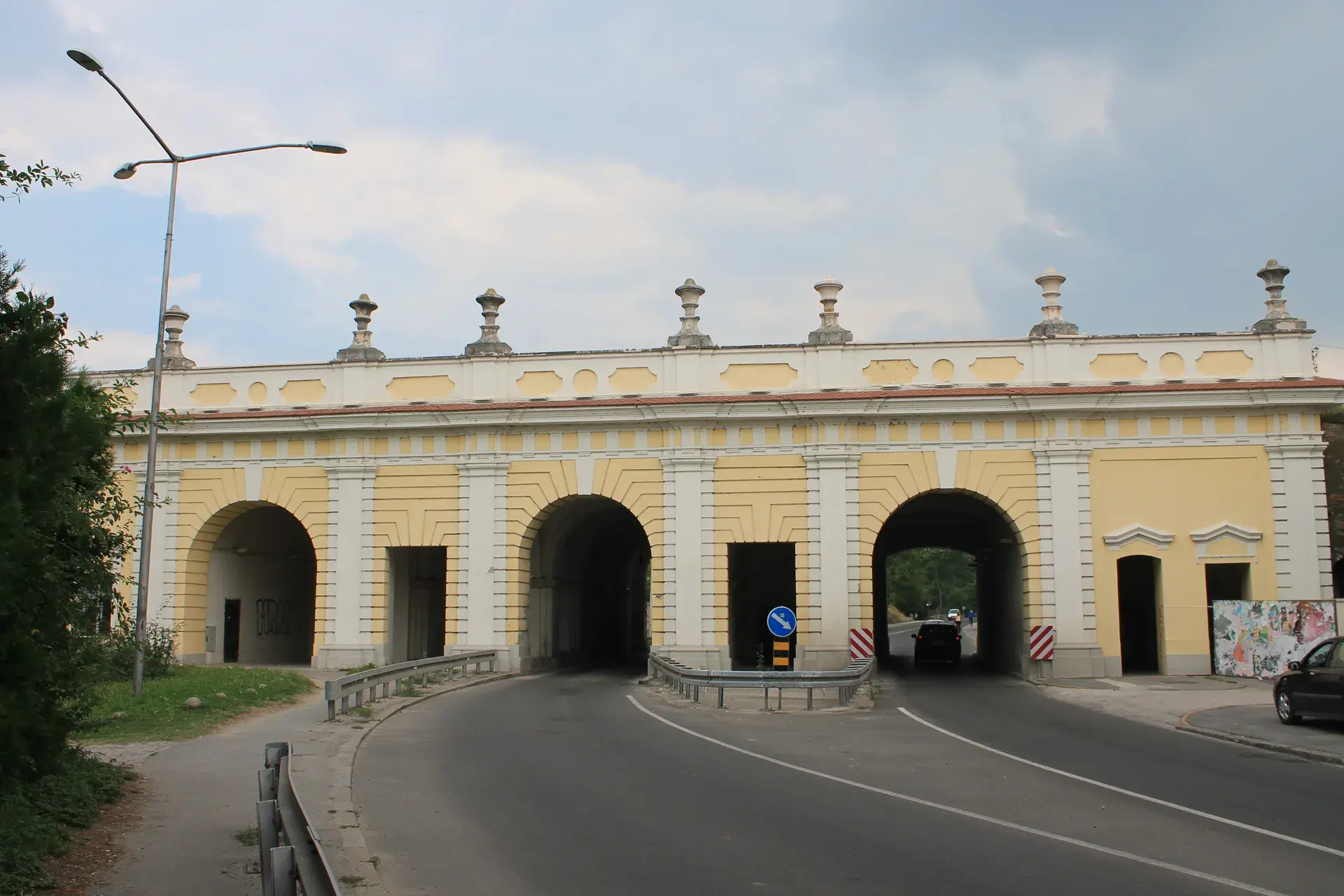
Located between the Saint Ernest and Saint Ignatius bastions, the Belgrade Gate was built in 1753 during the Austrian Habsburg administration. While the surrounding fortress ramparts adhered strictly to the rigid Vauban system of military engineering, designers were granted artistic freedom when crafting the entryways. This resulted in a striking Baroque-Classicist military style featuring ornamental pillars, framed windows, and sculpted crests.
The 10-meter-high structure contains four distinct archways. Two central lanes accommodate vehicular traffic, while two outer passages are reserved for pedestrians. Traffic and footstep echoes constantly reverberate off the vaulted brick archways of the passage. An unusual architectural feature is its asymmetrical design: the inner facade facing the town spans 40 meters, doubling the length of the 20-meter outer entry facade. This extended inner wall conceals four built-in guard posts and vaulted lateral chambers within its thickness. The structure also features six decorative pillars on the outer facade and eight on the inner side.
Defensive Origins and Historic Turning Points
The gate was originally constructed to secure the southern approach to Petrovaradin's Lower Town along the primary trade and military route heading toward Sremski Karlovci and Belgrade.
On November 9, 1918, the Belgrade Gate witnessed a major historical shift. The Serbian Army, led by Major Vojislav Bugarski, entered Petrovaradin and Novi Sad through this entryway, marking the official end of Austro-Hungarian rule in the region. A memorial plaque commemorating this event was unveiled near the gate in 1938.
A Notorious Military Prison
An adjacent structure to the gate operated as the Central Penal Institution of the Military Court of the Slavonian General Command. This military prison held several notable historical figures over the years. Inmates included Josip Broz Tito, the socialist Vasa Pelagić, writer Antun Gustav Matoš, Bulgarian writer Ljuben Karavelov, politician Jaša Tomić, and Admiral Matija Zmajević.
Modern Restoration and Daily Life
During World War II, the coat of arms of Novi Sad carved into the outer facade was destroyed by occupying forces in 1941. However, the gate underwent a comprehensive 35-million-dinarian restoration completed in 2015. This project stabilized the structure, repaired the brick and plasterwork, and successfully restored the municipal coat of arms above the central passage.
Today, the Belgrade Gate continues to function as an active thoroughfare, allowing modern vehicles and pedestrians to enter the historic cobblestone streets of the Petrovaradin Suburbium.
FAQ
When was the Belgrade Gate built?
The Belgrade Gate was built in 1753 during the Austrian Habsburg administration to secure the southern approach to Petrovaradin's Lower Town.
What architectural style is the Belgrade Gate?
It was designed in a Baroque-Classicist military style. While the fortress followed the strict Vauban engineering system, builders were allowed artistic freedom on the gates, resulting in ornamental details like decorative pillars.
Who was imprisoned near the Belgrade Gate?
An adjacent building served as a military prison that held notable historical figures, including Josip Broz Tito, Vasa Pelagić, Antun Gustav Matoš, and Admiral Matija Zmajević.
Was the Belgrade Gate restored?
Yes, the gate underwent a 35-million-dinarian restoration completed in 2015 to stabilize the structure, repair the brickwork, and restore the municipal coat of arms that was destroyed in 1941.