Church of the Name of Mary: Novi Sad's Neo-Gothic Landmark
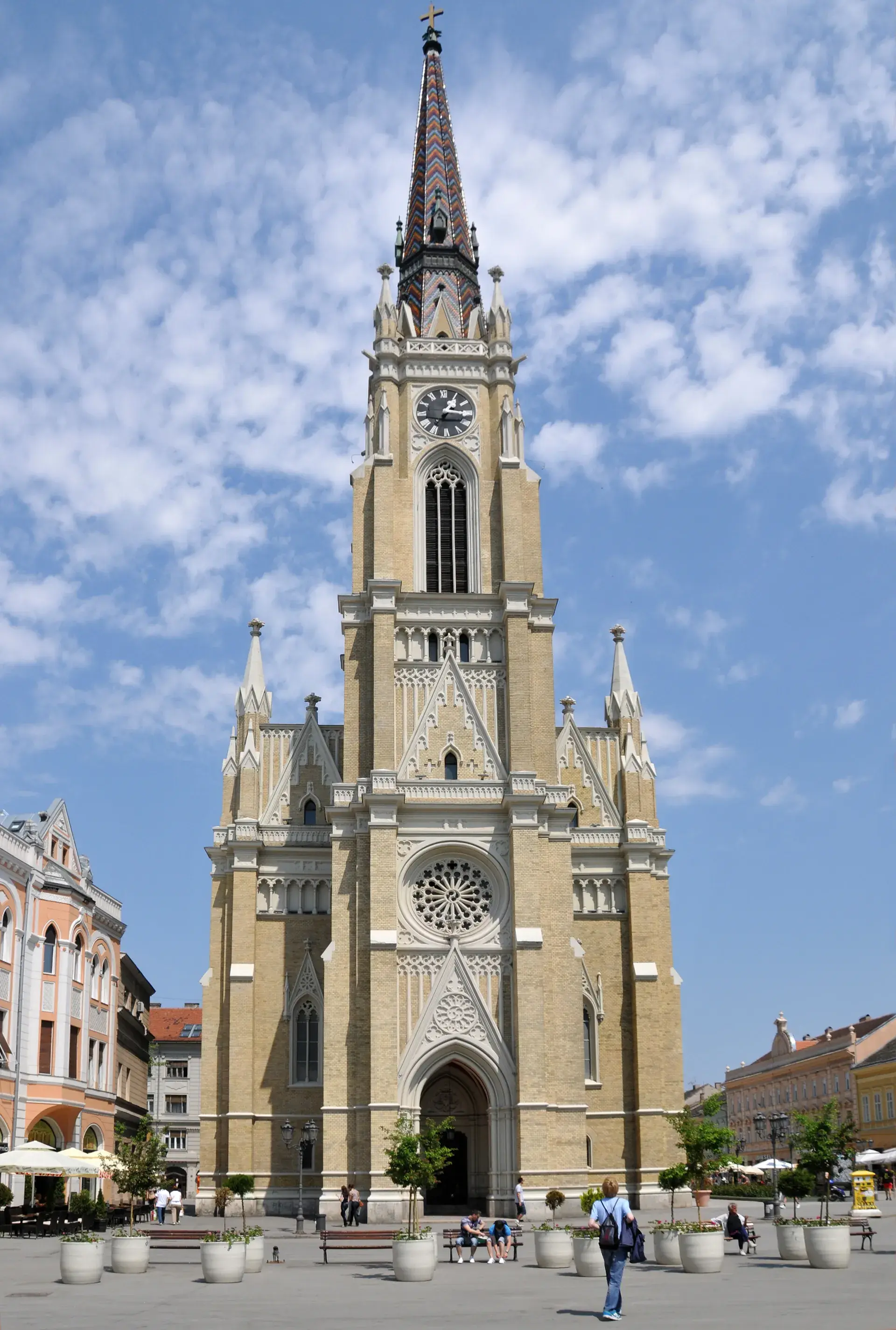
Dominating Liberty Square with a 72-meter tower, Novi Sad's most famous landmark is locally known as 'the Cathedral'—even though it technically isn't one. The Church of the Name of Mary (Crkva imena Marijinog) serves as a visual anchor in the city center and a striking symbol of Vojvodina's Catholic minority.
Neo-Gothic Architecture and Design
Measuring roughly 52.5 meters in length and 21.7 meters in width, the three-nave basilica is the tallest church in both Novi Sad and the wider Bačka region. Local architect György Molnár designed the structure pro bono in 1892. In a unique architectural pairing, Molnár also designed the Neo-Renaissance City Hall directly facing the church across Liberty Square. A preserved bust of the architect honors his work inside the church interior.
The exterior is noted for its multi-colored, diamond-patterned Zsolnay ceramic tile roof. These glazed tiles, manufactured in Pécs, Hungary, create a vibrant visual display as sunlight shifts across the building. Inside, the church features high vaulted ceilings, a Tyrolean carved wood main altar, and intricate stained-glass windows produced in Budapest that depict biblical scenes, saints, and local coats of arms.
A History of Resilience and Reconstruction
The current structure is the third Catholic church to stand on this site since the parish was established in 1702. The original 1719 church was destroyed around 1742. Its replacement stood for over a century until the 1848–1849 Hungarian Revolution, when severe bombardment destroyed its bell tower. After early repairs proved inadequate, the city council demolished the damaged building in 1891.
Groundbreaking for the current church took place in October 1892. The main structure was finished in late 1893, and the towering 72-meter bell tower was completed in October 1894. A decade later, a roof fire in 1904 led to a rebuild utilizing the distinctive Zsolnay ceramic tile pattern seen today.
Inside the Parish and Katolička Porta
Despite its monumental scale and the common local nickname 'the Cathedral' (Katedrala), the building operates strictly as an active Roman Catholic parish church. The actual seat of the Roman Catholic bishop for the region is located approximately 100 kilometers away in Subotica. Today, the church hosts regular Mass and religious services under the Diocese of Subotica.
The interior is also home to a mechanical pipe organ with 24 registers, built in 1899 by the Rieger brothers. This instrument regularly fills the high vaulted nave with music during organ recitals and classical sacred music concerts. Directly behind the church lies the Katolička Porta (Catholic Gate), a courtyard featuring an 1808 Early Classicist parish home built over former cemetery grounds. The church is open daily to visitors, though modest attire covering shoulders and knees is required for entry.
FAQ
Is the Church of the Name of Mary a cathedral?
No, despite its local nickname 'the Cathedral,' it is an active Roman Catholic parish church. The regional bishop's seat is located roughly 100 kilometers away in Subotica.
When was the Church of the Name of Mary built?
The current Neo-Gothic structure was constructed between 1892 and 1894. It replaced an earlier church that was severely damaged during the 1848–1849 Hungarian Revolution.
Can visitors go inside the Church of the Name of Mary?
Yes, the church is open daily to visitors. Entry requires modest attire that covers the shoulders and knees.
What is the courtyard behind the church?
The courtyard directly behind the church is known as Katolička Porta (Catholic Gate). It features an 1808 Early Classicist parish home built over former cemetery grounds.