Orthodox Bishop's Palace: Novi Sad Historic Landmark
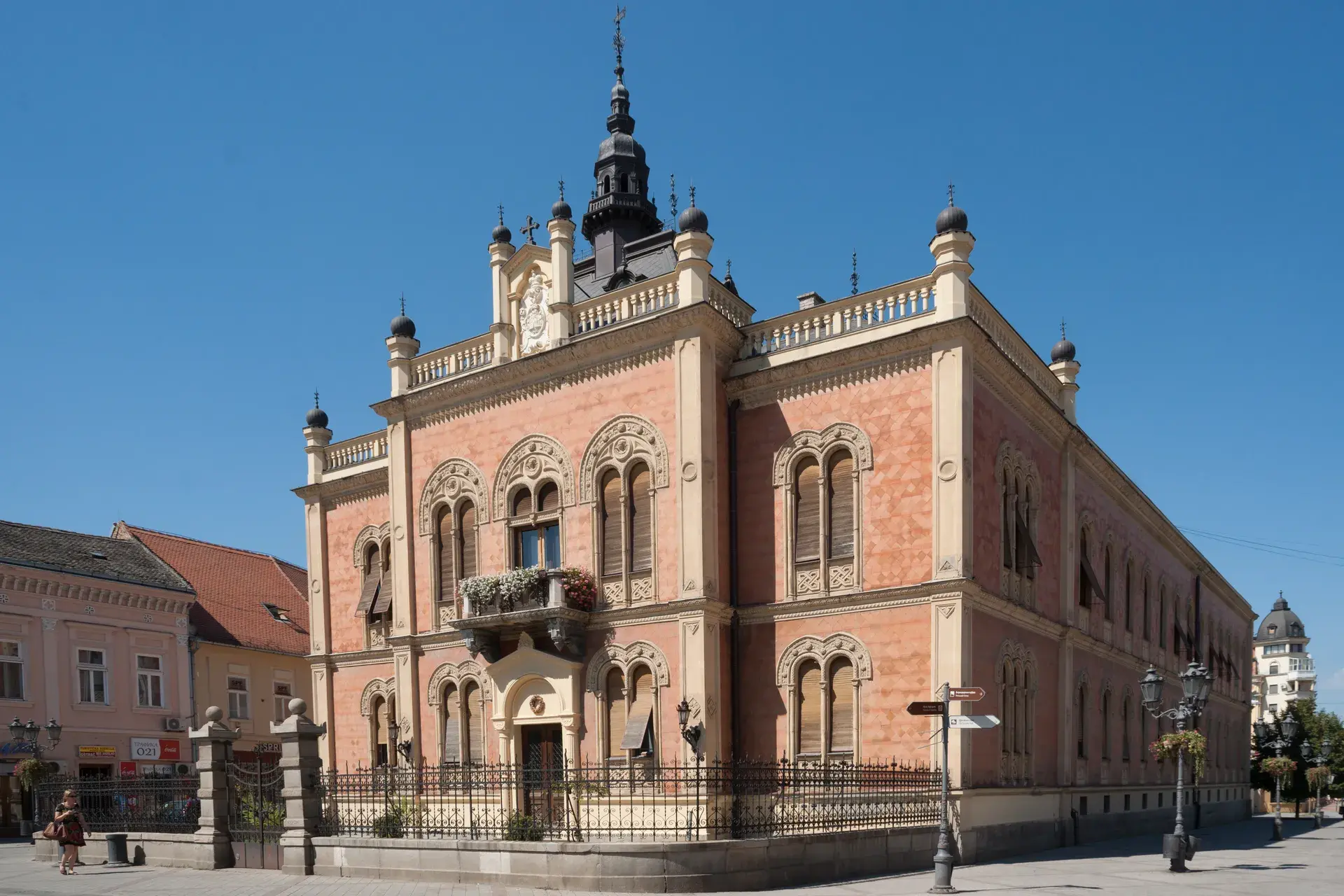
A striking red-brick palace anchors the end of Novi Sad's main pedestrian thoroughfare, hiding a history of bombardment and a secretly commissioned architect. Standing at the junction connecting Zmaj Jovina Street and Dunavska Street, the Orthodox Bishop’s Palace acts as a geographical pivot point linking Liberty Square to the Danube River parklands.
Architectural Brilliance and a Hidden Designer
The present Orthodox Bishop’s Palace was designed in 1899 by architect Vladimir Nikolić and completed in 1901. In a surprising historical twist, Nikolić refrained from officially signing his design plans. Because he was the godson of Patriarch Georgije Branković, he wanted to avoid public accusations of favoritism. Instead, architect Ferenc Raichle signed the official documents.
The structure is built in an eclectic Serbo-Byzantine Revival style that incorporates Byzantine, pseudo-Moorish, and medieval Serbian architectural motifs. The deep reddish hue of the exterior brick cladding is paired with yellow decorative tiles and stone window surrounds. This creates a distinct visual contrast at the termination of the paved Zmaj Jovina pedestrian corridor.
Byzantine and Moorish Influences
The exterior features arched bifora and trifora windows modeled directly after medieval Serbian monastery architecture, specifically drawing inspiration from the 12th-century Studenica Monastery. The building is also adorned with pseudo-Moorish sculptural elements crafted by sculptor Julije Anika.
The facade displays three coats of arms of the Eparchy of Bačka. The crest located on the main facade was carved in 1803 by Novi Sad artisan Aksentije Marković. It is a rare surviving artifact, having been salvaged from the earlier palace before its destruction.
From Destruction to Royal Declarations
The original bishop’s palace was erected on the site in 1741 by Bishop Visarion Pavlović. However, it was completely destroyed in June 1849 when Hungarian forces shelled Novi Sad from the Petrovaradin Fortress during the 1848–1849 uprising. Following decades without a permanent residence, construction on the present palace took place under Bishop Mitrofan Šević.
The newly completed palace soon witnessed a major historical event. In 1919, Prince Regent Aleksandar Karađorđević delivered a public address from the building's balcony following the unification of Banat, Bačka, and Baranja with the Kingdom of Serbia.
Current Use and Surrounding Monuments
Today, the palace serves as the active administrative seat and official residence of the Bishop of the Bačka Eparchy of the Serbian Orthodox Church. It forms a functional and architectural ensemble with Saint George’s Orthodox Cathedral, which is situated directly behind it. While the interior remains off-limits to general tourists without prior permission from church authorities, the detailed facade and open courtyard are easily visible from the street.
Directly in front of the palace stands a 2.3-meter bronze statue of the poet and physician Jovan Jovanović Zmaj. Erected in 1984 and created by Belgrade sculptor Dragan Nikolić, the monument depicts the poet walking along the exact street where he routinely took his daily walks during his lifetime in Novi Sad.
FAQ
Can visitors go inside the Orthodox Bishop’s Palace?
The interior is currently off-limits to general tourists as it functions as the active administrative seat and residence of the Bishop of the Bačka Eparchy. Access requires prior permission from church authorities.
Who designed the Orthodox Bishop’s Palace in Novi Sad?
The palace was designed in 1899 by architect Vladimir Nikolić. However, to avoid accusations of favoritism due to his relationship with Patriarch Georgije Branković, the plans were officially signed by architect Ferenc Raichle.
What happened to the original bishop's palace?
The original palace, built in 1741, was completely destroyed in June 1849 when Hungarian forces shelled Novi Sad from the Petrovaradin Fortress during the 1848–1849 uprising.