
Bratislava’s Blue Church: History & Architecture
Hungarian Secession Design and Architecture
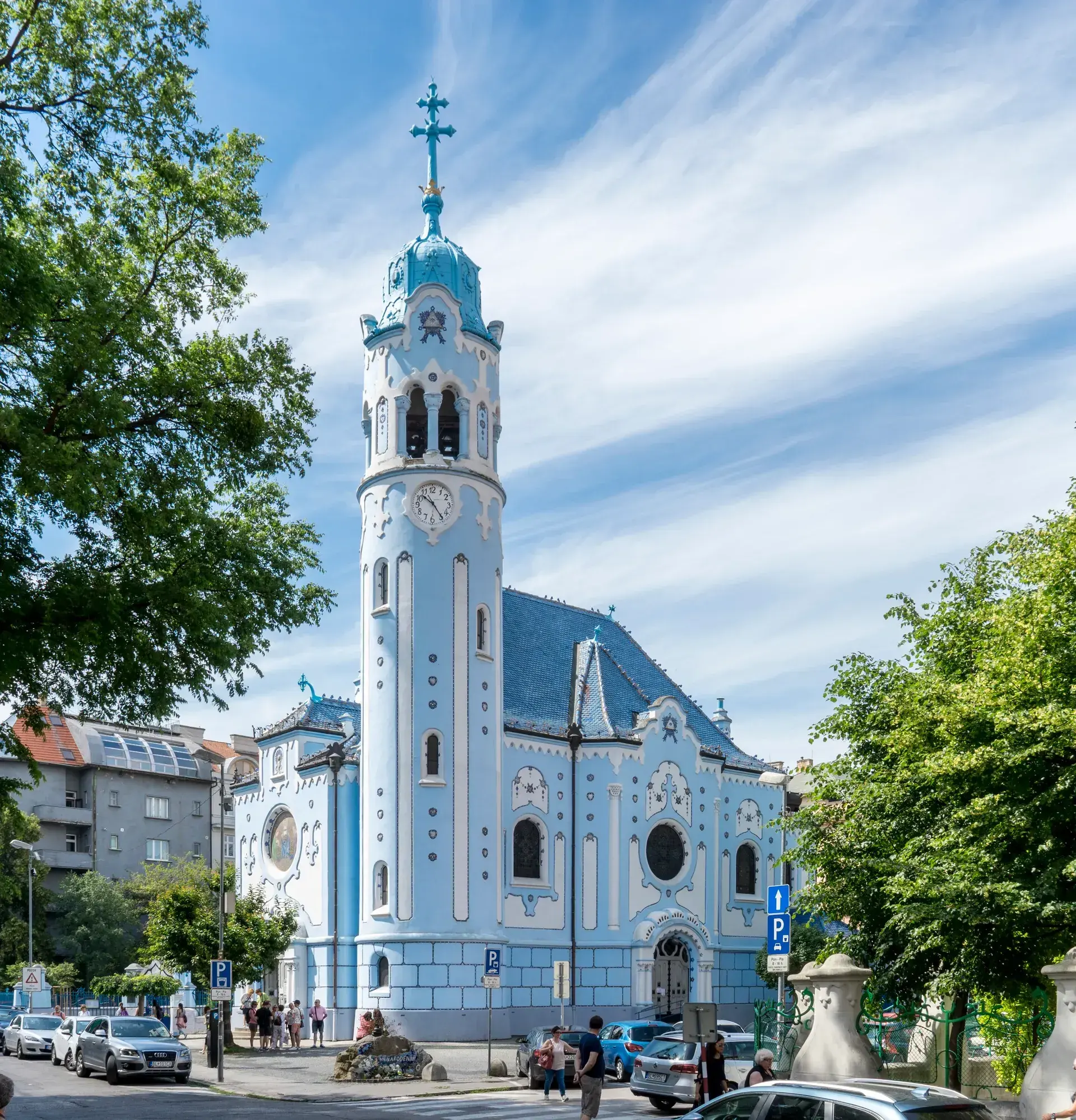
The Church of Saint Elizabeth of Hungary (Kostol svätej Alžbety Uhorskej), universally recognized as the Blue Church (Modrý kostolík), is situated on Bezručova Street on the eastern perimeter of Bratislava's Old Town. Designed by Budapest architect Ödön Lechner, a prominent master of the Hungarian Secession movement, the building is one of the most recognizable examples of Art Nouveau religious architecture in Central Europe.
Constructed between 1909 and 1913, the structure is built from reinforced concrete and brick. It is arranged around an oval-shaped single nave accompanied by a 36.8-meter-tall cylindrical bell tower. The exterior is defined by curved, organic contours, avoiding sharp right angles to give the masonry a soft, molded finish. Undulating white plaster ribbing frames its powder-blue facade, complemented by lustrous blue majolica accents and glazed ceramic roof tiles supplied by the renowned Zsolnay factory in Pécs, Hungary.
Although famous today for its monochromatic exterior, restoration research indicates that the church was not originally painted entirely blue. The stucco walls were initially finished in a muted grayish shade, designed to provide a sharper visual contrast against the deep blue glazed Zsolnay ceramics and roof tiles.
Bratislava walking tour with audio and quizzes: Hungary’s coronation city
2 hours8 stopsAudio guideStart any day, at your own paceTicket on your phone · 30-day refundOrigins and Royal Dedications
The church was commissioned around 1907 to commemorate the 700th anniversary of the birth of Princess Elizabeth of Hungary. It was initially planned as an integral school chapel for the adjacent Royal Catholic Gymnasium on Grösslingová Street, which was also designed by Lechner.
Erected during the reign of Emperor Franz Joseph I, the building served a dual commemorative purpose. In addition to honoring Saint Elizabeth, it paid homage to Empress Elisabeth of Austria ("Sisi"), who was assassinated in 1898. A marble memorial relief dedicated to the empress was placed on the grounds. The church was consecrated on October 11, 1913, standing as one of Lechner’s final major completed works before his death in 1914.
Decorative Motifs and Global Recognition
Throughout the church's plasterwork, mosaics, and iron details, rose motifs appear repeatedly. These details reference the traditional "Miracle of the Roses," a legend in which bread carried by Saint Elizabeth to feed the poor was transformed into blooming roses.
Built in an early-20th-century residential expansion district, the church stands as a testament to the modernization and architectural evolution of the city during the Austro-Hungarian era. It provides an Art Nouveau contrast to Bratislava's older architectural fabric, such as the Gothic St. Martin's Cathedral and the historic core's Baroque and Classical palaces. The building's architectural prominence is highlighted on an international scale by a miniature replica representing Bratislava at the Mini-Europe park in Brussels, Belgium.
Visiting the Church of St. Elizabeth
The Blue Church remains an active Roman Catholic parish church that hosts daily masses, sacramental rites, and local weddings. While the exterior and grounds can be viewed from the street at any time, interior visits are free of charge but restricted to brief daily windows scheduled around morning and late-afternoon liturgical services.
FAQ
Why is the church called the Blue Church?
Although officially dedicated to Saint Elizabeth of Hungary, it earned its popular name from its powder-blue facade, blue glazed roof tiles, and blue majolica ceramics produced by the Zsolnay factory.
Was the Blue Church always entirely blue?
No. Architectural restoration research revealed that the church's plaster walls were originally finished in a muted grayish tone, creating a deliberate contrast with the glazed blue tiles and ceramic decorations.
Can the interior of the church be visited?
Interior access is free but limited to narrow visiting windows around scheduled morning and late-afternoon religious services. The exterior is visible from Bezručova Street at all hours.
Who designed the Blue Church in Bratislava?
The church was designed by Budapest architect Ödön Lechner in the Hungarian Secession (Art Nouveau) style. Consecrated in 1913, it was one of his final completed projects before his death in 1914.