Old Slovak National Theatre: Bratislava Landmark
Neo-Renaissance Architecture on Hviezdoslav Square
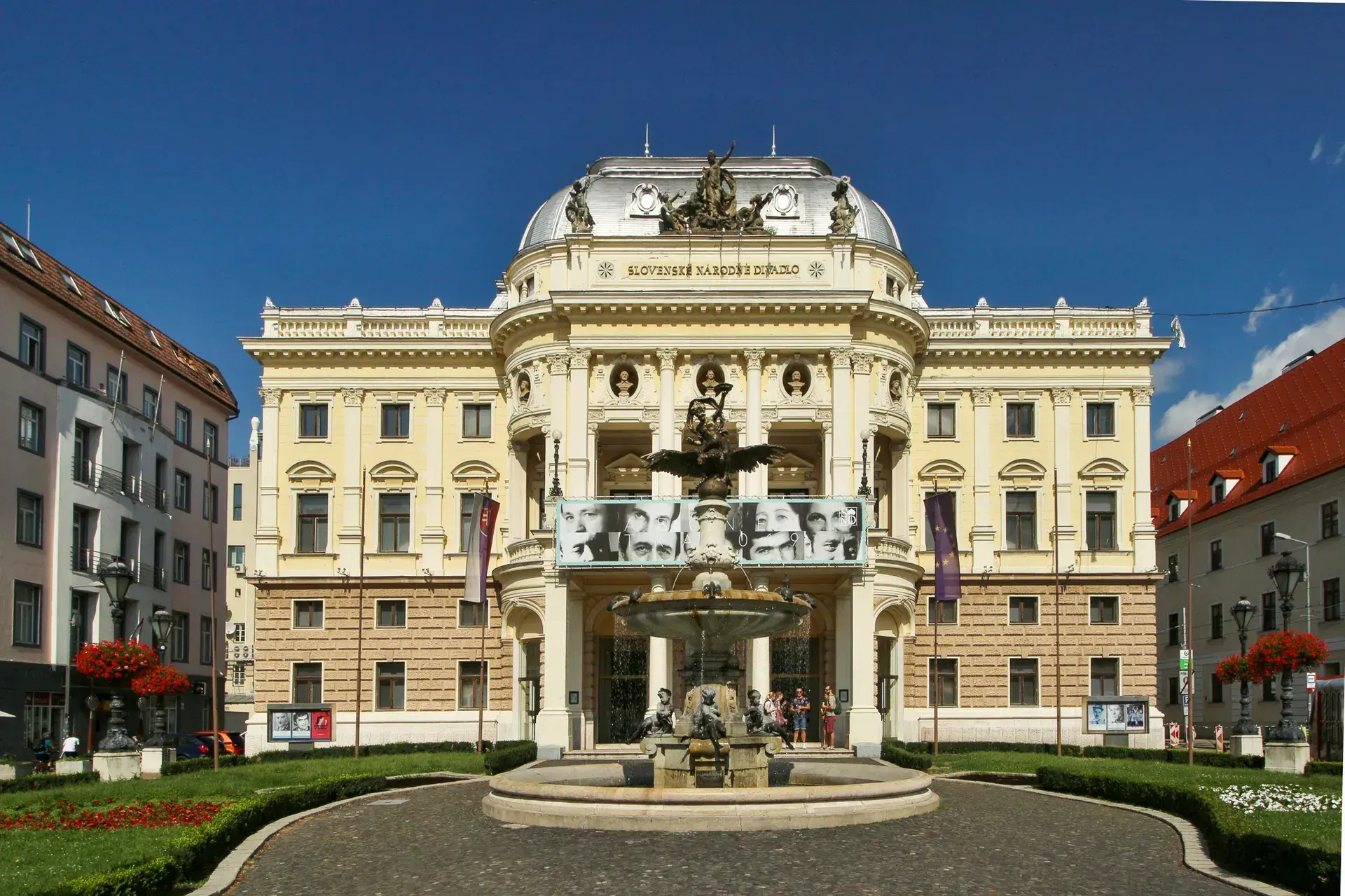
The historic building of the Slovak National Theatre stands prominently at the eastern terminus of Hviezdoslav Square (Hviezdoslavovo námestie) in Bratislava’s Old Town. Positioned at the threshold between the city's medieval core and the wider, tree-lined promenade developed during 19th-century Austro-Hungarian modernisation, the theatre remains one of the capital's architectural anchors.
Designed by the Viennese architectural partnership of Ferdinand Fellner and Hermann Helmer—who designed dozens of theatres across Central and Eastern Europe—the building exhibits an Eclectic, Neo-Renaissance style. It was erected between 1884 and 1886 by local builder Ignác Feigler Jr., replacing an older 1776 estate theatre commissioned by Count Juraj Csáky. The theatre officially opened on September 22, 1886, as the City Theatre of Pressburg with a performance of Ferenc Erkel’s opera Bánk bán.
Bratislava walking tour with audio and quizzes: Hungary’s coronation city
2 hours8 stopsAudio guideStart any day, at your own paceTicket on your phone · 30-day refundSculptural Details and the Facade Busts
The building's symmetrical exterior features an arched first-floor loggia, an ornate balustraded balcony, and classical pediments. Sculptural decorations include a stone group depicting the muse Thalia by Theodor Friedl, along with stone putti representing tragedy and comedy sculpted by Viktor Tilgner.
Set within oval niches on the facade are portrait busts that carry an unusual history. In the mid-1930s, Czechoslovak municipal authorities removed the original busts—depicting Johann Wolfgang von Goethe, William Shakespeare, Franz Liszt, József Katona, and Mihály Vörösmarty—with the intention of replacing them with Czech and Slovak cultural icons. The replacement sculptures were never completed, leaving the facade niches vacant for nearly 70 years. In 2003, copies of the original portraits were restored to their niches, with the exception of the lost bust of Vörösmarty, which was replaced by a newly crafted likeness of Wolfgang Amadeus Mozart.
Ganymede’s Fountain
Directly outside the theatre's main entrance on the pedestrian terrace sits Ganymede’s Fountain, created in 1888 by Pressburg-born sculptor Viktor Tilgner. Commissioned by the First Bratislava Savings Bank, the fountain’s upper register portrays the classical myth of Zeus, in the guise of an eagle, carrying Ganymede to Mount Olympus.
Beneath this classical scene, the fountain highlights the native biodiversity of the nearby Danube. Tilgner incorporated putti holding four native river fish—carp, catfish, pike, and perch—encircled by bronze depictions of turtles, frogs, and crayfish along the basin edges.
Cultural Transitions and Preservation
Initially serving touring German and Hungarian theatre companies, the venue took on a new institutional role following the establishment of Czechoslovakia. In 1920, the newly formed Slovak National Theatre launched operations here, accommodating professional opera, ballet, and drama companies under one roof.
During World War II, air raids inflicted foundation damage on the structure, leading to extensive repairs in 1949. Between 1969 and 1972, architect Rajmund Hirth directed a comprehensive technical modernization that preserved the historic facade, foyer, and auditorium while constructing a dedicated administrative and technical annex facing Komenského Square. The stage served as the primary home for SND Opera and Ballet until 2007, when the Slovak National Theatre opened its modern complex on Pribinova Street near the Danube riverfront.
In May 2021, the historic theatre closed to public performances because of severely deteriorated stage mechanics and structural elements. Regular productions remain consolidated at the newer facility on Pribinova Street while conservation planning and renovation work proceed for the 19th-century landmark.
FAQ
Who designed the historic Slovak National Theatre building?
The theatre was designed in a Neo-Renaissance style by the Viennese architectural duo Ferdinand Fellner and Hermann Helmer, and constructed by local Pressburg builder Ignác Feigler Jr. between 1884 and 1886.
Why were the niches on the facade left empty for decades?
Between 1934 and 1936, municipal authorities removed the original busts of Goethe, Shakespeare, Liszt, Katona, and Vörösmarty to replace them with Czech and Slovak figures. The new busts were never installed, leaving the niches empty until replica busts were placed in 2003, including Mozart in place of the lost Vörösmarty bust.
Is the historic theatre currently hosting performances?
The historic building has been closed to theatrical performances since May 2021 due to the deterioration of its stage technology and structural systems. Productions are temporarily consolidated at the SND New Building on Pribinova Street.