Čumil: Bratislava's Iconic Bronze Man at Work
An Unconventional Street Monument
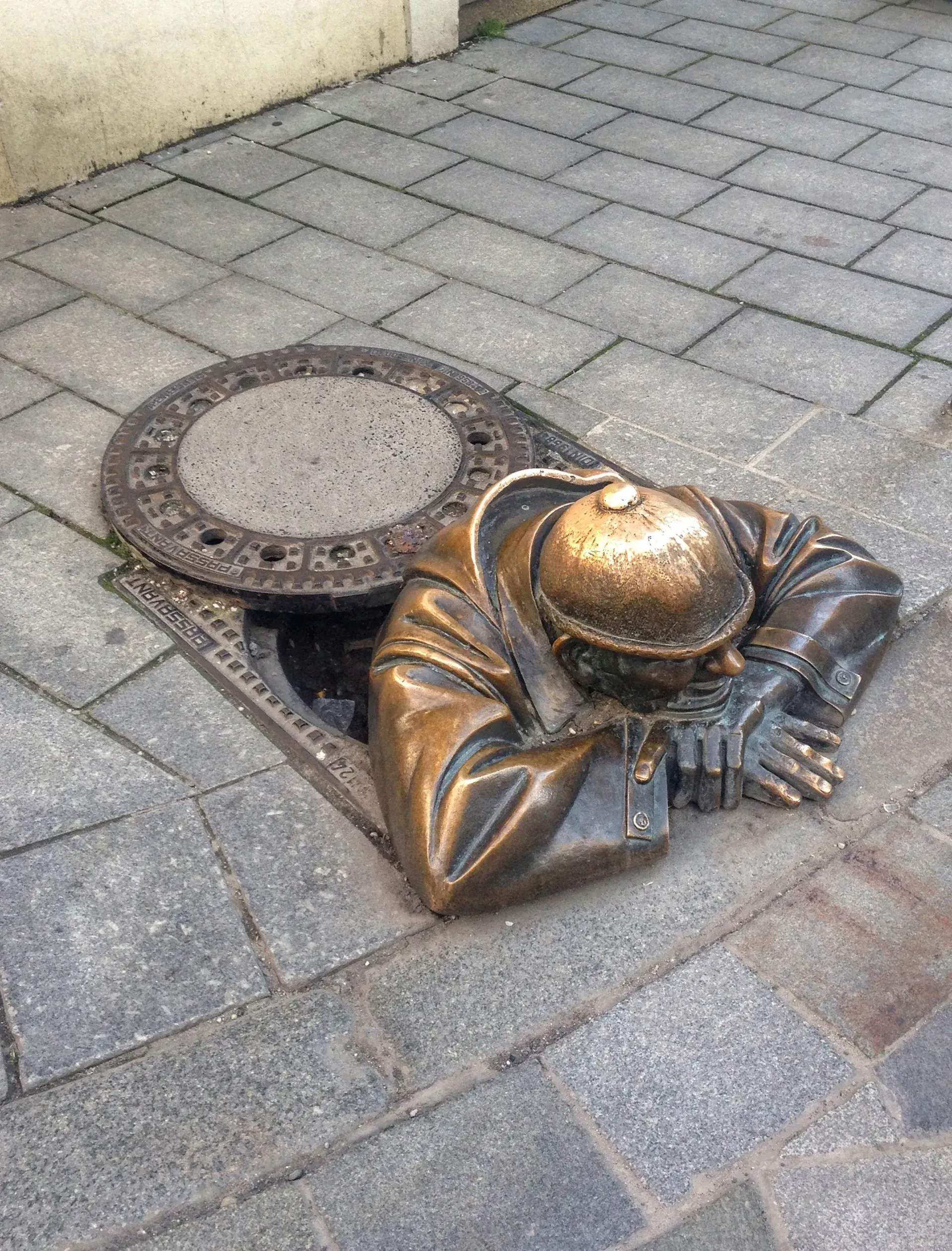
Emerging directly from an open bronze manhole with his chin resting comfortably on folded arms, Čumil is one of the most recognizable public sculptures in Bratislava. Created by Slovak artist Viktor Hulík, the life-sized bronze figure rests flush with the cobblestone street at the busy Old Town junction of Panská, Laurinská, and Rybárska brána streets. In colloquial Slovak, the name Čumil translates to "the watcher" or "the rubberneck," though municipal signs and English guidebooks commonly identify the artwork as "Man at Work."
Unlike traditional public monuments set atop grand pedestals, Čumil occupies the ground plane. Decades of tactile interaction have left the bronze pom-pom on his cap polished to a bright, reflective golden hue, standing out against the weathered, dark patina of his coat, hands, and the surrounding manhole rim.
Bratislava walking tour with audio and quizzes: Hungary’s coronation city
2 hours8 stopsAudio guideStart any day, at your own paceTicket on your phone · 30-day refundThe Revival of Bratislava's Promenade
Čumil was commissioned by municipal authorities in Bratislava’s Staré Mesto district as part of a late-1990s effort to revitalize the historic city center following the fall of communism. The sculpture was officially unveiled on July 26, 1997, during the Korzo Party, an outdoor gathering attended by tens of thousands of citizens and President Michal Kováč to celebrate the pedestrianization of Bratislava's central promenade.
Sculptor Viktor Hulík deliberately designed Čumil without any historical, political, or military figures in mind. The goal was to inject warmth, accessible scale, and humor into an urban core previously dominated by solemn ideological monuments. Along with other contemporaneous bronze installations, such as the silver-hatted Schöner Náci and the Napoleonic Soldier, Čumil helped redefine the city's pedestrian corridor linking Hlavné námestie to St. Martin's Cathedral.
Delivery Trucks and the Man at Work Sign
Because Čumil sits low and level with the pavement, authorized vehicles navigating the pedestrian zone frequently failed to notice him. In the years immediately following his installation, delivery vans struck the sculpture multiple times, on several occasions knocking off the figure's head.
To prevent further damage and preserve the artwork, municipal authorities placed a tall, official street-style sign right beside the manhole. Featuring an illustration of the sculpture beneath the bold text "MAN AT WORK," the sign serves both as an alert for drivers and as an official identifier for visitors. The artwork has occasionally required maintenance; in 2018, it was temporarily removed for roughly ten days so conservators could remedy corrosion around the mounting bolts caused by standing rainwater.
Urban Folklore and Persistent Myths
While Viktor Hulík conceived Čumil simply as a cheerful, imaginary laborer, various local theories have emerged regarding his identity. Some treat the statue as a tongue-in-cheek commentary on communist-era labor attitudes, portraying a worker enjoying an endless rest while merely pretending to work. Others interpret the figure as a mischievous rubberneck peering up at pedestrians on the promenade.
A widespread visitor tradition suggests that touching the polished pom-pom of Čumil's cap will grant a wish, provided the request is kept secret. The statue also faces frequent historical misconceptions: foreign visitors occasionally mistake his winter cap for a military helmet, sparking unfounded rumors that the piece honors a wartime soldier or a 1968 resistance hero. In reality, Čumil commemorates no historical individual, remaining a lighthearted celebration of civic life.
FAQ
What does the name Čumil mean?
Čumil translates colloquially from Slovak as "the watcher" or "the rubberneck." The figure is also known internationally as "Man at Work."
Why is there a traffic sign next to the statue?
Because the sculpture sits flush with the cobblestones, authorized delivery vehicles repeatedly struck and severed the bronze head. City authorities installed the "MAN AT WORK" sign to protect the statue from oncoming traffic.
Is Čumil based on a real person or resistance fighter?
No. Sculptor Viktor Hulík designed the figure as a purely imaginary character without political, military, or historical associations, aiming solely to bring humor and human scale to the pedestrian zone.