
Bratislava Castle: The Four-Towered Fortress
An Iconic Fortress on the Danube
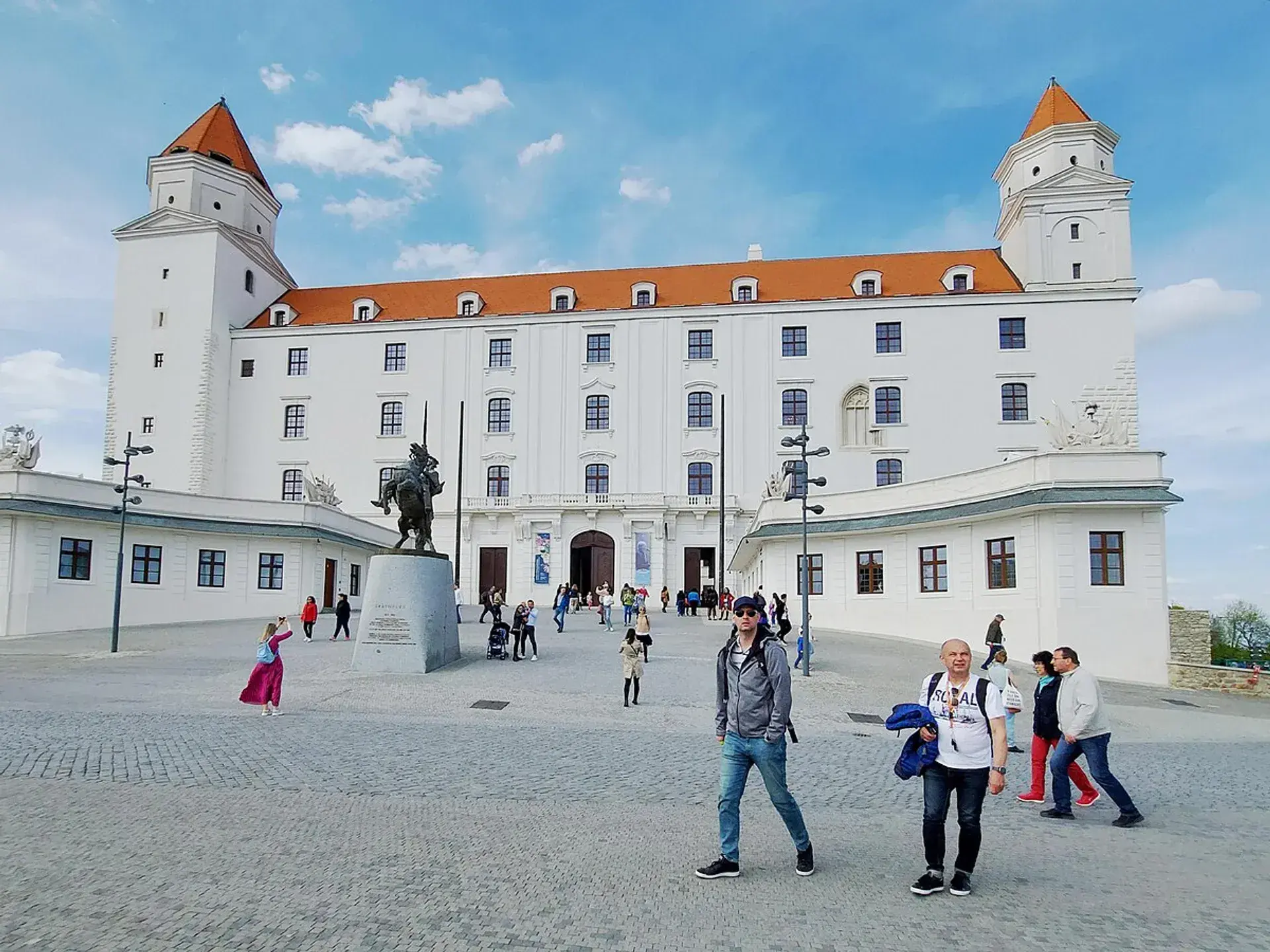
Perched on an isolated rocky hill of the Little Carpathians, Bratislava Castle stands between 80 and 85 meters above the Danube River. The monumental fortress serves as the capital's central skyline identifier and visual anchor. Its distinct rectangular, four-winged structure punctuated by four corner towers has earned the palace the local nickname "the upside-down table" (obrátený stôl).
The castle grounds are entered through four historic portals: the 15th-century Sigismund Gate, the Vienna Gate, the Leopold Gate, and the Nicholas Gate. Inside the complex, visitors encounter an entrance courtyard (Yard of Honor), external bastions, and the excavated stone foundations of a 9th-century Great Moravian basilica. Within the central palace courtyard, a historic hand-cut stone well plunges roughly 80 meters straight into the bedrock.
Bratislava walking tour with audio and quizzes: Hungary’s coronation city
2 hours8 stopsAudio guideStart any day, at your own paceTicket on your phone · 30-day refundMillennia of Imperial Transformation
The castle hill holds a history of continuous settlement beginning in prehistoric times, serving as an acropolis for a Celtic oppidum and later as a fortified Great Moravian stronghold. Following Ottoman expansion across Central Europe in the 16th century, the city—then known as Pressburg—became the capital of Royal Hungary. From 1552 until the late 18th century, the fortress guarded the Hungarian Crown Jewels, including the Holy Crown of Saint Stephen, inside the southwest Crown Tower. Rising roughly 47 meters, this tower is the castle's oldest standing section, adapted from a 13th-century medieval bergfried.
During the 1760s, Empress Maria Theresa commissioned a sweeping overhaul that transformed the military bastion into a grand Baroque-Rococo residential palace. Under her daughter Archduchess Maria Christina and Governor Duke Albert of Saxe-Teschen, the palace flourished as a royal seat. The extensive assembly of prints and drawings gathered here by Duke Albert was later moved to Vienna, where it established the founding collection of the world-renowned Albertina Museum. Local folklore maintains that Empress Maria Theresa still wanders the palace corridors at night in royal dress.
Imperial activities departed the hilltop in the 1780s, after which the complex housed a Catholic seminary and subsequent military barracks. On May 28, 1811, a devastating fire swept through the structure, gutting the palace and neighboring quarters. The fortress remained a charred, roofless ruin for well over a century until extensive reconstruction commenced in the 1950s. Comprehensive restoration campaigns continued through the 2010s, returning the palace to its bright white facade and red-tiled roofline.
Modern Museum and Public Grounds
Today, the palace houses the Museum of History, a branch of the Slovak National Museum. Its galleries display comprehensive exhibitions spanning archaeology, numismatics, and decorative arts. The southern wing also contains official representative premises utilized by the National Council of the Slovak Republic.
Beyond the museum exhibitions, the outdoor grounds serve as an active public and cultural gathering point. The restored northern French Baroque garden features manicured boxwood parterres, while the courtyard regularly hosts seasonal productions, including concerts, Bratislava Coronation Days, and the Summer Shakespeare Festival. Along the south-facing stone terrace, visitors experience sweeping river breezes and views over the Danube, looking across to the modern cable-stayed Most SNP bridge and the concrete apartment blocks of the Petržalka district.
FAQ
Why is Bratislava Castle nicknamed the upside-down table?
The castle earned the nickname (obrátený stôl) due to its geometric layout, consisting of a uniform rectangular palace body anchored by four protruding corner towers.
Can the grounds of Bratislava Castle be visited for free?
Yes. While the Museum of History inside the main palace requires paid entry, the surrounding grounds, the restored Baroque gardens, and the stone terraces overlooking the Danube are accessible to the public for free.
What is the history behind the Crown Tower?
Adapted from a 13th-century medieval bergfried, the 47-meter Crown Tower is the castle's oldest surviving section. Between 1552 and the late 18th century, it was used to safeguard the Hungarian Crown Jewels.
When was Bratislava Castle rebuilt after the 1811 fire?
After being gutted by fire on May 28, 1811, the castle remained a roofless ruin for more than a century. Systematic reconstruction began in the 1950s and concluded with further restorations through the 2010s.