Primate's Palace: History, Tapestries & Guide
Neoclassical Architecture on Primate's Square
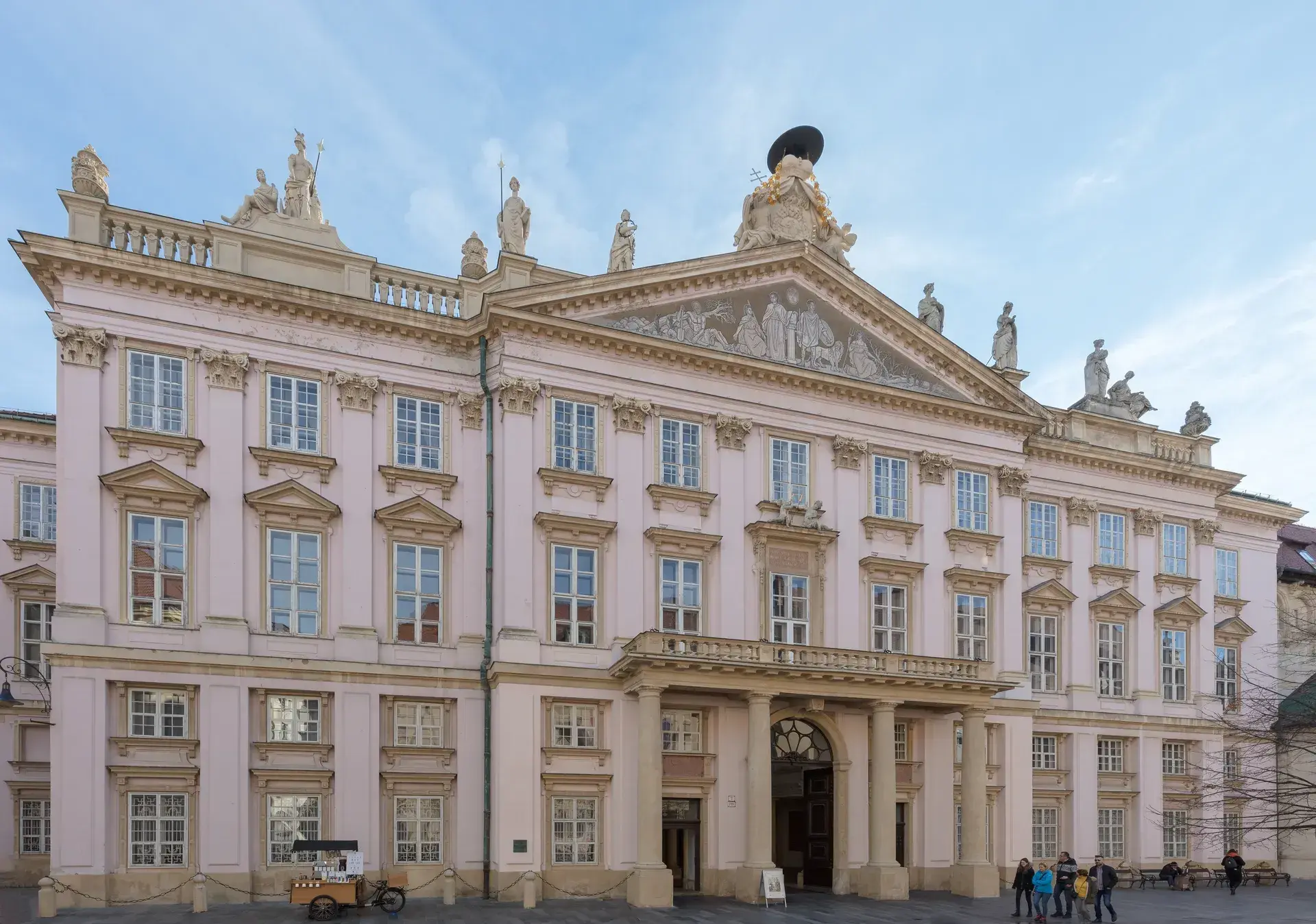
Built between 1778 and 1781 to designs by architect Melchior Hefele, the Primate's Palace (Primaciálny palác) is a prominent Neoclassical residence commissioned by Archbishop Cardinal József Batthyány. Constructed as a winter residence for the Archbishop of Esztergom during Bratislava's time as the coronation capital of Hungary, the building stands on Primate's Square directly behind the Old Town Hall, linking the civic core to the historical coronation path.
The palace's symmetrical pink-and-white facade features an attic balustrade lined with allegorical statues by J. Kögler and F. Prokop, as well as stone decorative urns by J. A. Messerschmidt. A grand central tympanum displays the archbishop's coat of arms, crowned by a cast-iron model of a cardinal's hat measuring one metre across and weighing approximately 150 kilograms. Flanking cherub figures hold the letters "I" and "C", representing Cardinal Batthyány's personal motto, Iustitia et Clementia (Justice and Clemency).
Bratislava walking tour with audio and quizzes: Hungary’s coronation city
2 hours8 stopsAudio guideStart any day, at your own paceTicket on your phone · 30-day refundThe Peace of Pressburg and European Geopolitics
The palace served as the setting for pivotal diplomatic and political milestones in European history. Most notably, on 26 December 1805, representatives of Napoleonic France and the Austrian Empire signed the Peace of Pressburg in the palace's Hall of Mirrors (Zrkadlová sieň) following the Battle of Austerlitz. The treaty concluded the War of the Third Coalition and set into motion the dissolution of the Holy Roman Empire the following year.
Decades later, the building hosted proceedings of the Hungarian Diet. In April 1848, King Ferdinand signed the April Laws within the palace walls, enacting sweeping legal reforms that included the formal abolition of serfdom.
The Rediscovered English Tapestries
In August 1903, the Roman Catholic Church sold the palace to the municipality of Bratislava. During subsequent municipal renovations that year, workers stripping wall coverings in an antechamber uncovered a concealed architectural cavity. Hidden inside were six 17th-century English tapestries woven at the Mortlake Tapestry Works near London.
Based on designs by Francis Cleyn, the tapestries depict the Greek myth of Hero and Leander. Today, this set remains the only known complete cycle of the Mortlake series surviving anywhere in the world.
Current Civic Role and Visiting Information
Today, the Primate's Palace serves as the official seat of the Mayor of Bratislava and the meeting venue for the City Council. The piano nobile features five monochromatic salons (Green, Brown, Blue, Red, and Gold), a glazed oratory overlooking the Chapel of St. Ladislaus, and the Hall of Mirrors, which regularly hosts state receptions, chamber music concerts, and civil weddings. In the central courtyard, a fountain features a 17th-century statue of Saint George slaying the dragon, which local legend claims turns on his horse and bows to townspeople once a year on Saint George's Day.
The palace exterior and stone courtyard are accessible from the outside for free. Visitors wishing to explore the interior—including the Hall of Mirrors, the monochromatic salons, and the rare tapestry collection—can enter through ticketed admission managed by the Bratislava City Gallery.
FAQ
What major historical treaty was signed at the Primate's Palace?
The Peace of Pressburg was signed in the Hall of Mirrors on 26 December 1805 between Napoleonic France and the Austrian Empire, ending the War of the Third Coalition.
What makes the tapestries inside the Primate's Palace unique?
Discovered in a concealed wall cavity in 1903, the six 17th-century English tapestries from the Mortlake Tapestry Works depict Hero and Leander and form the only complete surviving cycle of this series in the world.
Is entry to the Primate's Palace free or ticketed?
Viewing the palace facade and courtyard is free, while accessing the interior representative rooms, the Hall of Mirrors, and the Bratislava City Gallery exhibition requires paid admission.