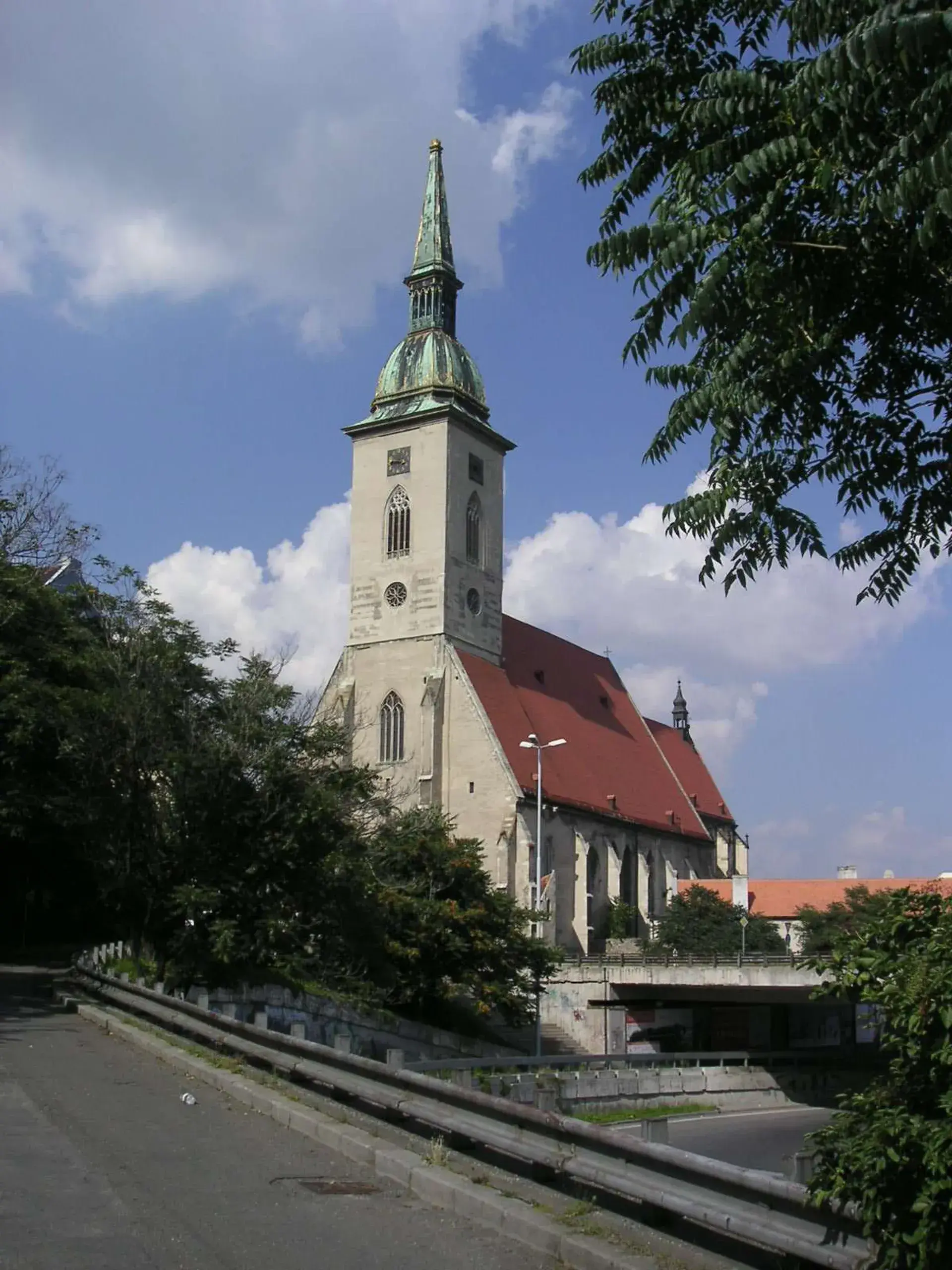
St. Martin's Cathedral: Bratislava's Coronation Site
St. Martin’s Cathedral (Katedrála svätého Martina), positioned at Rudnayovo námestie directly below Castle Hill, is the metropolitan cathedral of the Roman Catholic Archdiocese of Bratislava. Originating over an earlier 13th-century Romanesque church of the Holy Saviour and an adjacent parish cemetery, the Gothic cathedral began construction in the early 14th century and was formally consecrated in 1452. Embedded into the medieval city defenses, its fortified western tower once served as an active bastion.
The Royal Coronation Era
Following the Ottoman conquest of central Hungary and the fall of the historic coronation city of Székesfehérvár after 1526, Bratislava became Hungary's administrative capital and sanctuary. Between 1563 and 1830, St. Martin's Cathedral served as the official coronation church of the Kingdom of Hungary. Over this period, the sanctuary hosted ceremonies for 10 kings, 7 royal consorts, and 1 reigning queen—Maria Theresa, crowned here on June 25, 1741.
The first royal coronation was that of Maximilian II in 1563, and the tradition concluded with Ferdinand V in 1830. Today, the historic coronation procession through the city is commemorated by small cast-brass crowns embedded in the Old Town cobblestone pavement, linking the cathedral to the Main Square and the Franciscan Church.
Bratislava walking tour with audio and quizzes: Hungary’s coronation city
2 hours8 stopsAudio guideStart any day, at your own paceTicket on your phone · 30-day refundGothic Architecture and the Crown Spire
The three-nave cathedral measures 69.37 metres in length, 22.85 metres in width, and 16.02 metres in height, dominated by an 85-metre tower. Rather than carrying a standard Christian cross, the summit of the spire is crowned by a 300-kilogram gilded replica of the Hungarian Crown of Saint Stephen resting atop a cushion. A local myth suggested the cushion was large enough to accommodate a horse and carriage, though in reality the pillow measures approximately 1.2 to 1.35 metres square.
The tower has undergone significant structural transformations over the centuries. Lightning struck the original Gothic spire in 1760, and its Baroque replacement was destroyed by fire in 1835. In 1847, the tower was reconstructed in Neo-Gothic style to mount the gilded crown replica, and the interior underwent a re-Gothicization program between 1869 and 1877.
Lead Statuary and Underground Crypts
Inside the cathedral stands an 18th-century Baroque sculpture of Saint Martin dividing his cloak for a beggar, designed by Austrian sculptor Georg Raphael Donner between 1734 and 1744 as part of the original high altar. Cast in lead rather than standard bronze or stone, the monument is recognized as Central Europe's first monumental secularized religious sculpture in that metal.
Beneath the church floor, narrow, steep stone steps lead down into burial vaults situated up to six metres underground. In these subterranean crypts, the air temperature drops significantly amid quiet rows of stone funerary slabs.
Urban Transformations and Current Life
St. Martin's Cathedral serves as a geographic transition between the pedestrian streets of Bratislava's medieval core—including Kapitulská and Panská streets—and the upward path to Bratislava Castle. In the late 1960s and early 1970s, communist planners demolished the historic Jewish Quarter, Rybné Square, and the 1893 Moorish Neolog Synagogue to construct a four-lane roadway feeding the SNP Bridge, leaving high-speed vehicular traffic running alongside the cathedral walls. A Holocaust memorial and silhouette marker now stand in the adjacent cleared space.
Today, the cathedral continues its liturgical mission, holding daily Roman Catholic Masses in Slovak and Sunday services in Latin. Outside of service hours, the nave, treasury, and crypts are open to visitors. The structure also anchors the city's annual Coronation Days festival, which features historical re-enactments of royal ceremonies in period dress.
FAQ
Why is there a crown on top of St. Martin's Cathedral?
A 300-kilogram gilded replica of the Crown of Saint Stephen sits atop the 85-metre spire to honor the cathedral's historic role as the coronation church of the Kingdom of Hungary between 1563 and 1830.
Which monarchs were crowned at St. Martin's Cathedral?
The cathedral hosted the coronations of 10 kings, 7 royal consorts, and 1 reigning queen, Maria Theresa. The ceremonies began with Maximilian II in 1563 and concluded with Ferdinand V in 1830.
What is unique about the statue of Saint Martin inside the cathedral?
The 18th-century Baroque sculpture of Saint Martin dividing his cloak, created by Georg Raphael Donner, was cast in lead rather than bronze or stone, making it Central Europe's first monumental secularized religious sculpture in that metal.