Roman Forum Molinete: Heart of Roman Cartagena
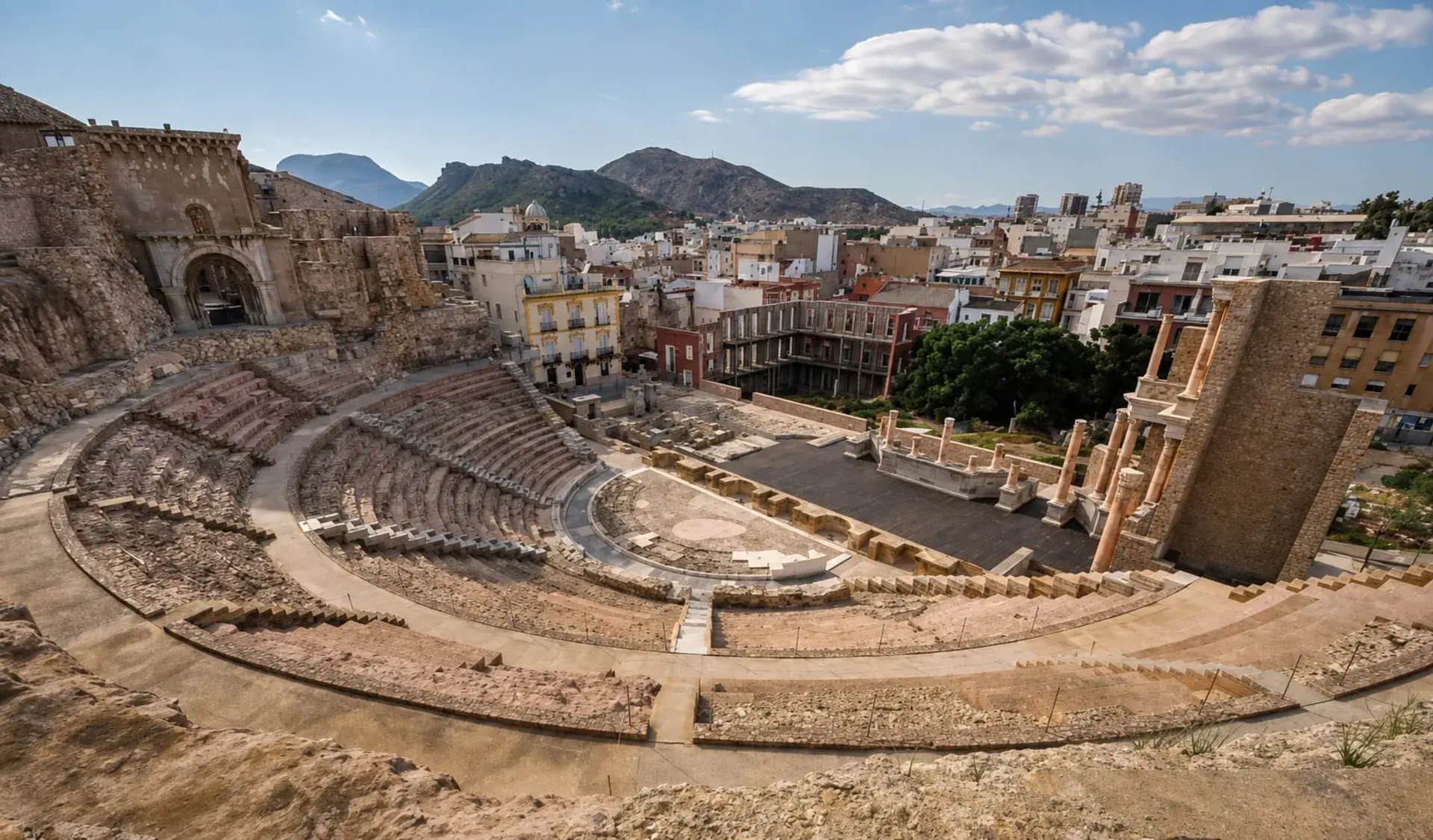
The Roman Forum Molinete is an archaeological park in Cartagena, Spain, representing the civic and religious epicenter of the ancient city of Carthago Nova. Situated on the Molinete hill, one of the city's five natural fortresses, the site reveals the urban heart of what was one of Roman Hispania's most significant ports.
History and Urban Transformation
The city's story begins with the Carthaginian general Hasdrubal the Fair, who founded Qart Hadasht in 227 BC. In 209 BC, the Roman general Scipio Africanus conquered the city, renaming it Carthago Nova. A major turning point occurred in 54 BC when the city received colonial status, leading to significant urban planning.
Under the reign of Emperor Augustus, Carthago Nova underwent intense development to mirror the grandeur of Rome. On the Molinete hill, which had been terraced with buildings since the 2nd century BC, a new forum district was developed. This new complex, built in the 1st century AD, replaced earlier domestic and artisan neighborhoods and became the hub of political, administrative, and religious life, hosting Imperial cult ceremonies and state processions.
Architecture and Key Discoveries
The forum complex featured a large rectangular plaza surrounded by Roman-style structures, including a basilica, government buildings (Curia), shops, and elite residences. Major construction took place in the 1st century AD, though some structures like the Atrium building date to the end of the 1st century BC.
One of the most significant discoveries is the Sanctuary of Isis and Serapis. This well-preserved temple dedicated to Egyptian deities was a turning point for studying Nilotic rites on the Iberian Peninsula. The adjacent Atrium building was used for ritual banquets honoring these gods, using rainwater collected in underground cisterns for purification. The Atrium was later converted into a residential building before a fire destroyed it in the late 3rd or early 4th century AD.
The site also includes a large thermal bath complex. Its frigidarium (cold room) still has its original marble floor. These baths were renovated in the 5th century and remained in use as social facilities until the 6th century. An inscription dedicated to Numisius Laetus, from a powerful local family, was found reused in a wall of the baths.
The Site Today
Today, the site is the "Museo del Barrio del Foro Romano," an archaeological park and museum that opened in 2020. An elevated walkway, designed by Amann Cánovas Maruri, protects the ruins while providing accessible views for visitors. The recovery project for the site received Spain's National Prize for Restoration & Conservation of Cultural Heritage in 2012.
The museum building displays over 350 artifacts from the 3rd century BC to the 20th century AD across three floors. A virtual reality app is also available, offering 360-degree reconstructions of daily life in ancient Carthago Nova. Ongoing archaeological work continues on the Molinete hill, allowing visitors to witness the research process.
FAQ
When was the Roman Forum in Cartagena built?
Major construction of the forum complex, including the thermal baths, began in the 1st century AD. The Atrium building, however, was built earlier, at the end of the 1st century BC.
What is unique about the Roman Forum Molinete?
A key feature is the well-preserved Sanctuary of Isis and Serapis. The discovery of this temple dedicated to Egyptian deities provided significant insight into the diverse religious practices and cultural connections within the Roman Empire.
What can you see at the Roman Forum Molinete today?
The site is an archaeological park and museum. Visitors can see the ruins of the Roman thermal baths, a basilica, the Atrium building, and the Sanctuary of Isis and Serapis. The museum houses over 350 artifacts found at the site.
Who were the important historical figures associated with Cartagena?
Hasdrubal the Fair, a Carthaginian general, founded the city as Qart Hadasht in 227 BC. The Roman general Scipio Africanus conquered it in 209 BC, and Emperor Augustus's reign saw its transformation into a major Roman city.