Patio de los Naranjos: Córdoba's Historic Courtyard
The Patio de los Naranjos, or Courtyard of the Orange Trees, serves as the iconic entrance to Córdoba's Mosque-Cathedral. While known for the fragrant scent of its citrus trees and the cooling sound of its fountains, the courtyard's famous orange trees were not part of its original Islamic design, reflecting a layered history of cultural transformation.
A History of Transformation
The courtyard's origins trace back to the construction of the Great Mosque, beginning in 786 AD. It was conceived as the sahn, or ablutions courtyard, a vital space for ritual purification before Muslim prayer. The initial galleries were started by Abderramán I and completed by his successor, Hixem I. During the Islamic era, the courtyard also functioned as a public forum for teaching and the administration of justice.
Following the Christian conquest of Córdoba in 1236 by Ferdinand III, the mosque was converted into a cathedral, and the courtyard was desacralized. Over the centuries, its function shifted, serving as a cloister, a public square, a leisure area, and even a cemetery, encapsulating the city's diverse historical narrative.
Architectural Evolution
The courtyard underwent several expansions throughout its history. In the 10th century, Abd al-Rahman III expanded it to the north, and Almanzor later extended it to the east. A major architectural transformation occurred in the 16th century under the direction of Bishop Martín Fernández de Angulo and architect Hernán Ruiz, the Elder. This remodeling introduced Christian architectural influences, such as the pointed half arches seen in the galleries today.
The Garden's Design and Sensory Experience
The present landscaped appearance was established between 1597 and 1601 by Bishop Francisco Reinoso. Although orange trees are documented from the 15th century, the original plantings during the Islamic period consisted of palm, cypress, and olive trees. Olive and cypress trees were reintroduced in the 18th century.
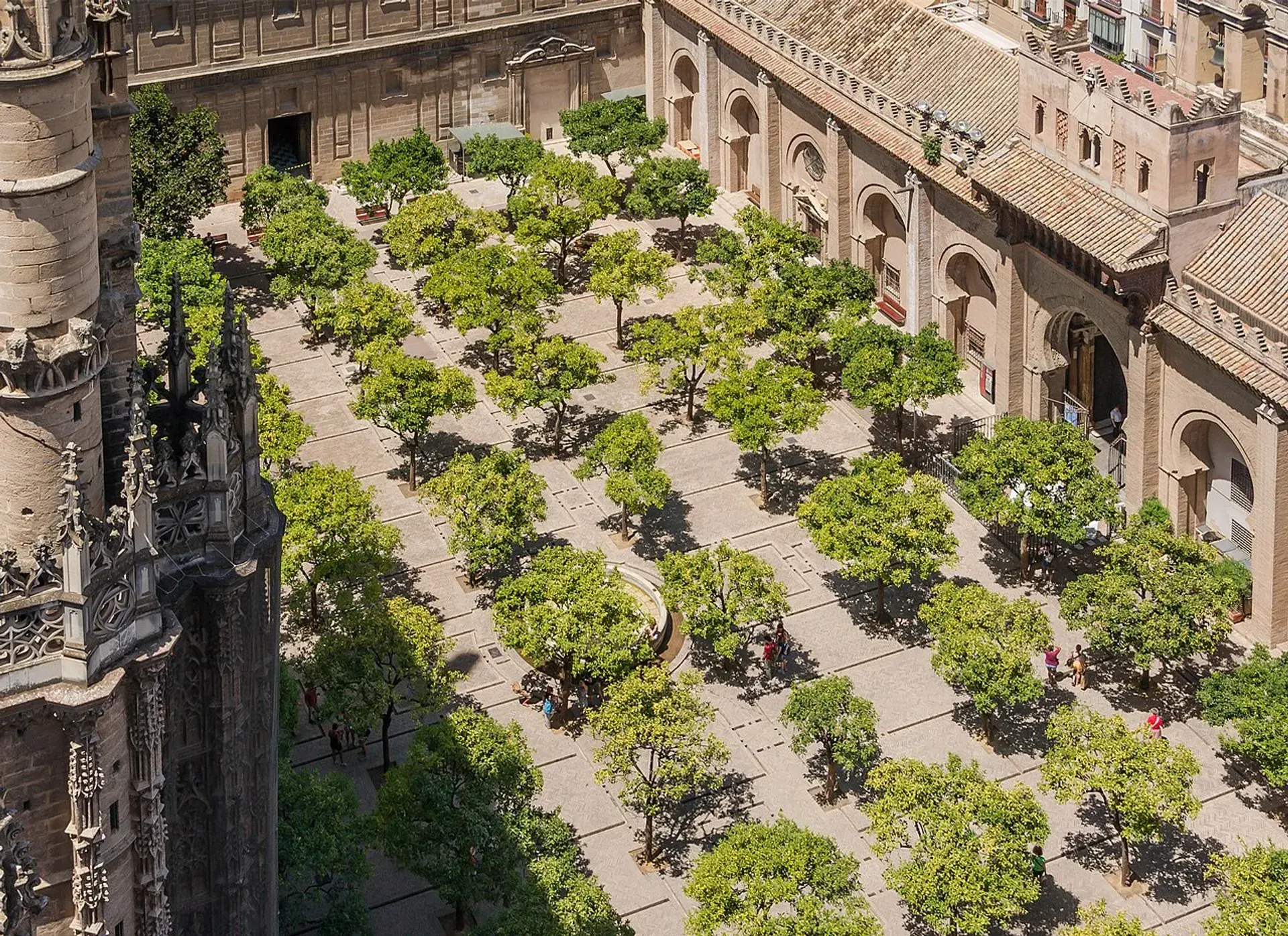
Today, the courtyard is home to 98 bitter orange trees planted in precise rows. In the spring, their blossoms fill the air with a delightful fragrance. The sensory experience is enhanced by the sound of flowing water from irrigation channels that traverse the pavement, providing a cooling effect in the warm climate.
Ingenious Engineering and Design
A remarkable feature lies hidden beneath the courtyard: a large cistern, or aljibe. This advanced hydrological system was designed to collect rainwater runoff from the mosque's roof. The collected water was used for ritual ablutions and to feed a sophisticated irrigation system of brick-lined channels that watered the trees.
The layout of the garden is also a feat of deliberate design. The 98 trees are meticulously aligned to mirror the arrangement of the columns inside the Mosque-Cathedral, creating a seamless visual continuation of the interior's famous 'forest of columns' into the open-air courtyard.
The Courtyard Today
Currently, the Patio de los Naranjos is an integral part of the Mosque-Cathedral complex and a significant attraction in Córdoba. It offers a tranquil, shaded resting spot for visitors. The space is also used for various public events and celebrations, notably as a gathering place to observe processions during Holy Week (Semana Santa).
FAQ
What was the original purpose of the Patio de los Naranjos?
The Patio de los Naranjos was originally the ablutions courtyard, or 'sahn', of the Great Mosque of Córdoba. It was a space for Muslims to perform ritual purification before prayer and also served as a public area for teaching and justice.
Were there always orange trees in the Patio de los Naranjos?
No. Despite its name, historical records indicate that the courtyard was first planted with palm, cypress, and olive trees. Orange trees are only documented from the 15th century onwards, and the current garden layout was established in the late 16th and early 17th centuries.
How are the trees in the courtyard watered?
The courtyard uses a sophisticated irrigation system originating from an underground cistern, or 'aljibe'. This cistern collects rainwater from the mosque's roof, which is then distributed to the trees through a network of brick-lined channels.
What is the significance of the tree arrangement in the courtyard?
The 98 trees are planted in rows that precisely align with the columns inside the Mosque-Cathedral. This design choice creates a visual extension of the interior's 'forest of columns' into the outdoor space.