Templo Romano: Córdoba's Ancient Roman Temple
A Glimpse into Ancient Rome
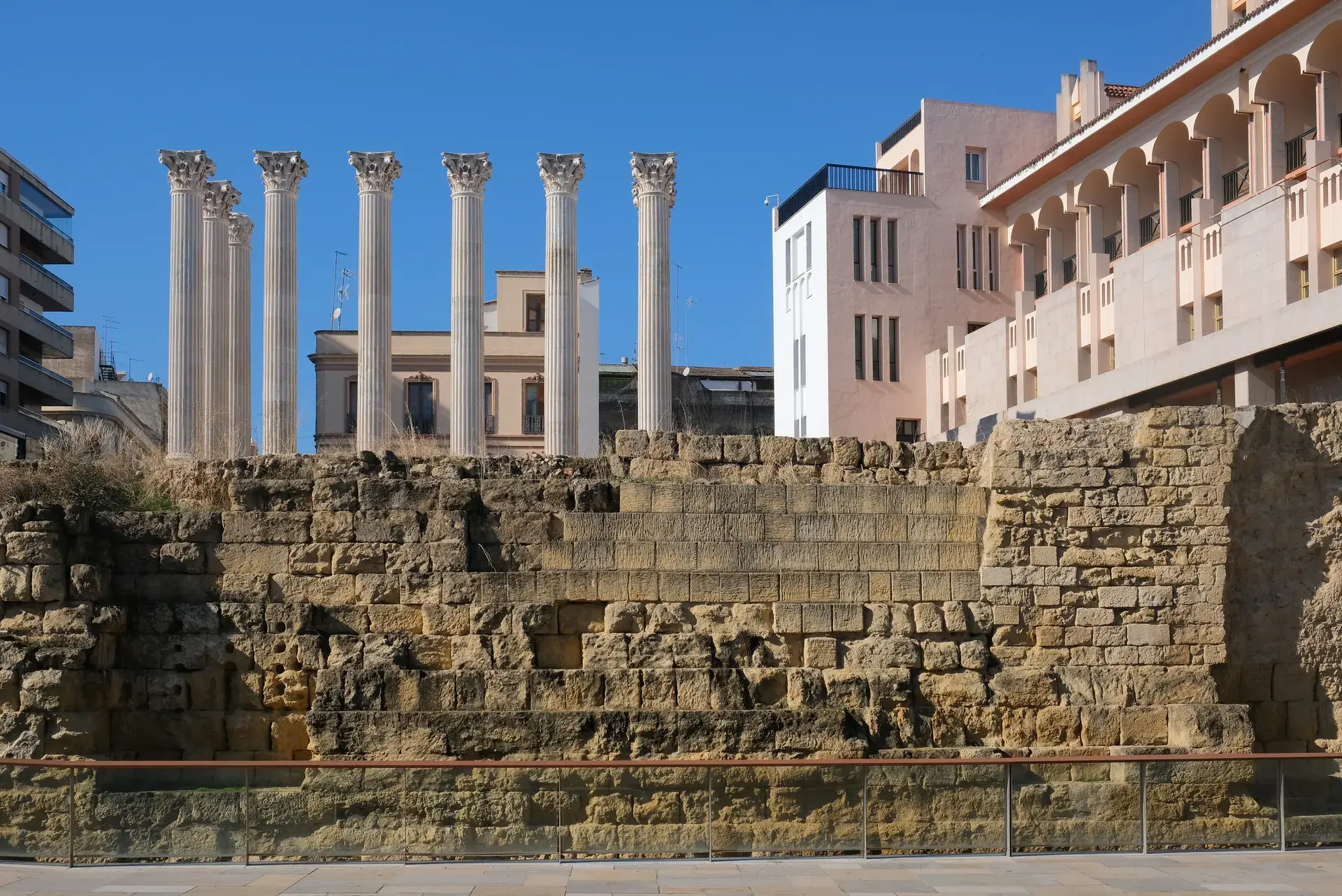
Nestled beside the modern City Hall on Calle Claudio Marcelo, the Templo Romano offers a striking view into Córdoba's Roman past. The towering Corinthian columns stand as a testament to the city's importance as Colonia Patricia, a prestigious capital in the Roman province of Baetica. This monumental structure, built entirely of marble, was a cornerstone of the city's religious and civic life.
Imperial Origins and Construction
The temple's construction began in the mid-1st century AD during the reign of Emperor Claudius and was completed approximately forty years later under Emperor Domitian. It was dedicated to the imperial cult, a practice of venerating emperors to reinforce loyalty to Rome. As part of the Provincial Forum, it was strategically placed on an artificial terrace overlooking the city's circus, forming a significant civic complex.
Architectural Grandeur
Originally, the Templo Romano was a pseudoperipteral, hexastyle temple of the Corinthian order, measuring 32 meters long and 16 meters wide. It stood on a podium 3.5 meters high and featured six grand columns on its front facade and ten along each side. To support the massive marble structure on a steep slope, Roman engineers utilized a rare and advanced foundation system known as 'antierides,' which employed fan-shaped buttresses to prevent the building from shifting.
A Serendipitous Discovery
For over 1,800 years, the temple remained largely hidden beneath the city. Its existence was only revealed in the 1950s during excavation work for the expansion of the City Hall. This was a surprise discovery, although the area had been known for centuries as 'los marmolejos' (the little marbles) due to the frequent unearthing of marble fragments. Following the discovery, architect Félix Hernández led the reconstruction efforts, re-erecting several of the columns that are visible today.
The Temple in Modern Córdoba
Today, the Templo Romano is an open-air archaeological site, fully integrated into the urban landscape. While the interior is not accessible, its grandeur can be appreciated from the street. The area has become a vibrant district where locals and visitors enjoy views of the ancient columns from nearby establishments. Original architectural elements from the temple are preserved and displayed in Córdoba's Archaeological Museum, with other pieces, like a fluted column, found in public spaces such as the Plaza de la Doblas.
FAQ
When was the Roman Temple of Córdoba built?
Construction on the Templo Romano began during the reign of Emperor Claudius (41-54 AD) and was completed in the second half of the 1st century AD under Emperor Domitian (81-96 AD).
Why was the Templo Romano built?
The temple was dedicated to the Roman imperial cult, which involved the worship of deified emperors. It was a central part of the Provincial Forum, a key religious and civic center in Roman Córdoba.
Can you go inside the Templo Romano?
No, the site is generally not open for interior visits. The temple remains are an open-air archaeological site that can be viewed from the surrounding street, adjacent to the City Hall.
When was the Roman Temple of Córdoba discovered?
The temple was unexpectedly rediscovered in the 1950s during excavation work for the expansion of Córdoba's City Hall. It had been largely buried and unknown for centuries.