Puerta del Puente: Córdoba's Historic Renaissance Gate
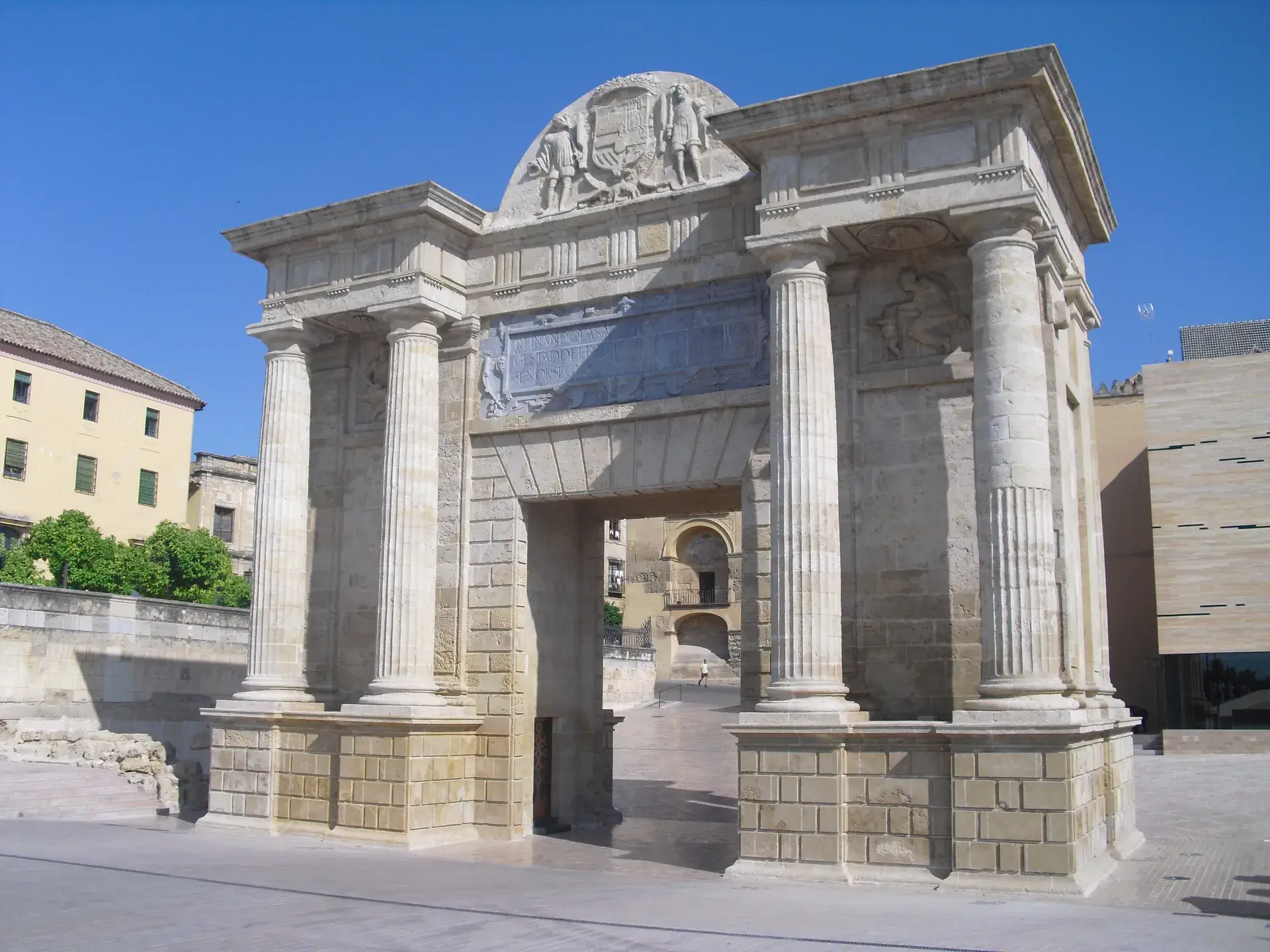
The Puerta del Puente, or Gate of the Bridge, is a monumental landmark in Córdoba, standing at the head of the historic Roman Bridge. This structure has marked the city's main southern entrance for centuries, standing on a site that has been continuously significant since antiquity.
A History Through Empires
The gate's origins are Roman, dating back to the 1st century during the reigns of emperors Tiberius and Claudius. It served as a strategic entrance connecting the Roman bridge with the Via Augusta. After the Roman period, a new gate was built during the Islamic era, known by names such as Bab al-Qantara (Gate of the Bridge) and Bab al-Wadi (Gate of the River). Following the Reconquista, it was called the Puerta de Algeciras.
The Renaissance Reconstruction
The current gate is a masterpiece of Spanish Renaissance architecture. In 1572, Corregidor Alonso González de Arteaga ordered the construction of a new gate to replace the deteriorated medieval structure and to artistically enhance the city's main entrance, partly to commemorate a visit from King Philip II.
Construction began under architect Francisco de Montalbán and was completed in 1576 by the renowned Hernán Ruiz III. The design features classical fluted Doric columns. The project faced significant challenges, with design complications causing the budget to more than double and leading to a four-year halt in construction.
Modern Transformations
Throughout the 20th century, the Puerta del Puente underwent several key changes. In 1912, the surrounding city walls were removed, leaving the gate as a freestanding structure. This led many locals to mistakenly refer to it as a triumphal arch due to its massive appearance. It was rebuilt as a memorial gate in 1928. In the late 1950s, the ground level around it was lowered to restore the gate to its original, more imposing height.
The gate, along with the Roman bridge and the nearby Calahorra tower, was declared a Bien de Interés Cultural in 1931. It is also part of Córdoba's historic center, a UNESCO World Heritage Site since 1984.
The Gate Today
Around 2005, the Puerta del Puente was converted into a cultural space. It now serves as an exhibition center, housing a permanent exhibit that details the gate's long history through texts and images. Visitors can access a balcony on the top floor, which offers panoramic views of the Roman Bridge, the Guadalquivir River, and the Mosque-Cathedral. Since the Roman Bridge was pedestrianized in 2004, the gate has become a central point on the city's main tourist route. According to official sources, the site is currently listed as "temporarily closed."
FAQ
When was the Puerta del Puente built?
The current Renaissance gate began construction in 1571 and was completed in 1576. It stands on the site of earlier Roman and Muslim gates that date back to the 1st century.
Why is the Puerta del Puente sometimes called a triumphal arch?
After the city walls connected to it were removed in 1912, its massive, freestanding appearance led many people to mistakenly refer to it as a triumphal arch rather than a gate.
What is inside the Puerta del Puente?
The Puerta del Puente houses an exhibition center with a permanent display on its history. It also features a viewpoint on its top floor offering panoramic views of the historic area, though it is noted as being temporarily closed.
Who designed the current Puerta del Puente?
The 16th-century Renaissance gate was initiated by architect Francisco de Montalbán and its monumental design was completed by the renowned architect Hernán Ruiz III.