Torre de la Calahorra: Córdoba's Historic Bridge Tower
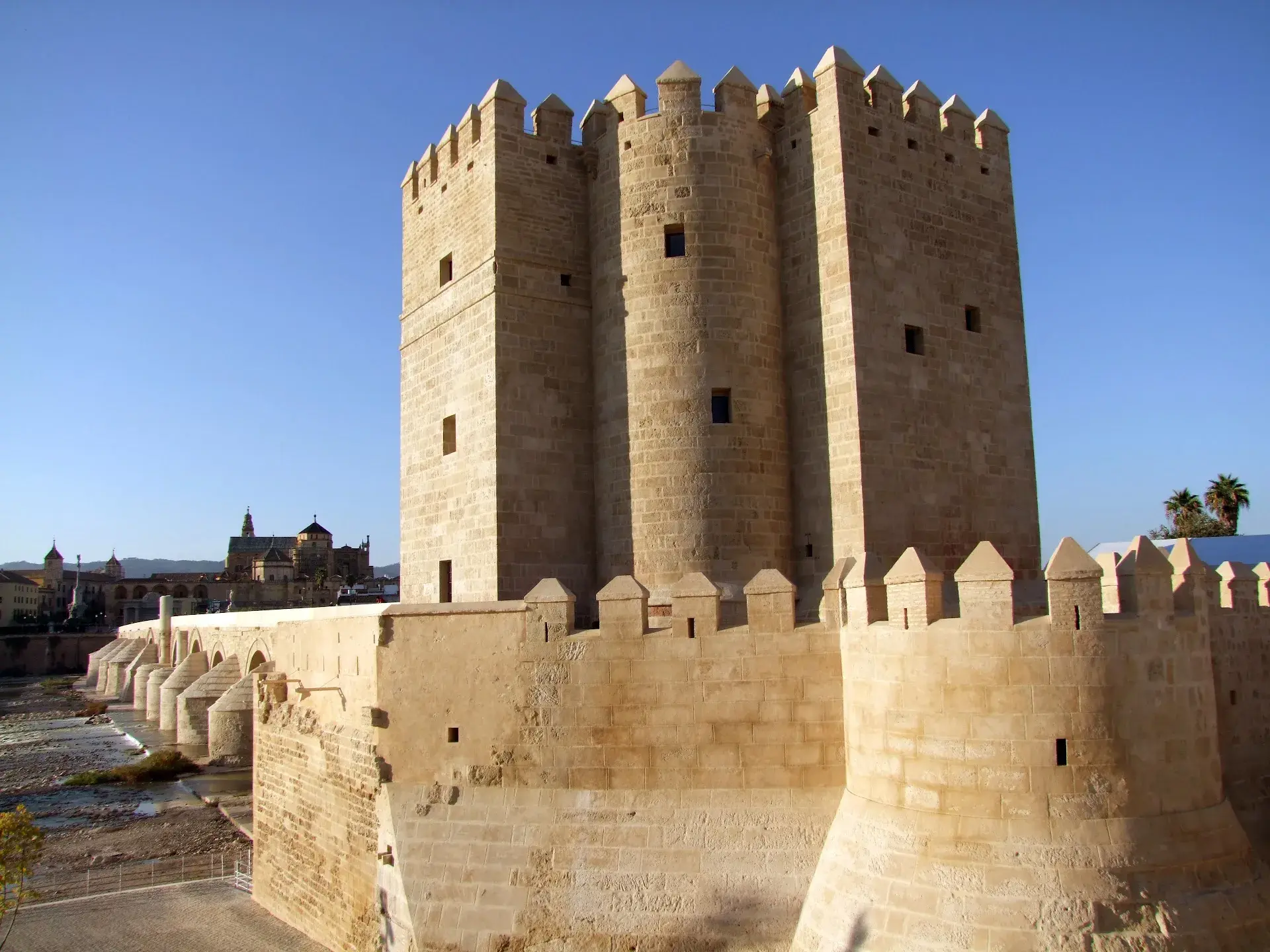
At the southern end of Córdoba's Roman Bridge stands the robust Torre de la Calahorra, a medieval defensive tower that offers historical insights and sweeping views from its battlements. This fortified gate is a tangible marker of the city's strategic importance and complex past.
Architectural History
The Torre de la Calahorra is a fortified gate of Islamic origin, first constructed in 1333 by the Almohad Caliphate to protect the Roman Bridge over the Guadalquivir River. Its initial form consisted of an arched gate situated between two towers. The structure played a defensive role during the Christian conquest of Córdoba in 1236.
A significant expansion occurred in 1369 when King Henry II of Castile ordered its reinforcement during the Castilian Civil War. This reconstruction added a third tower and two cylindrical projections, creating the distinctive cross-shaped layout seen today, which incorporates elements of Mudejar design and classic Spanish military architecture. During this project, the final arch of the Roman Bridge was slightly diverted to border the tower. The Torre de la Calahorra was declared a national historical monument in 1931 and, along with the bridge, received a Europa Nostra Award in 2014 for its restoration.
A Tower of Many Uses
Originally conceived as a formidable military fortification, the tower's purpose evolved dramatically over the centuries. In the 18th century, it served as a prison for foreign soldiers. Later that same century, it was repurposed as a quarantine station during a typhus epidemic. By the mid-19th century, its function had shifted again, becoming a girls' school for the local Campo de la Verdad neighborhood. This varied history showcases a profound transformation from a structure of war to one of confinement, isolation, and education.
The Living Museum of al-Andalus
Today, the Torre de la Calahorra houses the Living Museum of al-Andalus (Museo Vivo de al-Andalus). Managed by the Fundación Paradigma Córdoba for Coexistence, the museum is dedicated to the cultural, scientific, and artistic achievements of al-Andalus. Its permanent exhibition highlights the historical coexistence of Christian, Muslim, and Jewish cultures in Córdoba through audiovisual presentations.
Inside, visitors can also find a scale model depicting the Mezquita in its original Moorish state. The tower's roof is accessible and provides spectacular panoramic views of the Roman Bridge, the Guadalquivir River, and the Mosque-Cathedral. The museum operates daily, with visiting hours that vary by season.
FAQ
What is inside the Torre de la Calahorra?
The tower houses the Living Museum of al-Andalus (Museo Vivo de al-Andalus), which showcases the cultural, scientific, and artistic achievements of the period, emphasizing the coexistence of Christian, Muslim, and Jewish cultures.
Who built the Torre de la Calahorra?
The original structure was an Islamic fortified gate built in 1333 by the Almohad Caliphate. It was significantly expanded and reinforced in 1369 by order of King Henry II of Castile.
What was the Torre de la Calahorra used for?
Initially a defensive military tower, it later served as an 18th-century prison, a quarantine station during a typhus epidemic, and a 19th-century girls' school before becoming a museum.
Can you go to the top of the Torre de la Calahorra?
Yes, the tower's roof is accessible to visitors and offers panoramic views of the Roman Bridge, the Guadalquivir River, and the Mosque-Cathedral of Córdoba.
Discover Cordoba like never before
Dive into Cordoba hidden stories and secret spots with Ciceru interactive tours.
Explore tour
Audioguide
Quizzes
Maps
Solo
Couples
Groups & families

© Photo by Torre de la Calahorra via Google Maps · Google Places