Muralla y Arco de Bezudo: Cuenca's Castle Gate
The Northern Gateway of Cuenca
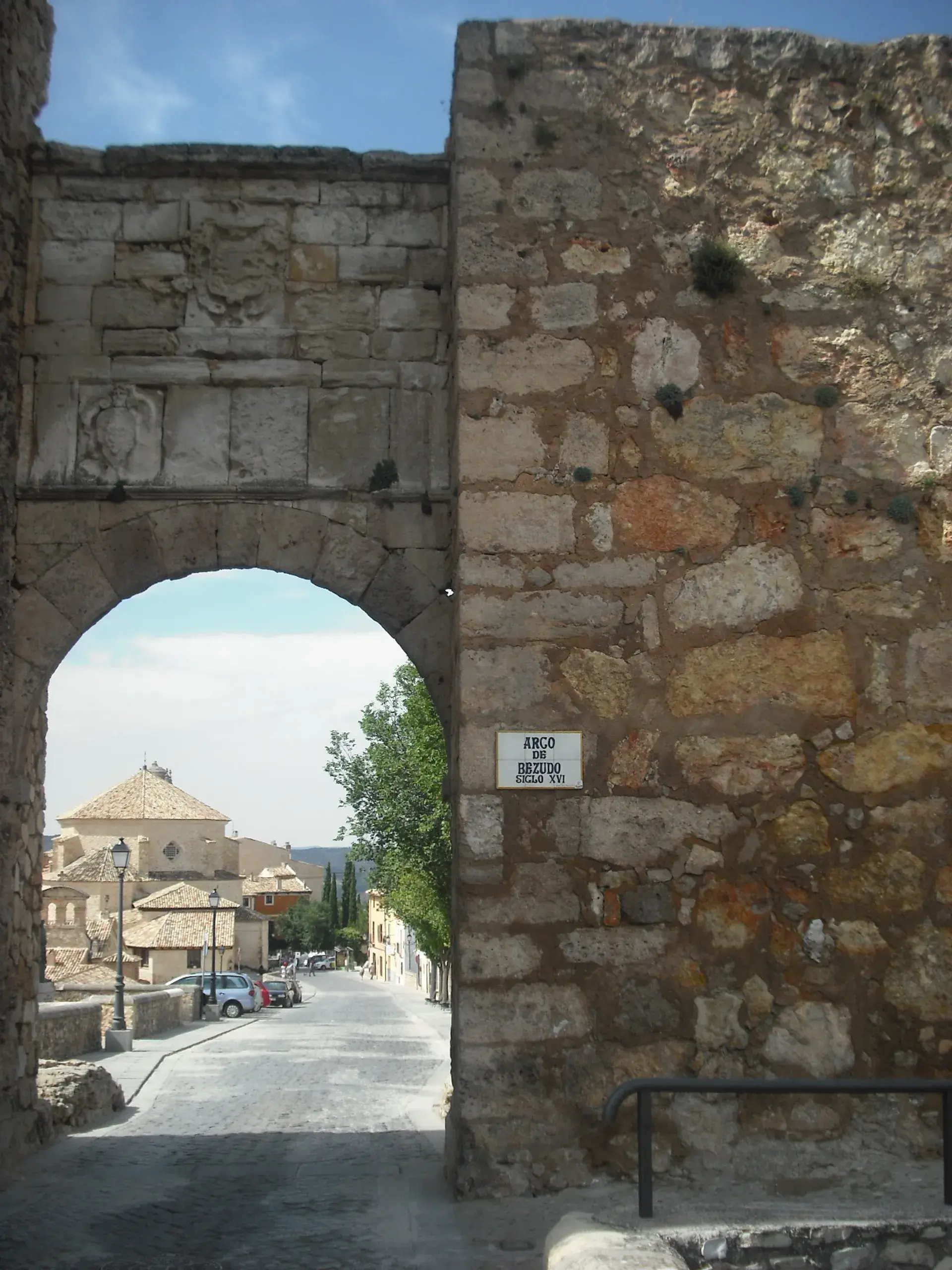
The Muralla y Arco de Bezudo forms the surviving northern entrance to the ancient fortified citadel of Cuenca. Situated at the end of Calle del Trabuco, the gate marks the highest elevation and the northern boundary of the city's UNESCO-inscribed upper historic district. Built across the narrowest isthmus of the limestone ridge where the Júcar and Huécar river gorges draw closest together, the gate historically guarded the only level land approach to the rocky promontory.
Origins and Military Transformations
The fortification originated during the 10th and 11th centuries under Andalusi rule as the primary northern gate of the citadel of Kunka. In September 1177, King Alfonso VIII of Castile took the fortress following a nine-month siege, converting it into a royal Christian stronghold.
Centuries later, in 1582, Corregidor García Busto de Villegas reconstructed the entrance into its current Renaissance design, replacing earlier medieval structures. The wider citadel suffered extensive damage during the Peninsular War (1808–1814), when occupying French forces detonated large sections of the compound. The remaining defenses saw further military deployment during the Carlist Wars before gradually transitioning away from active military fortification.
Renaissance Architecture and Defenses
The existing Arco de Bezudo features a 16th-century semicircular stone arch topped by the imperial Habsburg coat of arms, complete with the carved collar of the Order of the Golden Fleece. The gateway is framed by remnants of the former castle curtain walls, two square defensive towers, and a historic masonry bridge spanning a deep, rock-cut defensive moat.
Local civic tradition attributes the name of the gate to Captain Rodríguez Bezudo, an officer under Alfonso VIII who reportedly died storming the entrance on September 21, 1177, while attempting to hoist the Christian banner. The Spanish term bezudo describes someone with prominent lips, originating as a descriptive personal nickname before becoming integrated into regional heraldry and toponymy.
From Inquisition Seat to Provincial Archive
Directly adjacent to the gate stands a massive stone compound with a multifaceted institutional history. In 1574, King Philip II transferred the decaying royal fortress grounds to the Tribunal of the Holy Inquisition by royal decree. The site served for centuries as the regional headquarters and dungeon complex for the Inquisition.
Following the dismantling of the Inquisition, the facility operated as Cuenca's provincial civil prison until the 1970s. After an extensive restoration project carried out between 1985 and 1990, the building was repurposed to house the Archivo Histórico Provincial de Cuenca, preserving the written documentary heritage of the province.
Ramparts and Viewing Platforms
Today, the Arco de Bezudo functions as a public pedestrian portal connecting the historic quarter with mountain routes leading into the Serranía de Cuenca. The narrow geological constriction channels steady mountain winds directly through the stone threshold and along the exposed ramparts.
Stone staircases built into the masonry provide access to the upper battlements and the top of the arch, offering panoramic perspectives over both the Júcar and Huécar gorges. Alongside the historic stone span, a modern pedestrian footbridge designed by architects Javier and Miguel Ángel Redondo extends the crossing, providing dedicated viewing areas over the surrounding limestone terrain.
FAQ
What is the origin of the name Bezudo?
Local tradition states the gate was named after Captain Rodríguez Bezudo, who died during Alfonso VIII's siege in September 1177. The Spanish word 'bezudo' originally described an individual with prominent or thick lips, transitioning from a nickname into heraldic and geographic use.
What was the building adjacent to the Arco de Bezudo used for?
The complex served as the headquarters and prison of the Spanish Inquisition from 1574 onward, operated as a provincial civil prison until the 1970s, and now houses the Archivo Histórico Provincial de Cuenca.
Can visitors climb the walls of the Arco de Bezudo?
Yes. Stone stairs allow access to the top of the 16th-century arch and surrounding ramparts, which provide elevated views over both the Júcar and Huécar river gorges.
Discover Cuenca like never before
Dive into Cuenca hidden stories and secret spots with Ciceru interactive tours.
Explore tour
Audioguide
Quizzes
Maps
Solo
Couples
Groups & families

© Enrique Íñiguez Rodríguez (Qoan) | CC BY-SA 3.0