Puente de San Pablo: Cuenca's Iconic Iron Bridge
An Industrial Landmark Above the Huécar Gorge
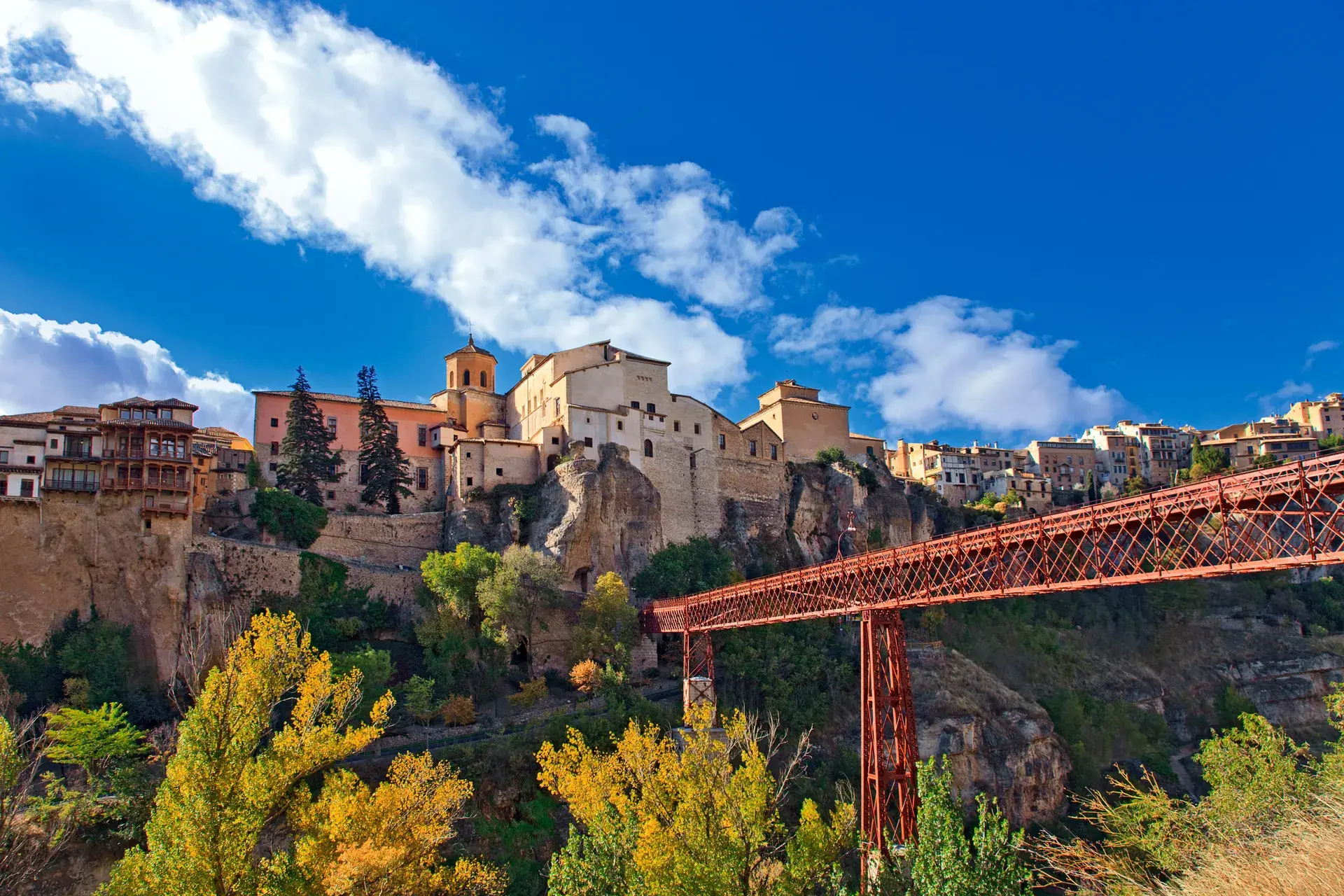
Suspended high above the Huécar River Gorge (Hoz del Huécar), the Puente de San Pablo is one of the most recognizable structures in Cuenca, Spain. The footbridge spans between 100 and 110 meters in length, resting approximately 40 meters above the canyon bed with structural clearances reaching up to 60 meters. Featuring an industrial lattice beam design painted deep red and floored with timber planks, it serves as a primary pedestrian link between Cuenca's historic quarter and the promontory of San Pablo.
Formally designated as a Bien de Interés Cultural and integrated within Cuenca's UNESCO World Heritage precinct, the bridge bridges a dramatic geological divide. Historically, the steep limestone chasms carved by local rivers served as natural defensive moats for the medieval city. Today, the bridge transforms this natural barrier into a celebrated crossing connecting Calle Canónigos and the cliffside near the famous Casas Colgadas (Hanging Houses) directly to the former Dominican Monastery of San Pablo.
The Sixteenth-Century Stone Predecessor
Before the iron structure existed, a massive Renaissance stone bridge spanned the chasm. Commissioned and funded by Cathedral Canon Juan del Pozo, it was built between 1533 and 1589 to provide Dominican friars easy access across the gorge without having to navigate steep descents and ascents along the canyon trails. Notable architects of the period, including Francisco de Luna and Andrés de Vandelvira, participated in its design.
The original bridge was supported by five monumental stone arches—a layout that led Spanish author Pío Baroja to later compare it to a "five-legged elephant" straddling the ravine. However, serious structural fractures emerged as early as 1786. Over the following century, the stone deteriorated, shedding loose rock that endangered laborers working fields on the canyon floor below. Deemed irreparably hazardous, the historic crossing was demolished with dynamite between March 29 and March 31, 1895. The falling masonry blocked the Huécar River and flooded nearby orchards, transforming what was intended as a public spectacle into a solemn event mourned by local residents.
The Rebuilding and the Disaster of 1902
Determined to restore the vital passage, authorities organized the construction of a modern replacement, funded largely by Bishop Wenceslao Sangüesa and the conciliar seminary. Civil engineer José María Fuster y Tomás designed a pedestrian bridge fabricated from industrial iron by George H. Bartle's foundry. The engineers anchored the iron framework directly atop the surviving 16th-century masonry pier bases and abutments.
Construction was fraught with hardship. The year 1902 became known locally as Cuenca's "black year," beginning with the collapse of the cathedral's bell tower in April. On July 31, 1902, disaster struck the bridge when a severe storm swept the nearly finished iron lattice completely off its supports, throwing the framework into the ravine. Undeterred, work crews salvaged and rebuilt the structure from the ground up, successfully inaugurating the footbridge on April 19, 1903.
Structure, Viewpoints, and Preservation
Crossing the Puente de San Pablo offers a distinct sensory experience. Hollow thuds echo as footsteps strike the wooden deck, winds funnel sharply through the limestone gorge, and breezy weather introduces a subtle lateral sway beneath the walkway. The open railings provide an unobstructed, frontal viewpoint of the wooden balconies of the Casas Colgadas clinging to the sheer cliffs opposite.
The bridge continues to function as an active footway linking visitors and residents to the Parador de Cuenca—housed in the former monastery—and the Espacio Torner art gallery, where Canon Juan del Pozo's black marble funerary slab remains preserved. To maintain safety and ensure structural longevity, the municipal government carries out ongoing preservation programs, including structural monitoring and periodic timber deck renewals. In May 2004, the footbridge received renewed national attention when newly married Prince Felipe and Princess Letizia walked across it and posed for official portraits framed against the canyon.
FAQ
When was the current Puente de San Pablo built?
Construction on the iron bridge began in 1902, and following repairs after a severe storm destroyed the initial framework, it was officially inaugurated on April 19, 1903.
What happened to the original bridge?
The original 16th-century stone bridge suffered fractures starting in 1786 and threatened the valley below with falling rocks. It was intentionally demolished using dynamite between March 29 and 31, 1895.
What makes the bridge's construction history unique?
The iron bridge rests upon the surviving stone pier bases of the 16th-century bridge. During Cuenca's 'black year' in 1902, a violent storm blew the nearly completed iron structure into the gorge, requiring it to be rebuilt before opening in 1903.
Which destinations does the bridge connect?
The footbridge connects Cuenca's historic old town near the Casas Colgadas with the former Dominican Monastery of San Pablo, which now hosts the Parador de Cuenca and the Espacio Torner gallery.