Church of Saint Pere, Figueres: History & Architecture
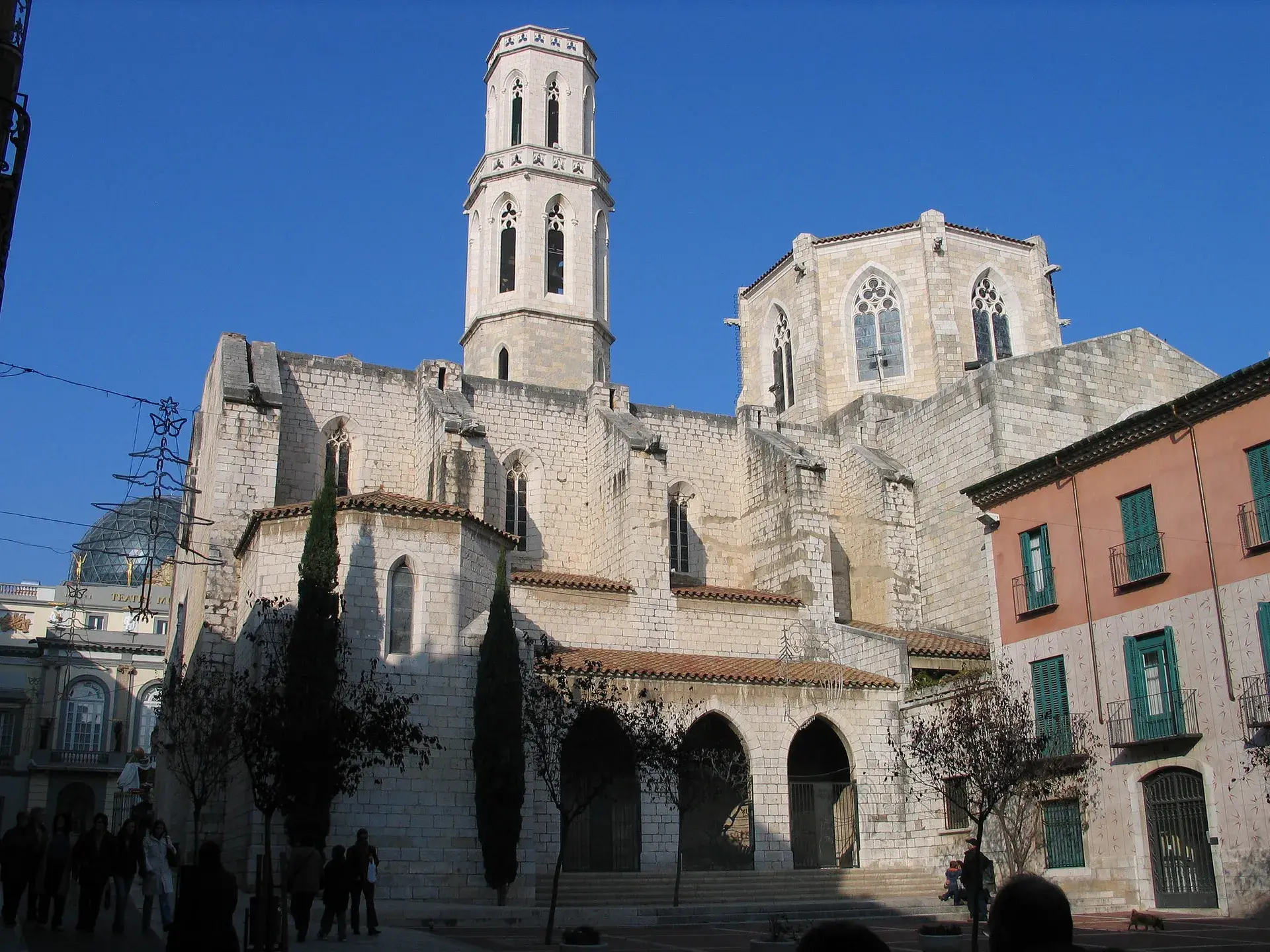
Standing at Plaça de l'Església in the historic center of Figueres, the Church of Saint Pere (Església de Sant Pere) is the city's oldest surviving religious monument and its main parish church. Protected as a Cultural Asset of Local Interest (Bé Cultural d'Interès Local) and listed in the Inventory of Architectural Heritage of Catalonia, the stone landmark anchors the old town directly across a narrow street from the Dalí Theatre-Museum.
Architectural Heritage: Romanesque Roots to Catalan Gothic
Predominantly Catalan Gothic in character, the church preserves layers of construction spanning nearly a millennium. Earlier Romanesque masonry remains visible on the north wall, including a narrow slit window (espitllera) at the base of the bell tower, though sources vary on whether these remnants date to the 10th–11th or 12th–13th centuries.
Inside, the intact 14th-century Gothic single nave features ribbed cross vaults, keystones, sculpted gargoyles, and side chapels tucked between structural buttresses. Daylight enters the tall stone interior through a large circular oculus installed when the main façade was rebuilt in 1578.
Subsequent additions reshaped the exterior profile over the centuries. Construction began on the north-side Chapel of the Sorrows (Capella dels Dolors) in 1678, and an attached octagonal bell tower on the north wall rises 38.80 meters, crowned in 1941 with a Gothic-style upper turret.
A Millennium of History and Wartime Survival
First documented on October 13, 1020, in the will of Count Bernat Tallaferro of Besalú, the parish was placed under the Monastery of Santa Maria de Vilabertran, an arrangement confirmed by Pope Paschal II in 1116. Medieval Figueres developed around the church, which served as the town's sole parish for nearly a thousand years until the parish of La Immaculada was established in 1954.
In the late 14th century—around 1378, though one tourism source places the beginning in the 13th century—King Peter the Ceremonious (Pere III) ordered the Gothic single-nave church built over the earlier Romanesque structure. In early November 1701, the church hosted the marriage ratification of 18-year-old King Philip V of Spain and 14-year-old Maria Luisa Gabriela of Savoy.
The church endured looting of its altarpieces, paintings, tapestries, and jewels during the Peninsular War, and in 1895 architect Josep Azemar added a dome over the crossing. Fires and bombings during the Spanish Civil War (1936–1939) severely damaged that dome, the 18th-century crossing, and the apse. Between 1941 and 1948, under rector Pere Xutglà, architects Amadeu Llopart, Enric Mora, and Josep Maria Sagarra rebuilt those sections in a sober Gothic style with an octagonal cimborium, leading to the temple's consecration on September 15, 1967.
Salvador Dalí and the Historic Plaza
Sant Pere bookended the life of Surrealist artist Salvador Dalí, who was born nearby in 1904 and received his baptism, first communion, and funeral inside the church. Dalí is buried directly across the street beneath the stage of the Dalí Theatre-Museum, a former municipal theater he selected in part because it stood right in front of the parish where he was baptized.
Both the church and the neighboring theater were gutted during the Spanish Civil War and later topped with 20th-century towers or domes. Together, they form a striking architectural juxtaposition across the plaza between austere Gothic-revival reconstruction and Surrealism. Just beyond the church lies the former medieval Jewish quarter (call jueu), where houses backing onto Sant Pere historically had no doors or windows facing it to keep the quarter isolated.
Active Parish Life, Art, and Local Traditions
Today, Sant Pere remains an active parish within the Roman Catholic Diocese of Girona, celebrating regular Masses on Monday, Wednesday, and Friday mornings at 10:00 AM, Saturdays and vigils at 6:00 PM, and Sundays and feast days at 12:00 PM. It also hosts the solemn Mass (ofici solemne) during Figueres's summer Festa Major de Sant Pere.
The church displays modern works by Empordà artists, including porch grilles and a tympanum sculpture by Ramon Pujolboira, a 3-by-5-meter Baptism of Jesus painting by Lluís Roura in the baptistery, and post-war sculptures by Frederic Marès and Charles Collet. Guided heritage visits and occasional climbs up the bell tower for panoramic views of Figueres and the Empordà plain are organized by groups such as Amics de Sant Pere and Amics dels Museus Dalí, as well as during European Heritage Days.
Among the parish's historic customs was the Processó de la Tramuntana, launched in 1612 after disease outbreaks. Until the city banned the event in 1868, the Confraternity of the Purest Blood held an annual three-day men-only pilgrimage from the neighboring Chapel of Sant Sebastià to the Sanctuary of Requesens to pray for the cleansing tramuntana north wind, singing a Salve at Sant Pere upon their return.
FAQ
What is the connection between the Church of Saint Pere and Salvador Dalí?
Salvador Dalí was baptized, received his first communion, and had his funeral inside the Church of Saint Pere. He is buried directly across the street beneath the stage of the Dalí Theatre-Museum, having chosen the former municipal theater in part because it faced the church where he was baptized.
What architectural styles are visible in the Church of Saint Pere?
The church is primarily Catalan Gothic, featuring a 14th-century single nave with ribbed cross vaults and side chapels between buttresses. It also incorporates Romanesque masonry on the north wall, a 1578 main façade with a large oculus, and mid-20th-century Gothic-revival reconstructions of its crossing, apse, and bell tower turret.
Is the Church of Saint Pere open to visitors outside of Mass times?
In addition to its regular Mass schedule, the church opens for cultural presentations, guided heritage visits, and occasional climbs up its 38.80-meter bell tower, including tours arranged by Amics de Sant Pere, Amics dels Museus Dalí, and during European Heritage Days.