Dalí Theatre-Museum in Figueres: History & Visitor Guide
Located at Plaça Gala i Salvador Dalí, 5 in the historic center of Figueres, Catalonia, the Dalí Theatre-Museum (Teatre-Museu Dalí) stands as one of Spain's most visited cultural landmarks. Managed by the Gala-Salvador Dalí Foundation in a listed heritage building owned by the Spanish State and Figueres City Council, it anchors the Dalinian Triangle alongside the Salvador Dalí House-Museum in Portlligat and the Gala Dalí Castle in Púbol.
The World's Largest Surrealist Object
Conceived and designed by Salvador Dalí as a unified artistic creation, the museum is described by the Foundation as the world's largest surrealist object. Since its official inauguration on 28 September 1974, it has grown to house more than 1,500 works spanning every period of Dalí's career, including paintings, drawings, sculptures, prints, installations, holograms, and stereoscopic works.
Alongside Dalí's own creations, the galleries display pieces from his private collection by artists he admired, including El Greco, Marcel Duchamp, Marià Fortuny, Antoni Pitxot, and Evarist Vallès. The complex encompasses the converted former theatre (Rooms 1–18), Torre Galatea (acquired in 1981), an adjoining building acquired in 1992, temporary exhibition rooms (19–22), and the Dalí·Jewels rooms (23–24), which opened in 2001.
From Burned Civic Theatre to Living Stage
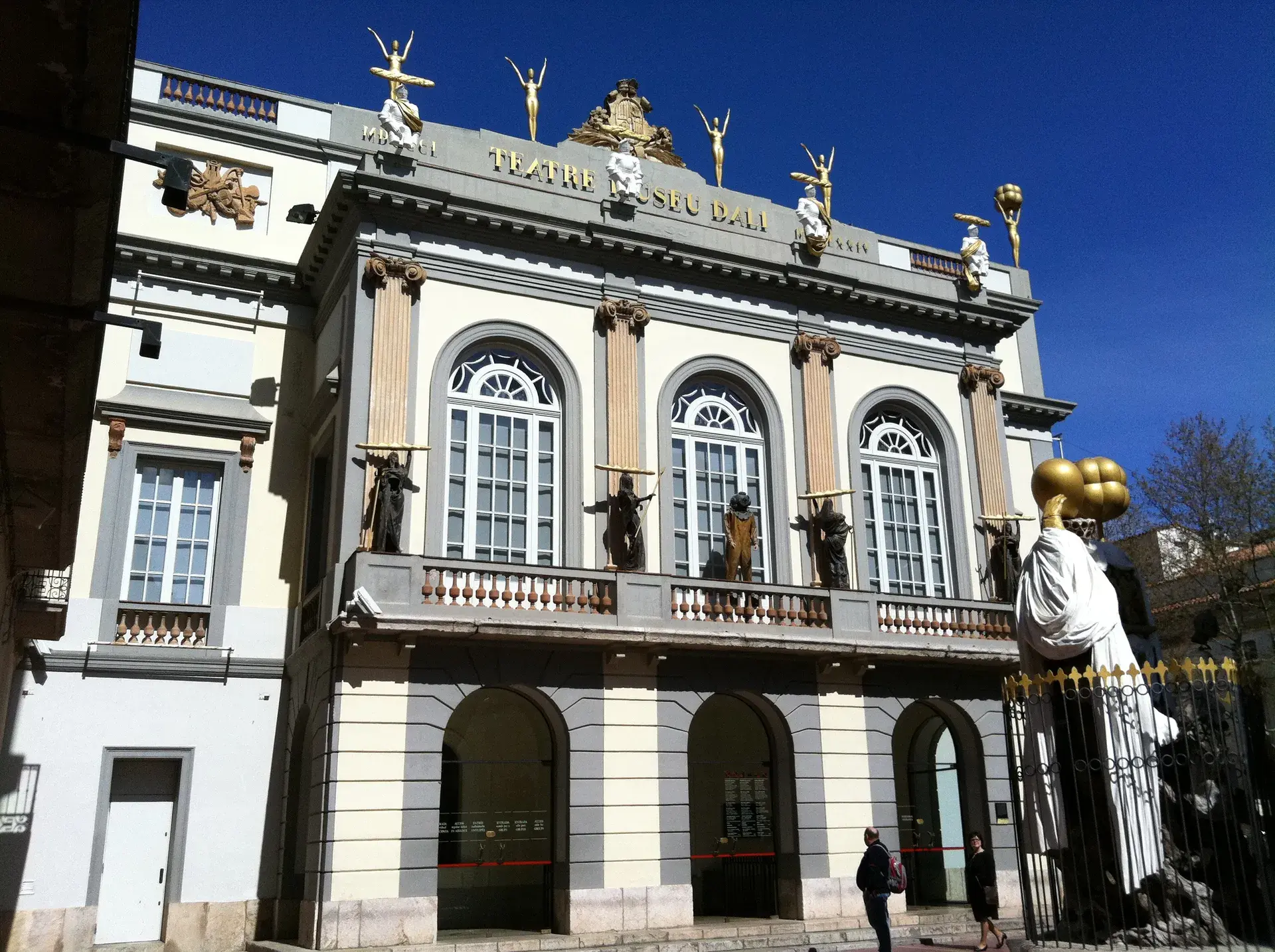
The core structure began as Figueres's neoclassical Municipal Theatre (Teatre Principal), designed by architect Josep Roca i Bros and built between 1848 and 1850. The building held deep personal significance for Dalí long before it became a museum: as a teenager in 1919, he held one of his first public art exhibitions in the theatre's foyer.
At the close of the Spanish Civil War in 1939, a fire gutted the theatre, leaving only its outer walls and facade standing. The transformation of the ruins began in 1960–1961, when Figueres mayor Ramon Guardiola asked Dalí to donate a single work for a dedicated room at the Empordà Museum. Dalí countered with a far grander proposal: rebuilding the ruined Municipal Theatre as an entire museum devoted to his art.
Figueres City Council approved the plan in 1968, and construction began in 1969 under architects Joaquim de Ros i Ramis and Alexandre Bonaterra, supported by Spanish government funding starting in 1970. After plans with Richard Buckminster Fuller fell through, Spanish architect Emilio Pérez Piñero designed and installed the transparent geodesic dome over the former stage. Following the 1974 opening, Dalí continued modifying the complex; after a 1984 fire at Púbol Castle, he moved into the adjoining Torre Galatea—formerly Torre Gorgot and renamed for his late wife Gala—where he lived until dying of heart failure on 23 January 1989 at age 84.
Surrealist Architecture and Signature Installations
From the street, the complex announces its surrealist character through dramatic visual contrasts. Giant white eggs—Dalí symbols of birth, hope, and creative potential—line the roof crenellations alongside gilded mannequin figures striking theatrical poses. Along the exterior of Torre Galatea, deep burgundy-terracotta walls are studded with hundreds of life-sized yellow plaster and concrete casts of pa de tres crostons, traditional three-cornered Figueres bread loaves, creating a raised texture whose red and yellow palette evokes the Catalan flag. Nearby Figueres bakeries even sell Pa de Dalí loaves inspired by the facade.
Inside the former theatre's open-air courtyard, semi-circular tiers of small windows resemble theatre boxes overlooking the Rainy Taxi, an installation featuring a Cadillac occupied by a shark-headed chauffeur and an ivy-covered mannequin passenger; inserting a €1 coin activates an internal piping system that sends artificial rain falling inside the car. Above the old stage, Pérez Piñero's glass-and-steel geodesic dome floods the central space with natural light and was likened by Dalí to the multifaceted eye of a fly.
Elsewhere in the galleries, optical and spatial illusions take center stage. The Mae West Room transforms furniture into a walk-in portrait—complete with a pink lip-shaped sofa, a suspended nose fireplace, eye paintings, and curtain hair—viewed through a reducing lens, while the Palace of the Wind features a trompe-l'œil painted ceiling depicting Dalí and Gala's feet.
Dalí's Crypt Beneath the Stage
In accordance with his wishes, Salvador Dalí was buried in a crypt directly beneath the former theatre stage. In stark contrast to the theatrical surrealism surrounding it, the grave slab itself is notably plain and modest.
The crypt drew international attention on the night of 20–21 July 2017, when a Spanish court ordered the 1.5-ton stone slab lifted so forensic experts could collect DNA samples for a paternity lawsuit brought by tarot reader Pilar Abel. DNA tests proved she was not his daughter, and witnesses present at the exhumation reported that Dalí's embalmed body remained well-preserved, with his trademark mustache still intact in its "ten past ten" position.
Nearby Figueres Landmarks and the Dalí Route
The Dalí Theatre-Museum anchors Figueres's historic center and serves as a focal point for Figueres Tourism's walkable "Dalí Route" ("Route of Ants"), marked by ant motifs on pavement tiles. Directly across the square stands the Gothic Church of Sant Pere, where Dalí was baptized in 1904, took his first communion, and had his funeral held in 1989.
Within short walking distance lie several other sites tied to his life and the museum's origins:
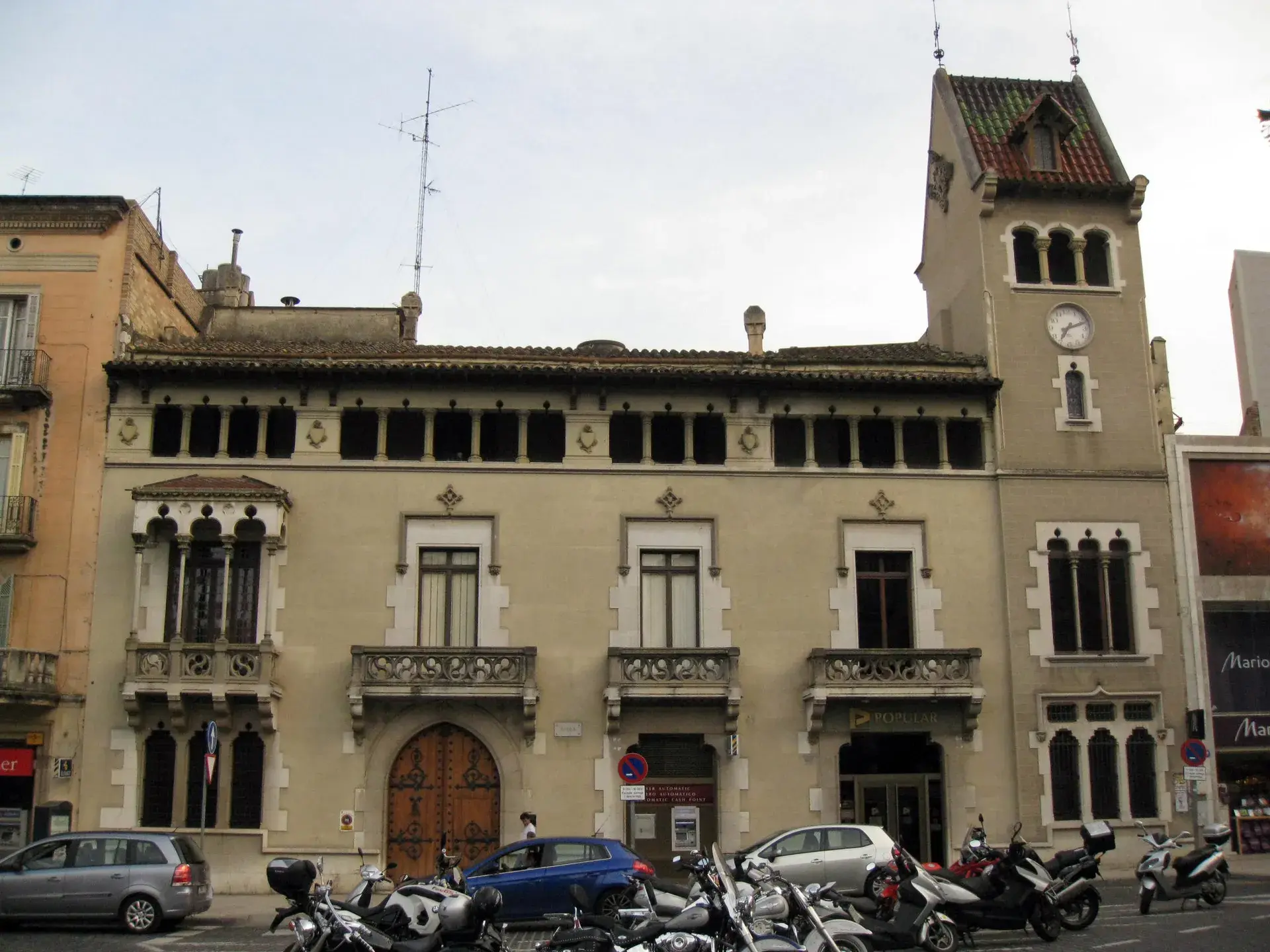
- Dalí's Birthplace (Casa Natal): Roughly 450 meters away at Carrer Monturiol, 20, this 1898 Modernist building housed his father's notary office (exterior viewing only).
- La Rambla and Toy Museum of Catalonia: Figueres's central promenade, where Dalí frequented the Astoria café and Canet bookshop, hosts the Toy Museum in the former Hotel París, displaying his childhood toys and photographs.
- Museum of the Empordà: Located a short walk away, this museum exhibits Dalí's 1962 painting Sant Narcís and was the institution whose offer of a single room sparked the Theatre-Museum project.
- Castell de Sant Ferran: About a 20-minute uphill walk from the museum, this 18th-century bastion fortress served as the site of the final meeting of the Second Spanish Republic's legislature in 1939.
Visitor Information and Practical Planning
The Dalí Theatre-Museum continues to draw large crowds, recording 707,176 visitors in 2025 according to The Art Newspaper, after the three Dalinian Triangle museums together reached a record 1,005,073 visitors during the museum's 50th-anniversary year in 2024. Also in 2024, the Foundation acquired the nearby Casa Giralt Ventolà to add 1,200 square meters of museum and administrative space. The museum does not provide an official in-house audio guide, leaving guests to explore its labyrinthine rooms independently.
Under the 2026 schedule, the museum opens Tuesday to Sunday year-round except during July and August, when it opens daily from 9:00 to 20:00. Seasonal hours run 10:30–18:00 (1 January–22 March, June, and 1 October–31 December) and 9:30–18:00 (23 March–31 May and September), with last admission 45 minutes before closing and closures on 1 January, 25 December, and most Mondays. Timed-entry tickets are recommended online; 2026 admission starts at €18.50 general, €15.00 reduced, and €26.50 for guided tours, with free entry for ages 0–8. Additional options include an annual open day on 6 January per Dalí's wish, Dalí de Nit summer evening visits from 1–23 August 2026 (21:30–midnight), and a combined ticket linking the museum with Antoni Gaudí's La Pedrera in Barcelona. For rail travelers, the museum lies a 12-to-15-minute walk from Figueres's conventional train station and about 20 minutes on foot from the Figueres-Vilafant AVE high-speed station.
FAQ
Where is the Dalí Theatre-Museum located and how is it reached by train?
The museum is located at Plaça Gala i Salvador Dalí, 5 in the historic center of Figueres, Catalonia, Spain. It is a 12-to-15-minute walk from Figueres's conventional train station and about a 20-minute walk from the Figueres-Vilafant AVE high-speed station.
Is Salvador Dalí buried inside the Dalí Theatre-Museum?
Yes. Following his death in January 1989 while living in the adjoining Torre Galatea, Dalí was buried according to his wishes in a plain, modest crypt directly beneath the former theatre stage.
What are the 2026 opening hours and ticket prices for the Dalí Theatre-Museum?
In 2026, the museum opens Tuesday to Sunday most of the year (10:30–18:00 or 9:30–18:00 depending on the season) and daily from 9:00 to 20:00 in July and August, closing on 1 January, 25 December, and most Mondays. Online timed-entry tickets start at €18.50 general, €15.00 reduced, €26.50 for guided tours, and free for ages 0–8, with a free annual open day on 6 January.