L’Obelisc de la Televisió: Wolf Vostell in Figueres
A Fluxus Landmark Outside the Teatre-Museu Dalí
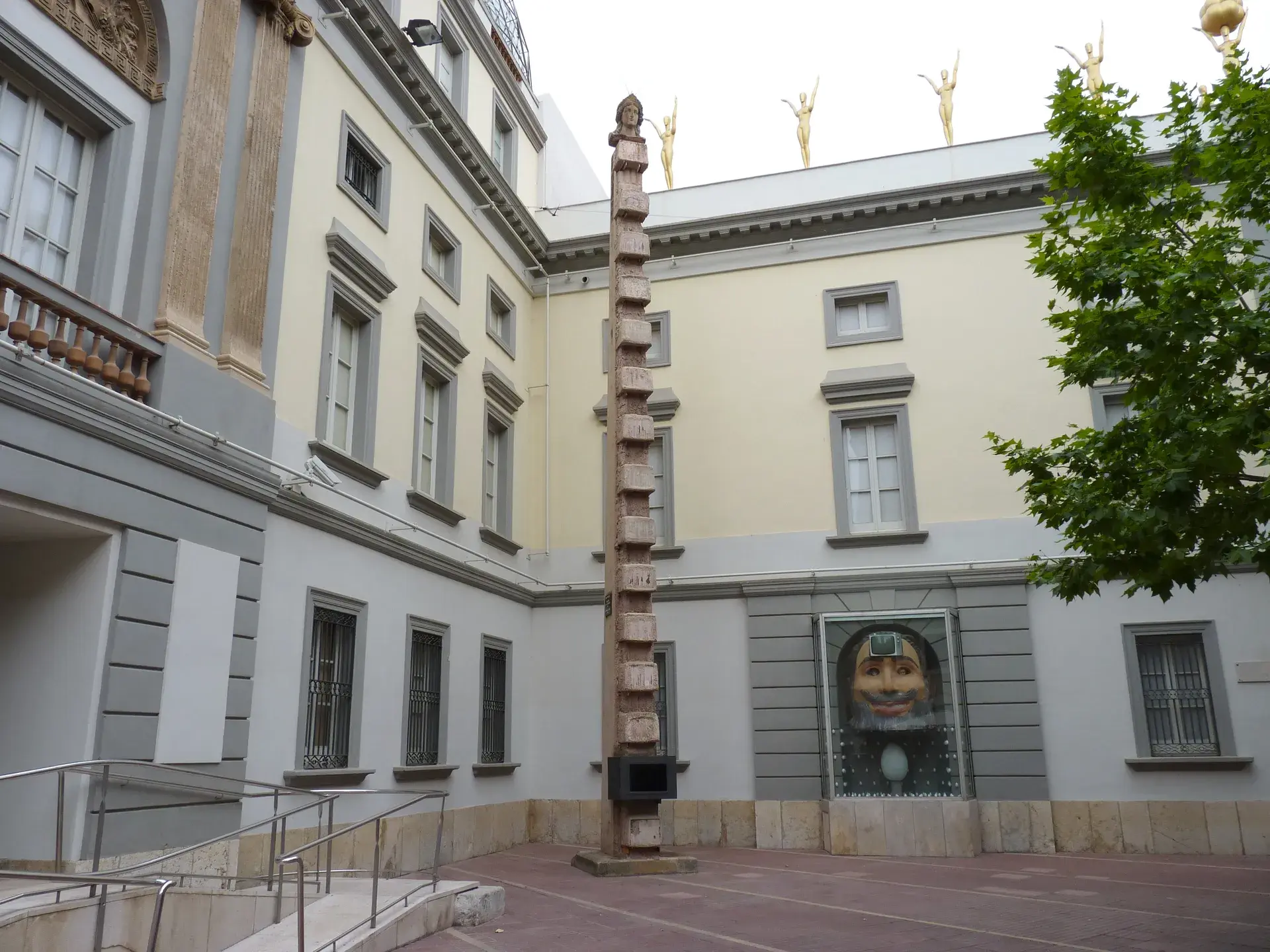
Rising 13 meters above a corner of Plaça Gala i Salvador Dalí, L’Obelisc de la Televisió—recorded in Fundació Dalí conservation files as Obelisc de la televisió – depressió endògena—forms an abrupt visual counterpoint at the entrance to the Teatre-Museu Dalí in Figueres, Spain. Created by German Fluxus, happening, and video art pioneer Wolf Vostell (1932–1998), the outdoor monolith is composed of 14 television sets stacked vertically and encased in tinted cement (ciment tenyit).
Sheltered from the regional Tramuntana wind in one corner of the square, the stark tower creates a brutalist contrast against the ornate, egg- and bread-adorned facade of the Teatre-Museu Dalí. Unlike the other monuments on the plaza, this landmark was not sculpted by Salvador Dalí himself, yet it serves as a permanent fixture of the open-air threshold that greets visitors before they enter the museum.
The 1978 Artistic Exchange Between Dalí and Vostell
The presence of Vostell's obelisk in Figueres stems from a direct artistic trade between two major figures of the 20th-century avant-garde. In 1978, Wolf Vostell met Salvador Dalí, who requested a work for his museum in Figueres. Rather than a one-sided commission, the two artists agreed on a reciprocal exchange benefiting both of their namesake institutions.
Vostell produced L’Obelisc de la Televisió for Figueres, while Dalí granted Vostell permission to execute El Telón de Parzival (also known as El fin de Parzival), an environment Dalí had originally conceived in 1929 featuring stacked Guardia Civil motorcycles and references to Richard Wagner's Parsifal, at the Museo Vostell Malpartida in Extremadura.
While the exchange is well documented, published sources differ on the monument's exact timeline. The Museo Vostell Malpartida chronology and Catalan Wikipedia place both the creation and installation of the Figueres obelisk in 1978. In contrast, English and German Wikipedia entries date the sculpture's creation to 1979 and state that it was installed outside the Teatre-Museu Dalí in 1988 alongside the completion of El fin de Parzival.
Symbolism, Mass Media, and Unresolved Details
Wolf Vostell became the first artist to incorporate a television set into an artwork in 1958 and developed the concept of dé-coll/age applied to television and everyday reality. The Figueres monolith belongs to his Depresión endógena series (1975–1978, with later iterations), a body of work examining individual and collective psychological depression triggered by external social pressures and mass media.
Observers frequently note the irony of using the classical obelisk form—historically reserved for civic heroes and ancient rulers—to elevate stacked household televisions entombed in concrete, interpreting the piece as a satirical monument to the caja tonta ("idiot box"). In other versions of the Depresión endógena series, Vostell went further by integrating live animals such as turkeys or peacocks and welcoming natural weathering, including bird droppings, as part of the sculpture's ongoing evolution.
Several physical details of the Figueres obelisk remain subject to conflicting accounts:
- The crowning bust: The column of 14 televisions is topped by a female head or bust fitted with an antenna. Some Spanish and Catalan monument guides identify the figure as Dalí's wife and muse, Gala, while other sources describe it simply as an unnamed woman's head, and a Catalan giant-heritage inventory classifies it as the bust of a traditional Catalan geganta.
- The live sky feed: English and German Wikipedia entries claim that Dalí installed a video camera inside the crowning head to transmit live images of the sky to the 14 screens below, though recent museum conservation records and visitor descriptions do not confirm whether such a broadcast system exists or operates today.
Plaça Gala i Salvador Dalí and Current Conservation
The Teatre-Museu Dalí opened in 1974 on the ruins of Figueres's 19th-century Municipal Theatre, which had burned in 1939 at the end of the Spanish Civil War. On Plaça Gala i Salvador Dalí, Vostell's television tower stands in dialogue with Dalí's own outdoor sculptures: Homenatge a Newton, three figures of academic painter Ernest Meissonier balanced on tire pedestals, and the monument to Catalan philosophers Francesc Pujols and Ramon Llull. Official local itineraries, including the Dalí Route and the Heritage Route of the Historical Centre, begin at or pass through this square on their way to the Rambla, Dalí's birthplace (Casa Natal), and the Museu del Joguet de Catalunya.
Today, the sculpture also serves a practical role on the museum grounds. According to Fundació Gala-Salvador Dalí visitor guidance, the museum entrance for visitors with reduced mobility is situated directly beside Vostell's obelisk. The institution also actively maintains the outdoor monument; its 2025 activity report notes that conservation work was performed on Obelisc de la televisió – depressió endògena to consolidate perimeter cracks across most of the television sets.
FAQ
Who created L’Obelisc de la Televisió in Figueres?
German Fluxus, video art, and happening pioneer Wolf Vostell created the sculpture following a 1978 meeting with Salvador Dalí.
Why is a Wolf Vostell sculpture outside the Teatre-Museu Dalí?
The work was created through a reciprocal museum exchange: Vostell produced the television obelisk for Figueres, and Dalí authorized Vostell to realize Dalí's 1929 concept El Telón de Parzival (or El fin de Parzival) at the Museo Vostell Malpartida in Extremadura.
What is L’Obelisc de la Televisió made of, and how tall is it?
The 13-meter-tall monolith consists of 14 television sets stacked vertically and bound in tinted cement (ciment tenyit), crowned by a female bust with an antenna.