Torre Galatea: Dalí's Surrealist Tower in Figueres
Standing at Pujada del Castell 26–28 in the historic center of Figueres, Spain, Torre Galatea is a fortified corner house and tower adjoining the Dalí Theatre-Museum. Recognized as a Cultural Asset of National Interest (Bé Cultural d'Interès Nacional / Bien de Interés Cultural), the building merges Figueres's medieval defensive heritage with the surrealist imagination of Salvador Dalí, who renamed the structure in 1983 and made it his final home.
From Medieval Fortification to Civic Landmark
Historically known as Torre Gorgot or Casa Gorgot, the building preserves the only visible surviving remains of Figueres's medieval defensive wall, which once included up to sixteen documented towers. The prominent Empordà Gorgot family settled in the house around 1636. While most heritage records date the surviving structure to the 17th century, one medieval heritage listing traces the tower's origin to the 13th century.
As Figueres expanded beyond its perimeter from the 16th century onward, most of the town's fortifications were demolished. After falling into abandonment, Torre Gorgot took on key civic functions in the 19th century, serving as a military barracks in 1812 and, from 1854, as a municipal water reservoir that collected surplus water from Sant Ferran Castle to supply the town's first running-water network.
In 1931, the Gorgot family commissioned architect Pelai Martínez i Paricio to oversee a major renovation, featuring a façade designed by a French architect friend of the family. The project reduced the house's two-meter-thick walls to 80 centimeters while keeping the tower's nearly three-meter-thick walls intact. On the ground floor and lower masonry beneath the painted upper levels, rough medieval and 17th-century architectural textures remain visible, including stone voussoirs, lintels, broken pediments, and defensive loopholes—one fitted with a circular open base designed to mount cannons.
Surrealist Transformation and Façade Symbolism
To expand the adjacent Dalí Theatre-Museum—which had opened in 1974 on the ruins of the old Municipal Theatre—the museum's Board of Trustees, Figueres City Council, and the Generalitat de Catalunya moved to acquire Torre Gorgot. Following a September 1981 pre-contract, the property transfer was completed between 1982 and 1983. In 1983, Dalí renamed the landmark Torre Galatea in honor of his late wife and muse, Gala, as well as in tribute to riddles and enigmas.
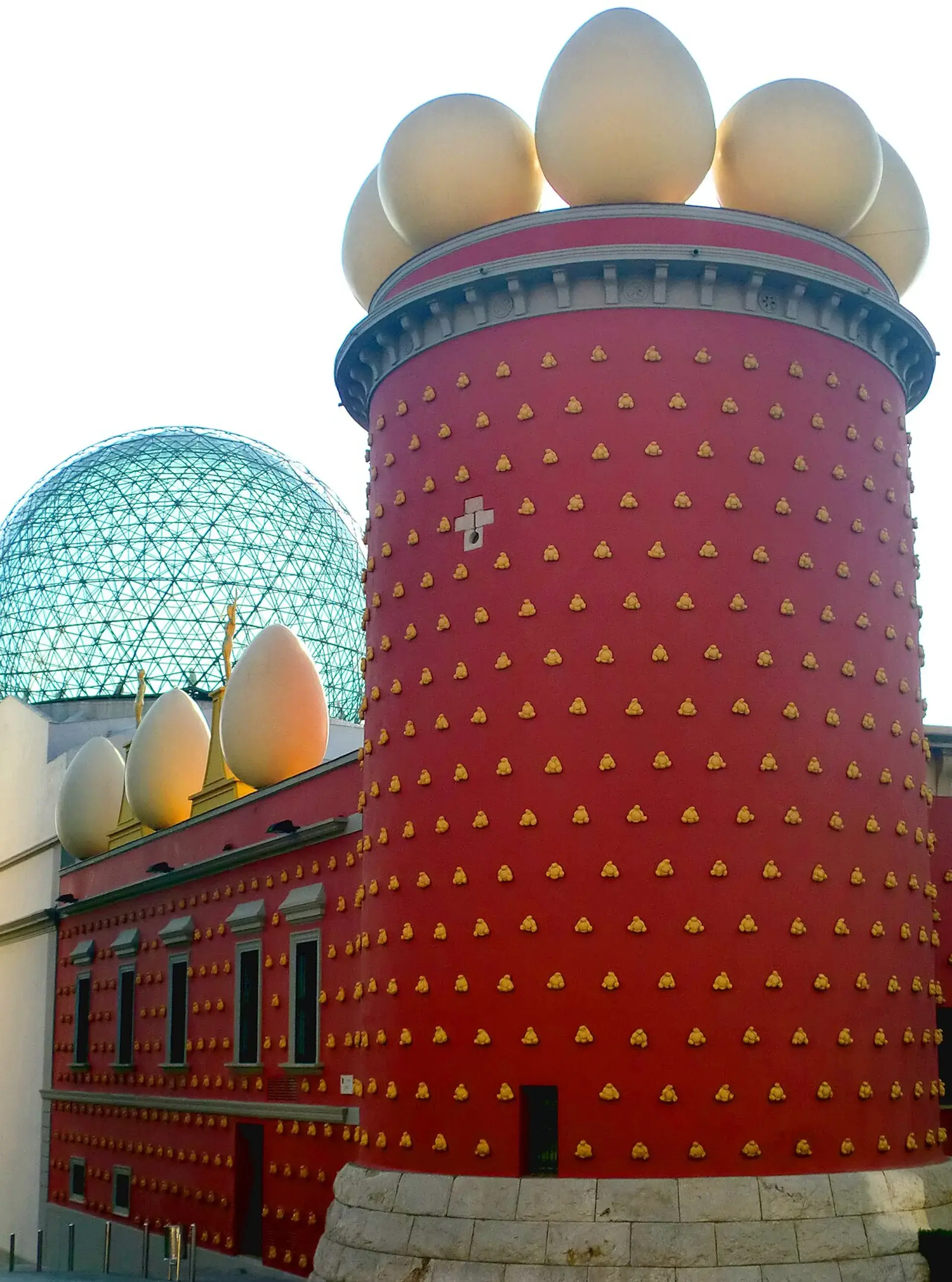
The building's exterior creates a dramatic visual contrast against the surrounding stone architecture of central Figueres. Its carmine and dark sienna walls are studded with sculpted replicas of traditional Catalan three-cornered bread loaves (pans de tres crostons, also called pa Dalí), a loaf Dalí famously ate, painted, and wore on his head like a hat at public events. According to heritage records, high-quality loaves of this shape were historically known as pans d'exèquies (funeral loaves) because they were served at funeral meals.
Along the upper cornice, 3.50-meter-tall white polyester eggs stand beside gilded mannequins. Local historical markers explain that Dalí placed the giant eggs on the roofline to symbolize future life and the bread loaves across the façade to represent basic nutrition, while certain gilded mannequins hold aloft gilded hydrogen atoms reflecting his fascination with nuclear physics and science. In late June 2019, the exterior and its surrealist ornaments were repainted after their original colors had faded.
Salvador Dalí's Final Residence
Following Gala's death in 1982, Dalí resided at Púbol Castle until an electrical fire in his bedroom in August 1984 left him severely burned. After leaving the hospital in October 1984, the artist moved into an apartment inside Torre Galatea. He lived there until his death on January 23, 1989, and was buried in a crypt beneath the main stage of the adjoining Dalí Theatre-Museum.
Role in the Dalí Theatre-Museum Complex and Figueres
Today, Torre Galatea forms an integral part of the Dalí Theatre-Museum complex managed by the Fundació Gala-Salvador Dalí, whose administrative headquarters is located at Pujada del Castell 28. Inside, the building accommodates the foundation's offices alongside museum extension spaces and temporary exhibition rooms. Immediately adjacent sits the Dalí-Jewels exhibition area, inaugurated in 2001 to showcase 37 gold-and-gemstone jewels designed by Dalí alongside his preparatory drawings.
While the museum's extension galleries are accessible as part of a paid visit to the Dalí Theatre-Museum, Dalí's former private apartment and the foundation offices are not open as a separate historic-home tour. Consequently, Torre Galatea is primarily admired from the exterior, where its façade serves as a backdrop for nightly summer projections of Dalí's works under Figueres's municipal cultural program. In September 2024, Figueres pastry chefs, the City Council, and the Fundació Gala-Salvador Dalí marked the Theatre-Museum's 50th anniversary by unveiling commemorative cookies shaped like the façade's pans de tres crostons in front of the tower.
Positioned between the Rambla and the 18th-century Castell de Sant Ferran, Torre Galatea stands directly across from the Church of Sant Pere—where Dalí was baptized, took his first communion, and had his funeral—and roughly 450 meters from his birthplace. A bidirectional walking trail marked by bronze ants on the pavement links the tower and Theatre-Museum with the train station, Tourist Office, Rambla, Plaça de la Palmera, and Dalí's birthplace. Together with the Dalí Theatre-Museum, the Gala Dalí Castle in Púbol, and the Salvador Dalí House-Museum in Portlligat, Torre Galatea anchors the Figueres corner of the Empordà region's Dalinian Triangle.
FAQ
Why is Torre Galatea decorated with bread loaves and giant eggs?
Salvador Dalí added the surrealist ornaments when transforming the tower in the 1980s. According to local historical markers, the traditional Catalan three-cornered bread loaves (pans de tres crostons) symbolize basic nutrition, the 3.50-meter white polyester rooftop eggs symbolize future life, and the gilded mannequins holding hydrogen atoms reflect Dalí's interest in nuclear physics and science.
Can visitors tour the inside of Torre Galatea?
While museum extension galleries inside the complex are included in a paid visit to the Dalí Theatre-Museum, Dalí's former private apartment and the administrative offices of the Fundació Gala-Salvador Dalí are not open as a separate historic-home tour, so the tower is primarily viewed from the outside.
What was Torre Galatea before Salvador Dalí renamed it?
Originally known as Torre Gorgot or Casa Gorgot, the building preserves the only visible surviving section of Figueres's medieval defensive wall and was home to the Gorgot family from around 1636. In the 19th century, the abandoned tower was repurposed as a military barracks in 1812 and as a municipal water reservoir in 1854.