Málaga Roman Theatre: History and Rediscovery
Ancient Origins and Vitruvian Design
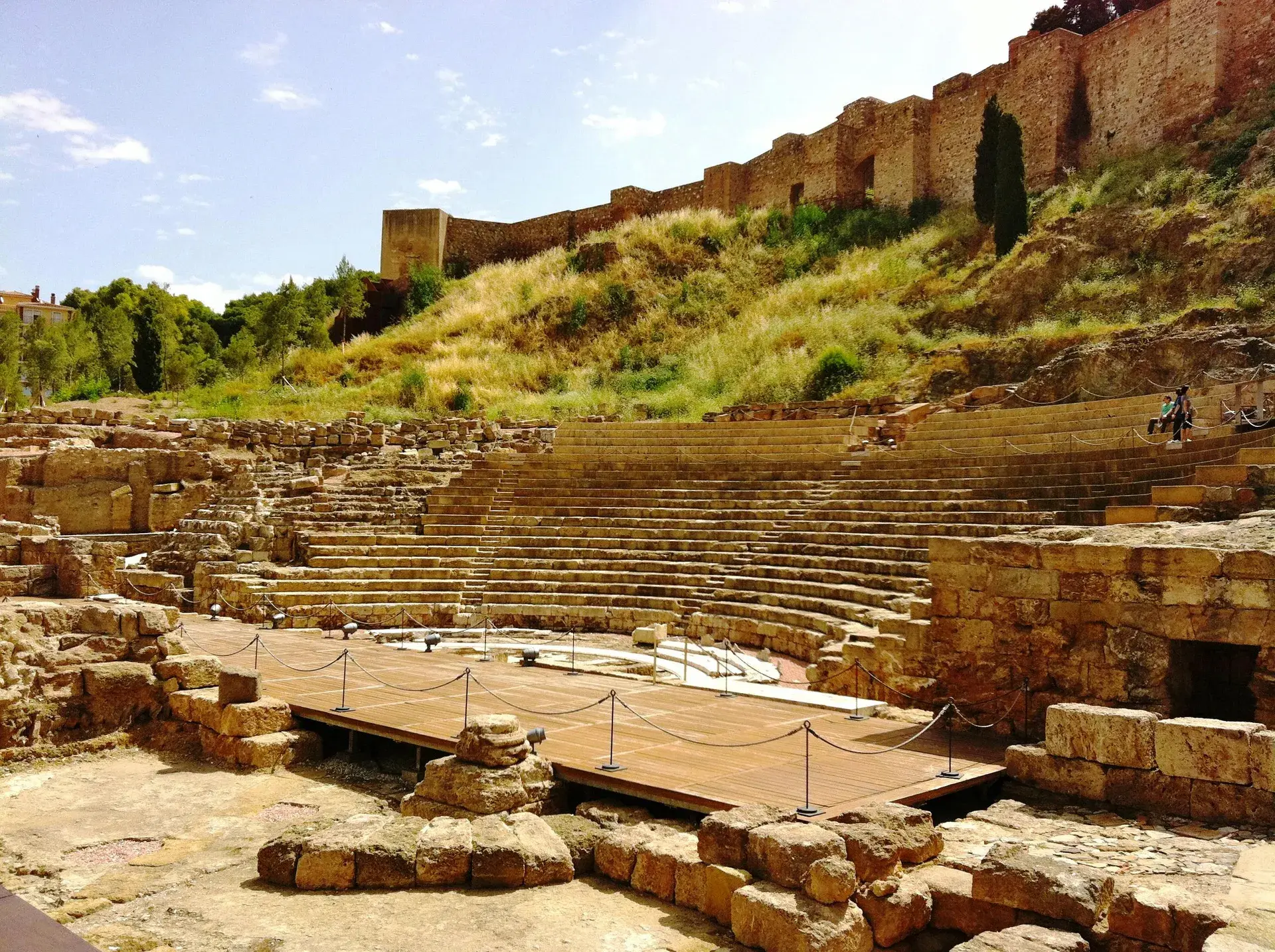
Standing at the foot of Gibralfaro hill along Calle Alcazabilla, the Roman Theatre of Málaga (Teatro Romano de Málaga) is the oldest standing structure in the city. Built in the 1st century AD during the reign of Emperor Augustus, the monument adhered to classical Vitruvian architectural principles. Engineers used the natural slope of the hillside to support the tiered semicircular seating area, known as the cavea.
The cavea measures roughly 31 metres in radius and reaches a height of 16 metres across 13 tiers of seating. Excavations have brought to light the key elements of the complex, including the arched entry and exit passageways (vomitoria), the semicircular orchestra paved in marble slabs, and the proscenium, which served as the stage.
From Garum Production to Moorish Quarry
The theatre remained in continuous theatrical use through the 3rd century AD. Following its abandonment as an entertainment venue, the complex was adapted during late antiquity into an industrial facility dedicated to the production of garum, the fermented fish sauce widely consumed across the Roman Empire.
After the Muslim conquest of the Iberian Peninsula in the 8th century, the derelict monument served as a convenient stone quarry. Builders extracted limestone blocks, columns, and carved capitals from the theatre to construct the fortifications of the adjacent Alcazaba fortress. These repurposed Roman columns and capitals remain visible today within the horseshoe arches of the fortress's Puerta de las Columnas. Over the subsequent centuries, urban development and silt runoff from the hill covered the remaining ruins, hiding them entirely from view.
The Casa de la Cultura and Uncovering the Stage
Between 1940 and 1942, the Francoist state began erecting the Casa de la Cultura directly over the buried site to house Málaga’s provincial archives, library, and museum. In 1951, landscaping work on the building’s exterior gardens accidentally struck ancient Roman stonework. Despite the discovery, authorities chose to finish the cultural centre directly over the ruins. Displeased local residents mockingly dubbed the building the Casa de la Incultura ("House of Lack of Culture").
During the 1970s, partially exposed sections of the theatre hosted youth theatre festivals, where a young Antonio Banderas performed on the ancient stage. Archaeological soundings in the late 1980s and early 1990s confirmed that the original Roman orchestra and stage structures were exceptionally well preserved beneath the foundations of the 20th-century complex. In response to these findings, the Casa de la Cultura was demolished between December 1994 and 1995 to enable the complete excavation and restoration of the theatre.
Archaeological Site and Interpretation Centre
Today, the Roman Theatre is classified as an Asset of Cultural Interest (Bien de Interés Cultural) and is managed by the Regional Government of Andalusia (Junta de Andalucía). An on-site modern cube-shaped Interpretation Centre introduces visitors to the monument through recovered Roman artifacts, architectural remnants, and audiovisual presentations. The glass and steel facade of the centre is etched with Latin passages from the Lex Flavia Malacitana, a 1st-century municipal legal code; among the text is Chapter LXII, which historically prohibited the unauthorized demolition of buildings.
The site periodically returns to its original purpose by hosting outdoor theatrical productions and classical drama festivals. Situated on Calle Alcazabilla, the theatre physically demonstrates Málaga's historical stratification, standing as a pivotal link in a pedestrian corridor uniting the Alcazaba, the Museum of Málaga, and the Picasso Museum.
FAQ
When was the Roman Theatre of Málaga built?
The theatre was constructed in the 1st century AD during the reign of Emperor Augustus and remained in continuous use until roughly the 3rd century AD.
Why was the theatre buried beneath a modern building?
Between 1940 and 1942, the Francoist government began building the Casa de la Cultura on the site. Although Roman remains were uncovered during landscaping in 1951, officials chose to finish the building over the ruins. Following archaeological soundings proving the stage's preservation, the structure was demolished between 1994 and 1995 to reveal the ancient theatre.
Can Roman elements from the theatre be seen elsewhere in Málaga?
Yes. Following the 8th-century Muslim conquest, builders quarried the abandoned theatre for construction materials. Recycled Roman columns and capitals were incorporated into the horseshoe arches of the Puerta de las Columnas in the adjacent Alcazaba fortress.