Pamplona Cathedral: Santa María la Real
Architectural Contrast and Royal History
The Catedral Metropolitana de Santa María la Real de Pamplona stands on the highest ground of the historic Navarrería borough, occupying a site with archaeological layers extending back to Roman settlements and early Christian basilicas. Following the collapse of a 12th-century Romanesque cathedral in 1390, King Charles III of Navarre initiated an extensive Gothic reconstruction that continued into the early 16th century. For centuries, the cathedral served as the civic and ceremonial heart of the Kingdom of Navarre, hosting royal coronations, baptisms, state funerals, and assemblies of the Cortes of Navarre.
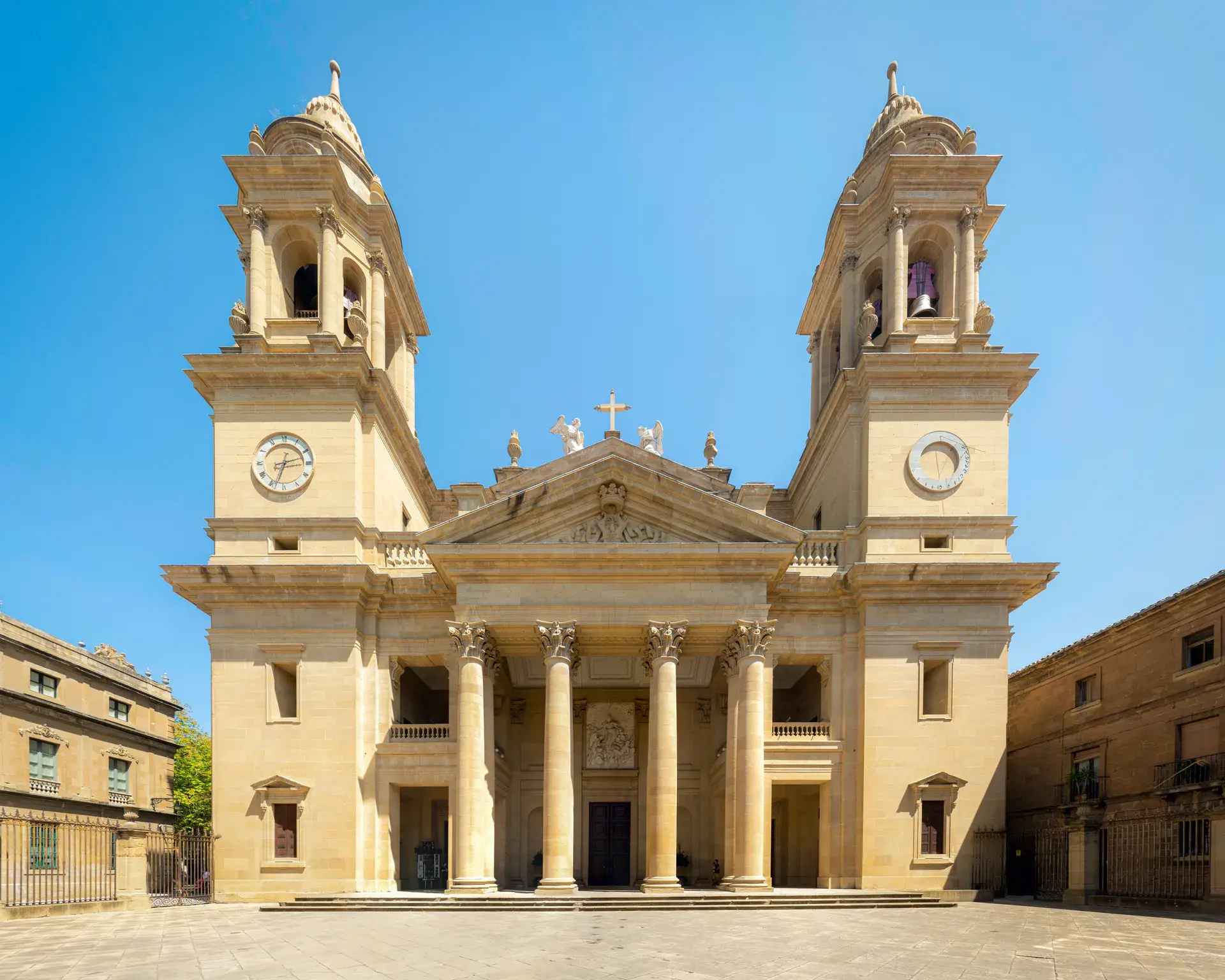
From the exterior, the cathedral presents a marked contrast to its medieval structure. In 1783, court architect Ventura Rodríguez designed a restrained Neoclassical façade and twin bell towers, which were constructed between 1784 and 1799. This classical exterior conceals a soaring French Gothic temple featuring a 28-meter-high central nave illuminated by 16th-century stained-glass lancets.
The Gothic Cloister and Royal Pantheon
The interior houses several important artistic and religious monuments. At the center of the church rests the 15th-century alabaster mausoleum of King Charles III of Navarre and Eleanor of Trastámara, sculpted by Johan Lome of Tournai. The cathedral also preserves a 12th-century silver-plated Romanesque statue of Santa María la Real, as well as the Barbazana Chapel, known for its complex octagonal star-vault.
Completed around 1472, the Gothic cloister is renowned for its delicate tracery and sculpted stone capitals. While many capitals present traditional stonework, several 14th-century reliefs depict local artisans alongside early scenes of bull running and baiting, demonstrating the historic roots of the city's bull traditions.
Rare Medieval Kitchen and Historic Bell
Among the complex's ancillary buildings is an intact 14th-century monastic kitchen. Anchored by a massive, free-standing central stone chimney vault, it is recognized as one of only three surviving medieval Gothic kitchens of its kind in Europe.
The cathedral's north tower houses "María," a bell cast in 1584. Weighing approximately 12 tonnes, it is the second-largest bell in Spain and ranks as the country's largest working church bell.
Current Life and Pilgrimage Heritage
Today, Santa María la Real serves as the seat of the Archdiocese of Pamplona y Tudela, holding regular daily masses and diocesan ceremonies. Positioned along Calle Dormitalería above the Ronda del Barbazana ramparts, it anchors the eastern boundary of Pamplona's historic core.
The complex also functions as a major stop for pilgrims traveling the Roncesvalles route of the Camino Francés, serving as an intake point where pilgrim credentials receive official stamps. Visitors can access the cloister, refectory, treasury, and Barbazana Chapel through the Occidens museum circuit. The building has also made appearances in literature; in Ernest Hemingway's novel The Sun Also Rises, protagonist Jake Barnes visits the cathedral to pray, reflecting on its Neoclassical exterior.
FAQ
What makes the cathedral's kitchen unique in Europe?
The complex preserves an intact 14th-century monastic kitchen built around a free-standing central stone chimney vault, making it one of only three surviving Gothic kitchens of its kind in Europe.
What is the significance of the cathedral's "María" bell?
Cast in 1584 and weighing roughly 12 tonnes, the "María" bell in the north tower is the largest functioning church bell in Spain.
Who designed the Neoclassical façade of Pamplona Cathedral?
The Neoclassical façade and twin bell towers were designed by architect Ventura Rodríguez in 1783 and constructed between 1784 and 1799.